
You're standing in a half-demolished kitchen in Tyler, with cabinet doors stacked against the wall, a skillet still sitting on the old range, and two countertop samples propped on the island. One has the clean, predictable look your family wants. The other has natural movement that makes the kitchen feel custom. The decision sounds simple until you remember who cooks, how often hot pans land on the counter, and how quickly coffee, tomato sauce, and red wine appear during a normal week.
That's the practical question behind quartz vs granite countertops for kitchens. Neither material wins every category. Quartz usually gives you stronger stain and moisture resistance with less maintenance, while granite generally handles direct heat better. Your household habits, design preferences, budget, and realities of installing stone in an East Texas home should guide the choice.
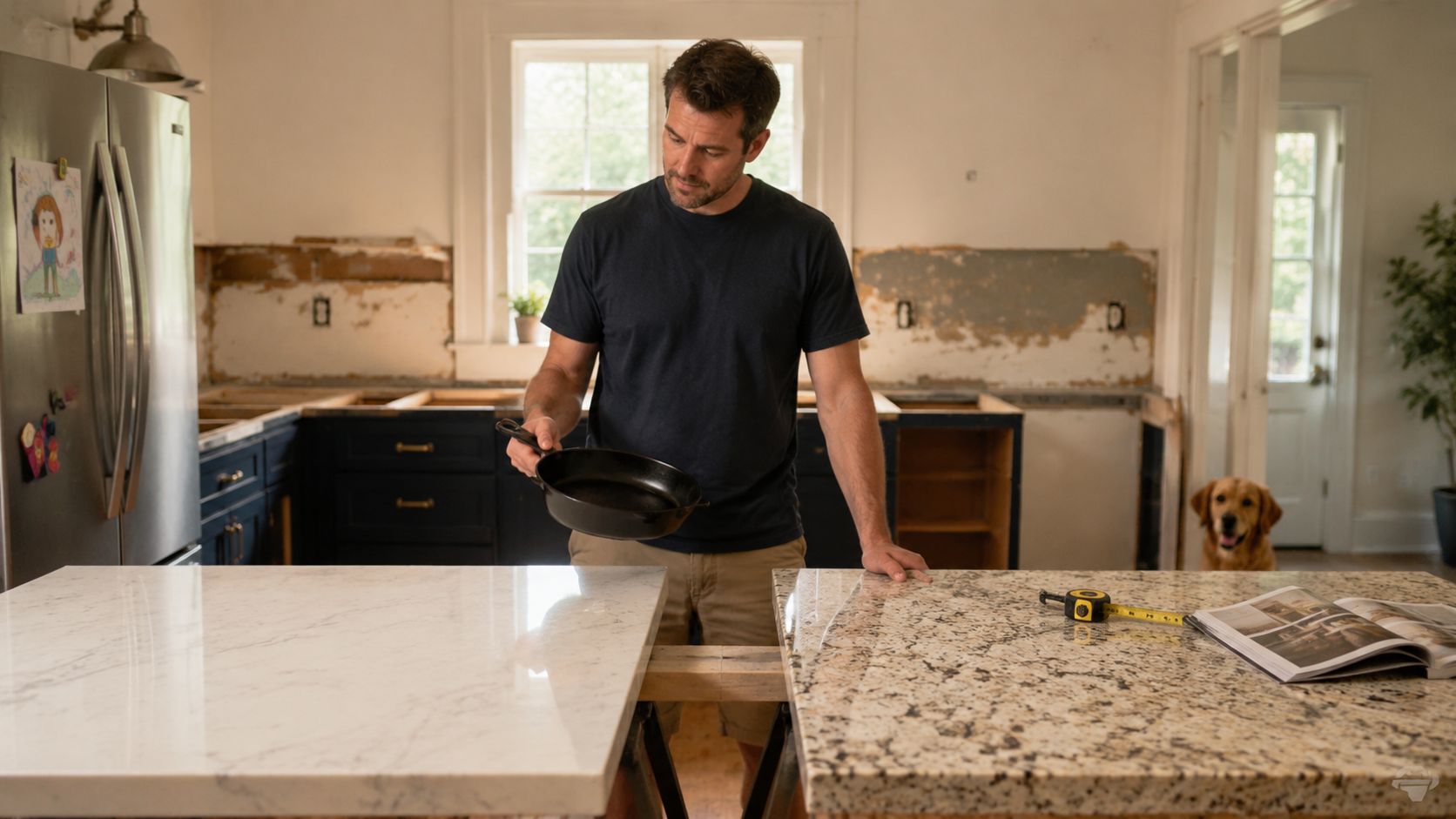
Table of Contents
- Choosing Between Quartz and Granite for Your Kitchen
- What Quartz and Granite Are
- Durability and Maintenance in Real Kitchens
- Appearance and Design Flexibility
- Cost and Long-Term Value
- How to Decide Based on Your Household
- Countertop Installation for East Texas Homes
Choosing Between Quartz and Granite for Your Kitchen
A kitchen that sees daily cast-iron cooking, roasting pans, and Dutch ovens puts different demands on a countertop than a room used mostly for coffee and light meals. Hot cookware may move straight from the oven to the island. Spilled juice, cooking oil, tomato sauce, and coffee may sit there while breakfast, homework, and cleanup compete for attention.
The main trade-off is practical: quartz is non-porous and typically easier to keep free of absorbed stains, while granite is generally more tolerant of hot cookware. Neither surface handles every kind of kitchen abuse equally well. Quartz reduces worry about absorption and routine sealing, but trivets remain necessary. Granite offers stronger heat tolerance, though its sealer and natural pores require more attention.
| Performance area | Quartz | Granite |
|---|---|---|
| Stain and moisture resistance | Non-porous, no routine sealing required | Naturally porous, sealing helps resist absorption |
| Direct heat | Use trivets because resin binders can discolor or micro-fracture | Generally more heat-tolerant |
| Appearance | Consistent patterns and broad design control | One-of-a-kind natural variation |
| Daily care | Wipe spills with suitable household cleaning methods | Wipe regularly and maintain the sealer |
| Installed price position | Often carries a modest premium | Often costs less, but slab selection changes the price |
Quartz is currently more common in the U.S. countertop market than granite. That market preference does not settle the decision for an East Texas kitchen. Installed pricing varies with the slab, edge profile, sink cutouts, backsplash, access, and fabrication, so a broad market comparison is only a starting point. Pricing details belong with the project quote, not the showroom label.
What matters more than the showroom ranking
A busy family with young children may value quartz because spilled drinks and cooking oil are less likely to soak into the surface. A homeowner who bakes, sears steaks, and regularly sets down hot cookware may prefer granite's heat tolerance and natural variation, accepting periodic sealing as part of ownership.
Installation quality can change how either material performs. Older East Texas homes may have uneven cabinet runs, walls that are not perfectly square, or seasonal movement around slab foundations. The fabricator must verify cabinet support, plan seam locations, and account for access before cutting the slab. Poor leveling or inadequate support can create problems even when the selected stone is well suited to the household.
Start with three questions:
- How do you cook? Frequent high-heat cooking points toward granite, especially when hot pans are likely to reach the counter.
- How do you clean? A household that wants simple wipe-down care may prefer quartz.
- What look do you want to live with? Granite varies from slab to slab, while quartz provides more predictable design control.
At the island, choose the surface that matches the mess and heat your kitchen produces, not just the sample that looks best under showroom lighting.
What Quartz and Granite Are
A granite countertop begins as natural igneous stone. Quarries remove large blocks, fabricators slice them into slabs, and polishing exposes the minerals, flecks, and movement formed underground. No two slabs are identical, even when they share a commercial color name. That variation is part of granite's appeal, but it also affects how the slab must be laid out around sinks, cooktops, seams, and overhangs.
Quartz countertops are engineered surfaces made with crushed natural quartz, polymer resins, and pigments. In the 1960s, Breton S.p.A. developed the Bretonstone process in Italy, combining roughly 90% to 95% crushed natural quartz with binders before pressing the mixture under heat and pressure into a non-porous slab (history of quartz and granite countertops).
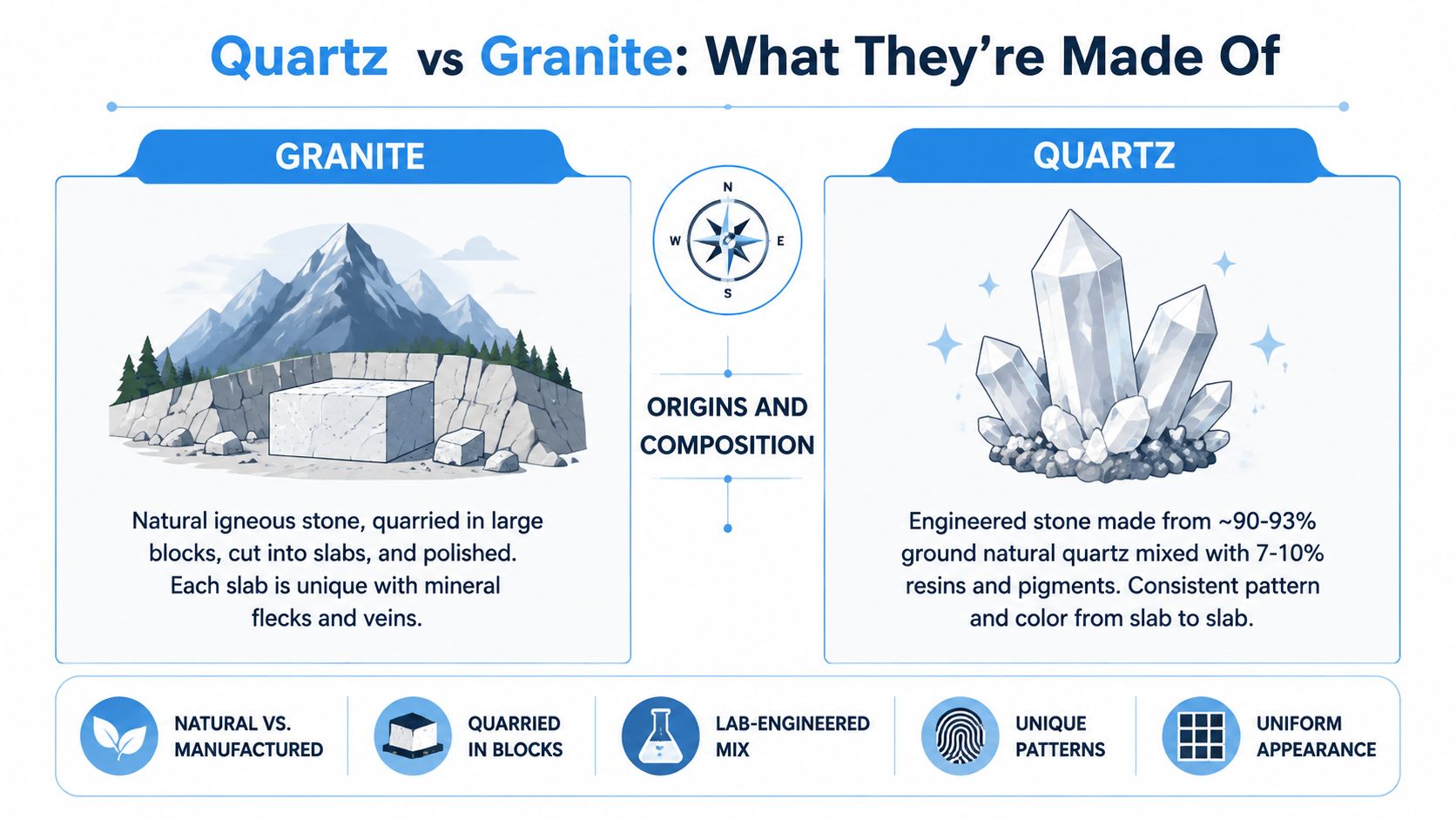
Composition explains the heat-versus-stain trade-off homeowners notice at the island. Granite's mineral structure generally handles hot cookware better, while its natural pores can absorb moisture and oil if sealing is inadequate. Quartz's resin matrix limits absorption and simplifies spill control, but concentrated heat can affect the resin and lead to discoloration or damage.
Material rule: “Natural” and “engineered” describe origin, not a simple quality ranking.
Why composition affects fabrication
Granite may contain fissures, mineral pockets, and density changes. These features are not automatically defects, but they require careful slab inspection and layout. An experienced fabricator positions sink cutouts, cooktop openings, seams, and overhangs where the stone provides adequate support.
Quartz usually offers more controlled density and patterning, which helps adjoining pieces look consistent. It still requires accurate measurements, proper support, and careful handling. A uniform pattern does not prevent cracking, chipping, or heat damage.
The two materials also set different design expectations. Granite delivers a geological surface that cannot be duplicated exactly. Quartz can repeat a manufactured pattern across an island and perimeter run. For additional material and design context, homeowners can browse Varun Marbles.
Quartz gained broader adoption in the 1990s and early 2000s, as homeowners sought low-maintenance surfaces with a high-end appearance. It is not a plastic imitation of stone. It is a manufactured slab whose performance depends on both natural quartz particles and resin binders.
Durability and Maintenance in Real Kitchens
Quartz and granite both hold up well under ordinary kitchen use, but they fail in different ways. Quartz's strongest practical advantage is resistance to absorbed spills. Granite's strongest practical advantage is tolerance for hot cookware.
A technical comparison lists quartz at 0.03% maximum water absorption, compared with 0.1% to 0.4% for granite (technical quartz and granite comparison). That difference helps explain why coffee, cooking oil, tomato sauce, wine, and similar spills are usually easier to manage on quartz. Sealed granite can perform well, but the sealer needs to remain effective.
| Performance factor | Quartz countertops | Granite countertops |
|---|---|---|
| Water absorption | Listed at 0.03% maximum in one technical comparison | Listed at 0.1% to 0.4% in the same comparison |
| Stain resistance | Strong resistance because the surface is non-porous | Depends more heavily on sealing and spill cleanup |
| Heat exposure | Resin binders can discolor or micro-fracture under concentrated heat | Generally tolerates direct heat better |
| Routine care | Regular wiping, without routine sealing | Regular wiping plus sealer maintenance |
| Edges and corners | Can chip from hard impact | Can also chip, with some repairs often possible |
| Sun exposure | Some formulations can discolor with prolonged UV exposure | Slab-specific behavior should be discussed with the fabricator |
Heat is the trade-off many articles underplay
Granite generally has the advantage around hot pans. One benchmark-style comparison reported granite surviving rapid thermal shifts up to about 300°F, while quartz can risk damage above roughly 150°F to 300°F, with the exact limit depending on formulation (countertop heat and durability comparison).
That doesn't mean granite is indestructible or that quartz can't be used in a serious kitchen. It means a quartz island should have trivets or heat pads within easy reach. A roasting pan lifted from the oven, a cast iron skillet after searing, or a hot griddle can concentrate heat in one small area. Use a barrier instead of testing the manufacturer's limit.
Stains, scratches, and repairs
Quartz handles everyday staining with less fuss. Wipe coffee and tomato sauce promptly, avoid abrasive products, and follow the surface manufacturer's care guidance. Granite deserves the same quick cleanup, but porous stone creates more opportunity for oil, wine, or colored liquids to penetrate if sealing has weakened.
Both surfaces resist ordinary scratching, but neither should become a cutting board. Dragging cast iron across the counter can damage an edge or leave marks, and a heavy pan dropped on a corner can chip either material. Granite chips can often be filled and polished by a stone repair professional. Damaged quartz may require replacement of a larger section when the repair won't blend with the factory pattern.
For water spots and mineral residue on granite, a practical granite cleaning guide from Sunset Shine Home Cleaning can help you avoid harsh cleaning habits. During a remodel, the installation team should also document seam locations, inspect edges, and explain care requirements through a clear quality assurance process.
Appearance and Design Flexibility
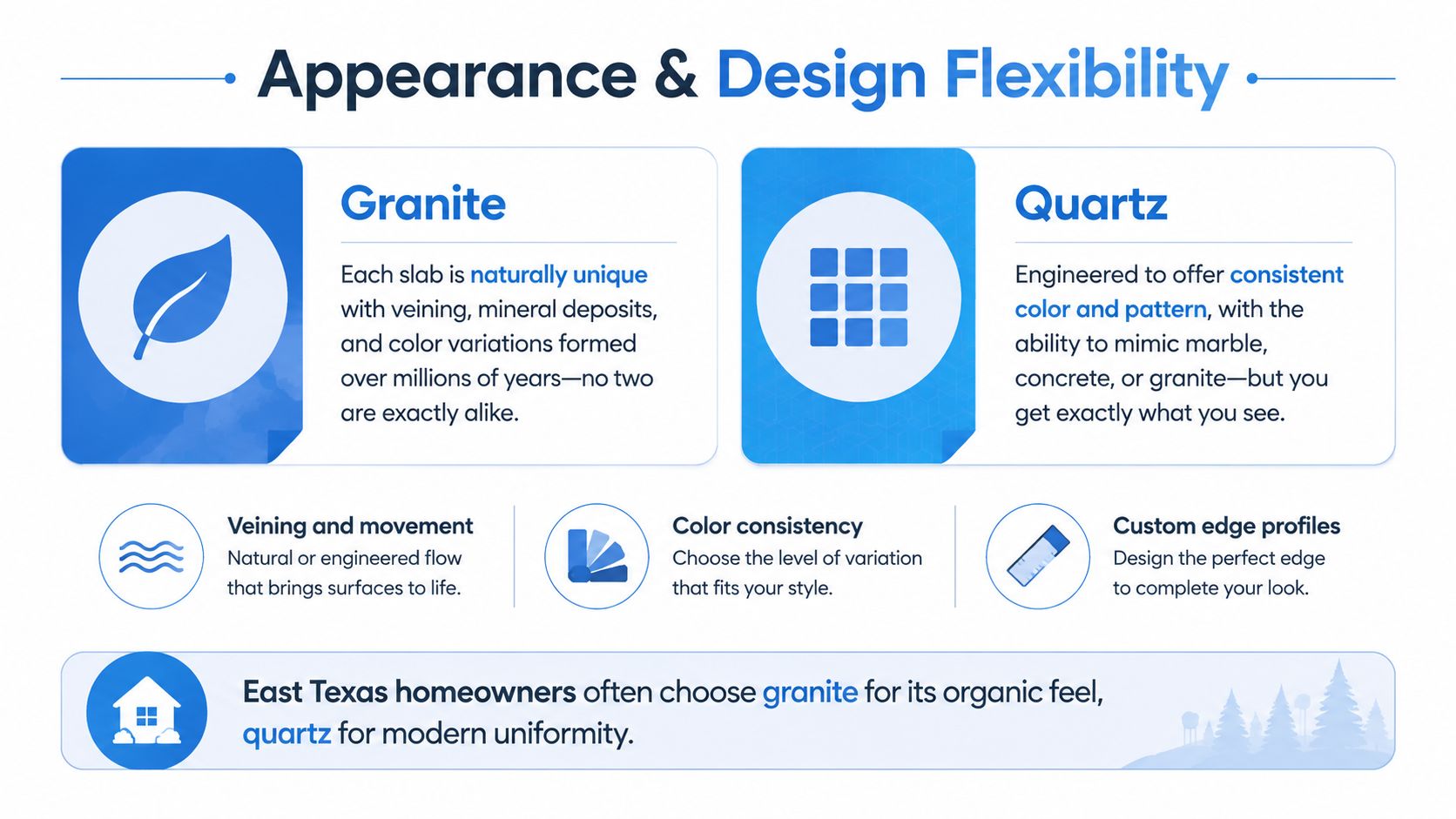
Granite's appeal starts with variation. Mineral deposits, veining, and color shifts formed by geological processes make each slab distinct. A granite island can become the visual anchor of a traditional, rustic, or transitional kitchen because the surface has movement that manufactured materials intentionally reproduce.
East Texas homes often suit warm earth-toned granite selections, including familiar commercial colors such as Uba Tuba, Santa Cecilia, and Dallas White. The names alone aren't enough, though. Two slabs with the same label may differ noticeably, so choose the actual slab rather than relying only on a small showroom sample.
Quartz takes the opposite approach. Manufacturers can control color, repeat pattern, and veining, which makes it easier to coordinate a long island with perimeter counters. Quartz can imitate marble, concrete, or granite while giving you a more predictable result. That consistency works especially well in contemporary kitchens, clean-lined cabinetry, and open plans where several surfaces must relate to one another.
Edges, seams, and slab scale
Both materials support common edge profiles such as eased, beveled, and ogee edges. Quartz's uniform composition can make detailed profiling more predictable, while granite's natural variations require the fabricator to inspect the edge area before cutting.
Large islands deserve special planning. Quartz slabs are often available in larger formats, which can help reduce visible seams on expansive counters. Granite availability depends heavily on the particular slab and distributor. In either case, seam placement should follow cabinet breaks, sink areas, or less conspicuous sections rather than landing in the middle of a prominent work zone.
Lighting changes the decision. Bright daylight can reveal movement in granite and make quartz veining look sharper or softer than it appeared under showroom lights. Warm under-cabinet lighting may emphasize beige and gold minerals, while cooler lighting can make white quartz appear more gray.
Ask to see full slabs in person. Small samples hide pattern scale, color transitions, and the portion of the slab that will land at the island edge. Lay cabinet, flooring, backsplash, and paint samples beside the slab before approving fabrication.
Cost and Long-Term Value
Quartz and granite overlap in price, but their costs respond to different variables. Quartz often carries a modest premium. Granite can be less expensive when the slab is locally available and the layout is straightforward, yet rare, highly patterned, or imported stone can raise the total quickly. Quartz pricing also changes with brand, pattern complexity, thickness, edge work, and the number of slabs required.
| Cost factor | Granite | Quartz |
|---|---|---|
| Typical installed range | About $45 to $100 per square foot | About $55 to $120 per square foot |
| Main price variables | Slab rarity, origin, movement, cuts, availability | Brand, pattern, slab size, cuts, edge detail |
| Sealing | Recurring maintenance may be required | No routine sealing required |
| Repairs | Some chips can be filled and polished | Pattern matching can make repairs more difficult |
| Quote risk | Slab and fabrication allowances can change the total | Brand and fabrication allowances can change the total |
Look beyond the material price
A useful countertop quote should list demolition, template work, fabrication, delivery, installation, sink and cooktop cutouts, edge profiles, backsplash pieces, plumbing coordination, and disposal. Vague allowances leave room for the final invoice to change once the installer measures the kitchen or confirms the slab.
East Texas homes also deserve a site-specific review. Cabinet walls may be out of square, older kitchens may need leveling, and tight access can affect delivery and installation planning. Large islands, seams, sink cutouts, and overhangs should be priced from the actual layout rather than a rough room measurement.
Granite requires a maintenance conversation before purchase. Ask which sealer the installer recommends, how often the fabricator advises checking it, and whether sealing affects warranty requirements. Quartz removes routine sealing, but it still needs sensible cleaning and protection from direct heat. That trade-off matters in kitchens where hot pans and heavy cooking are common.
Repair expectations belong in the value calculation. Some granite chips can be filled and polished, although the repair may remain visible depending on the stone. Quartz repairs can be harder to disguise when the pattern must match across a manufactured surface. Ask the fabricator how each material is handled before approving the order.
Resale value depends on the buyer and the quality of the renovation. Both materials can support a well-finished kitchen because they read as durable, substantial surfaces. Quartz may attract buyers who want predictable design and simple care, while granite can appeal to those who value natural stone and stronger heat tolerance. Neither option makes up for poor cabinet layout, weak lighting, or careless installation.
Review this kitchen remodeling cost guide before requesting bids. Then obtain written quotes from fabricators who have inspected the actual kitchen, confirmed the selected slab, and explained every allowance.
How to Decide Based on Your Household
Start with the way your kitchen operates, not the material label. A surface that looks perfect in a sample display may frustrate you if its main weakness conflicts with your daily routine.
Match the counter to your cooking
Choose granite when direct heat is a regular part of the workflow. That includes households that sear in cast iron, use roasting pans frequently, or move hot cookware across the island during large meals. Granite still benefits from trivets and prompt cleanup, but its heat tolerance gives high-heat cooks more practical margin.
Choose quartz when cleanup and stain resistance dominate. Families with young children, frequent breakfast traffic, and busy entertaining schedules may prefer a non-porous surface that doesn't depend on sealing to resist absorption.
A weekend entertainer may land in the middle. Quartz can simplify cleanup after drinks and appetizers, while granite may feel more forgiving around hot serving dishes. The right choice depends on whether spills or heat creates the bigger recurring problem.
Use maintenance tolerance as a decision filter
Granite asks you to pay attention to sealing and to clean spills before they have time to penetrate. In humid East Texas conditions, your installer should explain how moisture, usage, and the selected stone affect the care schedule. Don't accept a generic maintenance promise for every granite slab.
Quartz generally suits homeowners who want a simpler care routine. It still needs protection from concentrated heat and harsh treatment, but the surface doesn't require the same sealing routine as porous natural stone.
Household test: Choose the material that protects you from the mistake you make most often, whether that's leaving a hot pan down or forgetting to wipe a spill.

Consider sustainability honestly
Quartz is manufactured with binders and requires factory processing. Granite is quarried natural stone, but quarrying, transportation, cutting, polishing, and fabrication also carry environmental costs. A useful comparison should consider embodied carbon, resin chemistry, transportation distance, and fabrication waste rather than treating “natural” as automatically environmentally preferable.
Recent countertop trend coverage identifies growing interest in low-VOC resins, recycled content, and other eco-friendly options in 2025, but the specific environmental profile varies by product and supplier (2025 countertop trends and sustainability). Ask manufacturers about recycled content, resin chemistry, product documentation, and how the fabricator handles offcuts.
Homeowners planning to sell within a few years should prioritize a broadly appealing color, durable installation, and a layout that functions well. A neutral quartz or approachable granite can support resale, but unusual pattern choices should reflect your own enjoyment rather than an assumption about every future buyer.
Countertop Installation for East Texas Homes
Professional installation begins before the slab reaches your driveway. The crew should inspect cabinet installation, verify level, confirm wall conditions, and create a precise template. That template controls sink placement, overhangs, seams, appliance clearances, and the way the finished counter meets backsplashes and walls.
A small measurement error can create a major problem. An uneven cabinet run in an older ranch home may require shimming or cabinet adjustment before the stone is installed. A slab foundation that shifts seasonally doesn't excuse poor preparation, and the installer should identify support and leveling concerns before fabrication.
What the process should include
- Site inspection and template: The installer measures the actual cabinets and records appliances, walls, sink dimensions, and overhang requirements.
- Slab selection and layout: You approve the slab and discuss where veins, mineral movement, seams, and cutouts will land.
- Fabrication: CNC equipment and skilled finishing shape the sink openings, cooktop cutouts, edges, and seams.
- Delivery and setting: The crew checks the support, places the slabs, aligns seams, and secures the material without forcing it into an uneven run.
- Finishing and handoff: Seams receive final attention, edges are inspected, sinks and plumbing are coordinated, and care instructions are provided.
Quartz may be available through regional distribution channels serving Tyler or Longview, while a particular granite slab may need to come through a larger Dallas or Houston distributor. Availability varies, so ask whether the fabricator owns or directly controls the slab. A brokered material can create additional communication steps when the layout changes.
Questions for a local fabricator
Ask who performs the template, where fabrication occurs, how seams will be placed, whether CNC cutting is used, and who handles damage discovered at delivery. Request a written explanation of the support plan for islands, overhangs, cooktop openings, and farmhouse sinks.
You can also compare construction methods when evaluating how different contractors approach planning, fabrication, and field work. For broader remodeling questions, including whether your project may require local approval, review whether you need a permit for a kitchen remodel.
Keep the first day after installation quiet. Avoid placing heavy appliances, leaning ladders against the counter, or exposing fresh seams and adhesive areas to unnecessary stress. Your installer should tell you when sinks, plumbing, sealers, and normal kitchen use can resume, and should leave you with written care guidance for the selected material.
Home Pro's Remodeling & Repairs coordinates kitchen remodeling, including cabinet, layout, finish, and countertop work, through a design-build process for homeowners across Tyler and East Texas. If you're weighing quartz against granite, visit Home Pro's Remodeling & Repairs to request an onsite consultation and discuss your kitchen's cooking habits, cabinet conditions, material choices, and project budget.