
Most homeowners searching for a contractor in Longview, TX start with the same advice: collect three bids, choose a reasonable price, and get the work moving. That sounds sensible, but it misses the risks that cause the worst budget overruns and schedule failures in East Texas.
A contractor can submit a polished estimate and still lack enough crew capacity to finish your project. Texas also doesn't issue a statewide general contractor license, so homeowners must verify local compliance, insurance, and trade credentials themselves. Then there's the City of Longview permit process, where incomplete plans can hold up a project before anyone swings a hammer.
The right question isn't “Who gave me the lowest number?” It's “Who can legally manage this scope, staff it consistently, submit a complete permit package, and communicate when conditions change?”
Table of Contents
- Why Getting Three Quotes Is Not Enough in Longview
- Understanding the Longview Construction Market
- What Credentials Actually Matter in Texas
- How Longview Permitting Affects Your Project Timeline
- Matching Your Project to the Right Contractor Specialty
- The Labor Shortage Problem Every Homeowner Should Know About
- Your Contractor Vetting and Estimate Checklist
Why Getting Three Quotes Is Not Enough in Longview
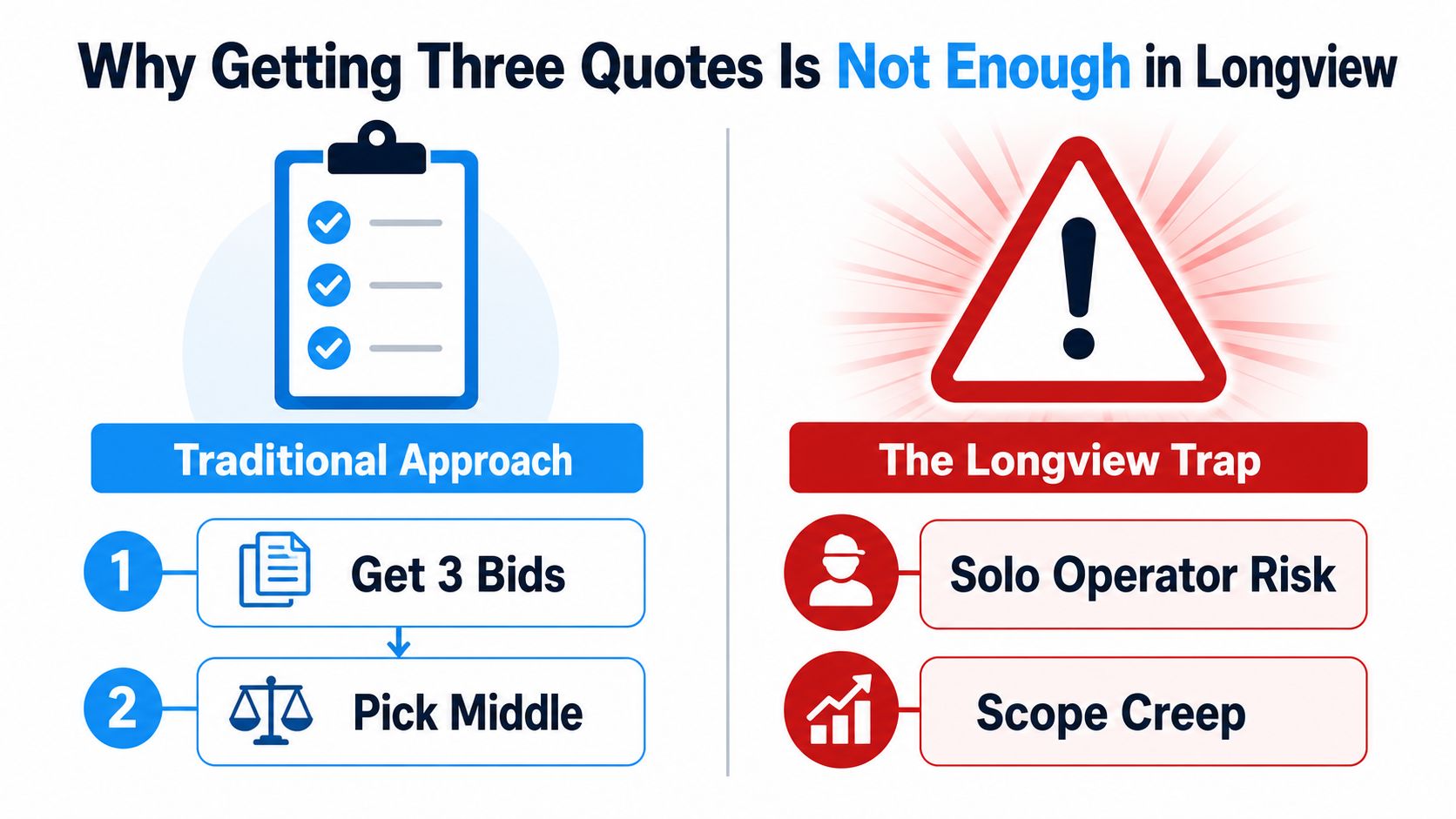
Three bids show price differences. They do not show whether a contractor can staff your job, keep trades moving, or meet the promised sequence. In Longview, production capacity deserves more attention than the gap between estimates. A low bid may come from an operator carrying too many projects. A high bid may depend on outside electricians, plumbers, or HVAC technicians who are already booked.
Use the first meeting to inspect the crew plan. Ask how many workers the contractor employs directly, which trades are subcontracted, and whether those subcontractors have reserved time for your project. Get clear coverage for framing, drywall, finish carpentry, electrical, and plumbing. Vague answers are not a schedule.
Evaluate capacity before price
East Texas contractors face a difficult hiring environment. Texas industry data reports that 76% of contractors struggle to fill hourly craft roles and 78% struggle to fill salaried positions, with especially serious shortages in electrical work and finished carpentry (Texas construction labor shortage data). A thin staffing plan can turn a cheap estimate into added labor, idle days, and a delayed finish.
Ask these questions before comparing totals:
- Who will be on site: Get the names or roles of the project manager, lead carpenter, and major trade partners.
- How many jobs are active: Several overlapping remodels can leave your project short of workers.
- What happens if a trade falls behind: Require a specific backup plan instead of “we'll handle it.”
- Are licenses verifiable: Electrical, plumbing, and HVAC work must go to properly licensed trades.
Specialized work needs the same scrutiny. If your remodel includes generator preparation or installation, use a curated Texas generator installers list to identify the right specialty instead of assuming a general remodeler handles every regulated system.
Practical rule: Accept a bid only when it identifies the workers, scope, trade sequence, and response plan for delays.
Understanding the Longview Construction Market
Longview isn't a small, isolated contracting market. Construction and extraction represented 8.0% of local employment, compared with 4.1% nationally, according to the Bureau of Labor Statistics Longview occupational employment data. The area had 9,470 construction and extraction jobs, and the occupation group averaged $24.22 per hour, or about $50,380 annually, making construction one of the area's most significant blue-collar employment categories.
That employment base tells homeowners two things. First, construction work is economically important locally, so demand for capable contractors is real. Second, a busy market doesn't guarantee that a contractor has room for your job. A company may be healthy, experienced, and still unable to start when you want because its dependable crews are already committed.
Residential permit activity adds another layer of uncertainty. Longview issued 148 residential building permits worth $43.7 million in 2024, including 157 permitted housing units, while single-family homes represented 88.5% of permits (Longview residential construction activity). The same report says construction activity fell 31.4% from the prior year, which shows how quickly local volume can change.
Longview Construction Market Snapshot
| Metric | Value | Trend |
|---|---|---|
| Construction and extraction employment | 9,470 jobs | Major local employment category |
| Share of local employment | 8.0% | Above the 4.1% national figure |
| Average hourly wage | $24.22 | About $50,380 annually |
| Residential permits in 2024 | 148 | Measurable but volatile activity |
| Value of residential permits | $43.7 million | Significant local project value |
| Single-family share of permits | 88.5% | Residential work dominates the permit mix |
| Permitted housing units | 157 | Active housing construction |
| Change from prior year | Down 31.4% | Project volume can shift quickly |
Don't treat those figures as a promise that your remodel will start quickly. Use them as context when a contractor gives you an aggressive start date. A firm price and a confident salesperson don't replace a staffed production calendar.
What Credentials Actually Matter in Texas
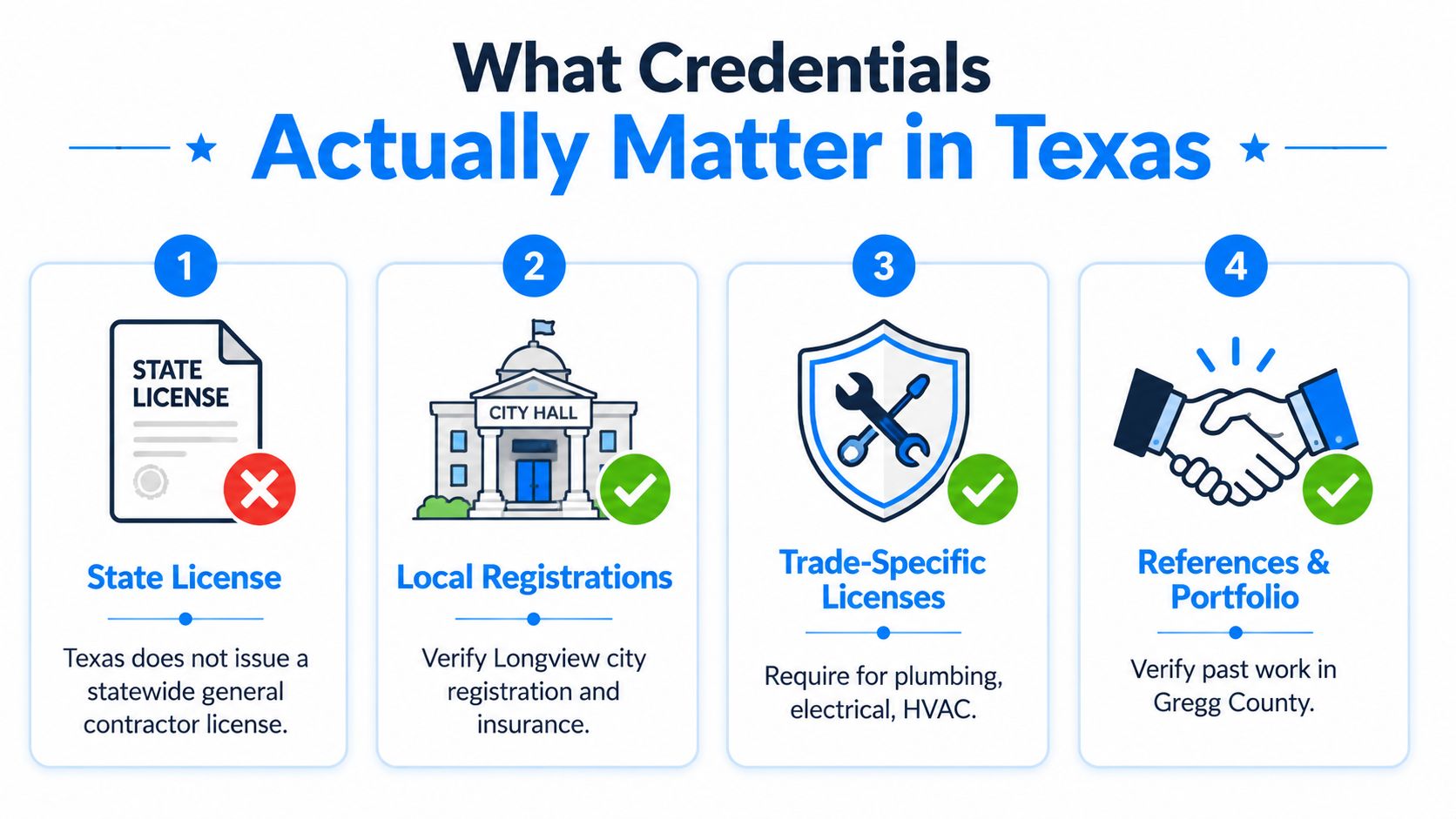
Texas doesn't issue a statewide general contractor, home-builder, or remodeler license. That means a person can market general remodeling services without holding one universal state credential, while regulated work still requires the appropriate trade licensing and local compliance (Texas contractor licensing requirements).
That changes your role as the homeowner. You aren't checking one license number and calling the job protected. You're assembling a paper trail that shows the contractor and every regulated trade can legally perform the work.
Ask for documents, then verify them
Start with the contractor's business identity and local requirements. Ask whether the company is registered with the City of Longview when the project requires contractor registration, and request current certificates of insurance. Don't accept a verbal assurance that coverage exists. Call the insurer using contact information you independently verify and confirm that the certificate applies to the company performing your work.
For regulated scopes, identify the actual trade contractor. Electrical, plumbing, and HVAC work shouldn't be assigned to an unnamed “sub.” Ask for the responsible business name and the relevant license information, then verify it through the appropriate Texas licensing authority.
Your checklist should include:
- Local registration: Confirm whether the contractor must register with Longview for your scope.
- General liability coverage: Verify the named business and policy status directly with the carrier.
- Workers' compensation or equivalent protection: Ask how employees and subcontractors are covered.
- Trade licensing: Match each electrical, plumbing, or HVAC scope to a properly licensed professional.
- Written references: Call recent customers and ask specifically about delays, cleanup, change orders, and communication.
- Portfolio relevance: Look for completed projects with the same complexity, not just attractive photographs.
In a no-license state, documentation isn't bureaucracy. It's how you separate an accountable contractor from someone who simply knows how to sell a job.
How Longview Permitting Affects Your Project Timeline
A kitchen remodel can look simple on paper. Remove cabinets, adjust a wall, move a sink, add lighting, and install finishes. In practice, the permit path depends on what changes behind the drywall. A cosmetic replacement may require less review than work involving structure, plumbing relocation, electrical changes, energy compliance, or accessibility requirements.
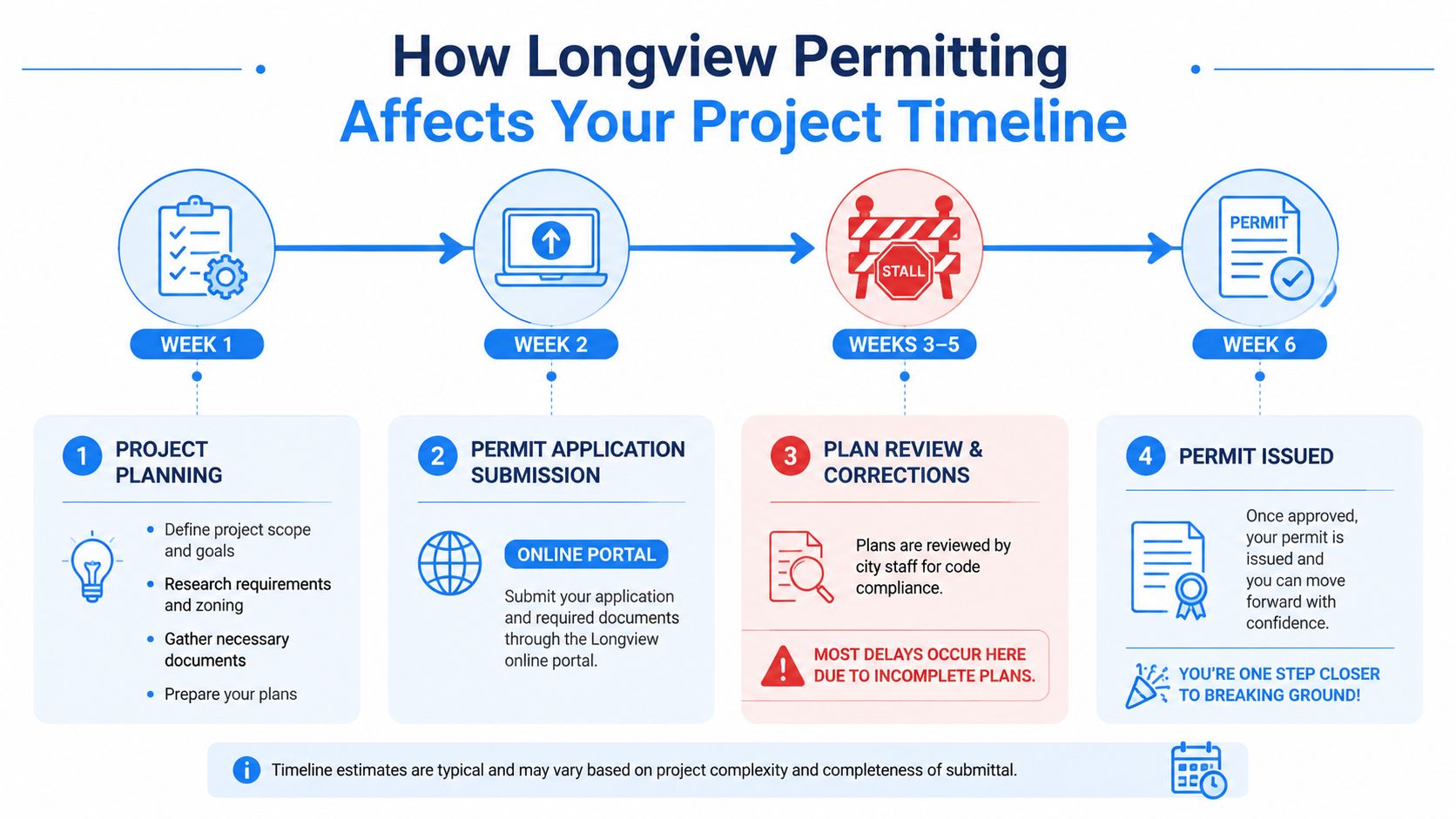
Longview centralizes permitting, inspection requests, contractor registration, and permit status tracking through its online permit portal. The city also requires PDF plans and compliance documents for the Energy Code and Texas Accessibility Standards. That makes plan completeness a schedule-control issue, not an administrative detail.
A realistic kitchen remodel sequence
Suppose your contractor plans to remove a wall between the kitchen and dining area, relocate plumbing, and install new electrical circuits. Before demolition, the contractor should know whether the wall is structural, document the proposed framing, prepare the necessary plan sheets, and include the required compliance materials.
The contractor then submits the package through the portal and tracks corrections digitally. If the plans omit a framing detail or required compliance document, the reviewer can't approve the package as submitted. The job may sit while the contractor revises drawings, resubmits, and waits for the next review step.
Use this pre-submission check:
- Confirm the scope: Make sure the plans show structural, plumbing, electrical, and exterior changes.
- Request the PDF set: Ask to see what will be uploaded, not just a sketch or sales estimate.
- Check compliance documents: Confirm Energy Code and Texas Accessibility Standards materials are included where applicable.
- Assign responsibility: Put permit submission, correction responses, and inspection requests in the contract.
- Block demolition: Don't authorize removal of walls or systems before the contractor confirms the permit path.
For a homeowner-focused explanation of permit decisions, review whether a kitchen remodel needs a permit. The central lesson is simple: a contractor who prepares a complete package can protect the start date far better than one who merely promises to submit quickly.
Matching Your Project to the Right Contractor Specialty
The right contractor depends on the job's technical density. A bathroom refresh with limited layout changes isn't the same assignment as a whole-home reconfiguration, a barndominium, or a commercial tenant build-out. Hire for the actual scope, not for a broad service list printed on a website.
| Project Type | Typical Scope | Best-Fit Contractor Type | Key Consideration |
|---|---|---|---|
| Kitchen or bathroom remodel | Fixtures, cabinets, surfaces, plumbing, electrical, ventilation | Residential remodeler or design-build firm | Verify who controls the licensed trades |
| Room addition | Foundation, framing, roofing, systems, finishes | Design-build remodeler or residential builder | Confirm structural design and permit responsibility |
| Barndominium or new build | Site work, structure, utilities, interior completion | Custom home builder or new-construction contractor | Review experience with the full build sequence |
| Roofing replacement | Tear-off, roof assembly, flashing, drainage | Roofing specialist or remodeler with roofing crews | Confirm materials, ventilation, and warranty responsibility |
| Commercial tenant build-out | Partitions, accessibility, life-safety systems, finishes | Commercial general contractor | Commercial insurance, scheduling, and lien procedures matter |
| Small repair or finish work | Drywall, trim, painting, limited carpentry | Skilled handyman or trade specialist | Keep the scope narrow and clearly documented |
Don't confuse project models
A design-build firm coordinates design decisions and construction through one structured process. That can suit additions and whole-home remodels where layout, budget, permitting, and construction must stay aligned. A trade-specific contractor may be the better fit for a focused roof, electrical, plumbing, or surface project.
A production builder is organized around repeatable construction sequences and larger commitments. That model may not fit a highly customized occupied-home renovation. Conversely, a residential remodeler may not have the systems, insurance structure, or documentation needed for a commercial tenant improvement.
Good project management means coordinating scope, people, materials, inspections, and decisions before they become emergencies. Foundation's guide to managing construction projects is useful background for understanding why coordination matters beyond the estimate.
For commercial work, compare the contractor's experience with commercial renovation contractors rather than assuming residential remodeling experience transfers automatically. Ask for a portfolio with comparable occupancy, access, code, and scheduling constraints.
The Labor Shortage Problem Every Homeowner Should Know About
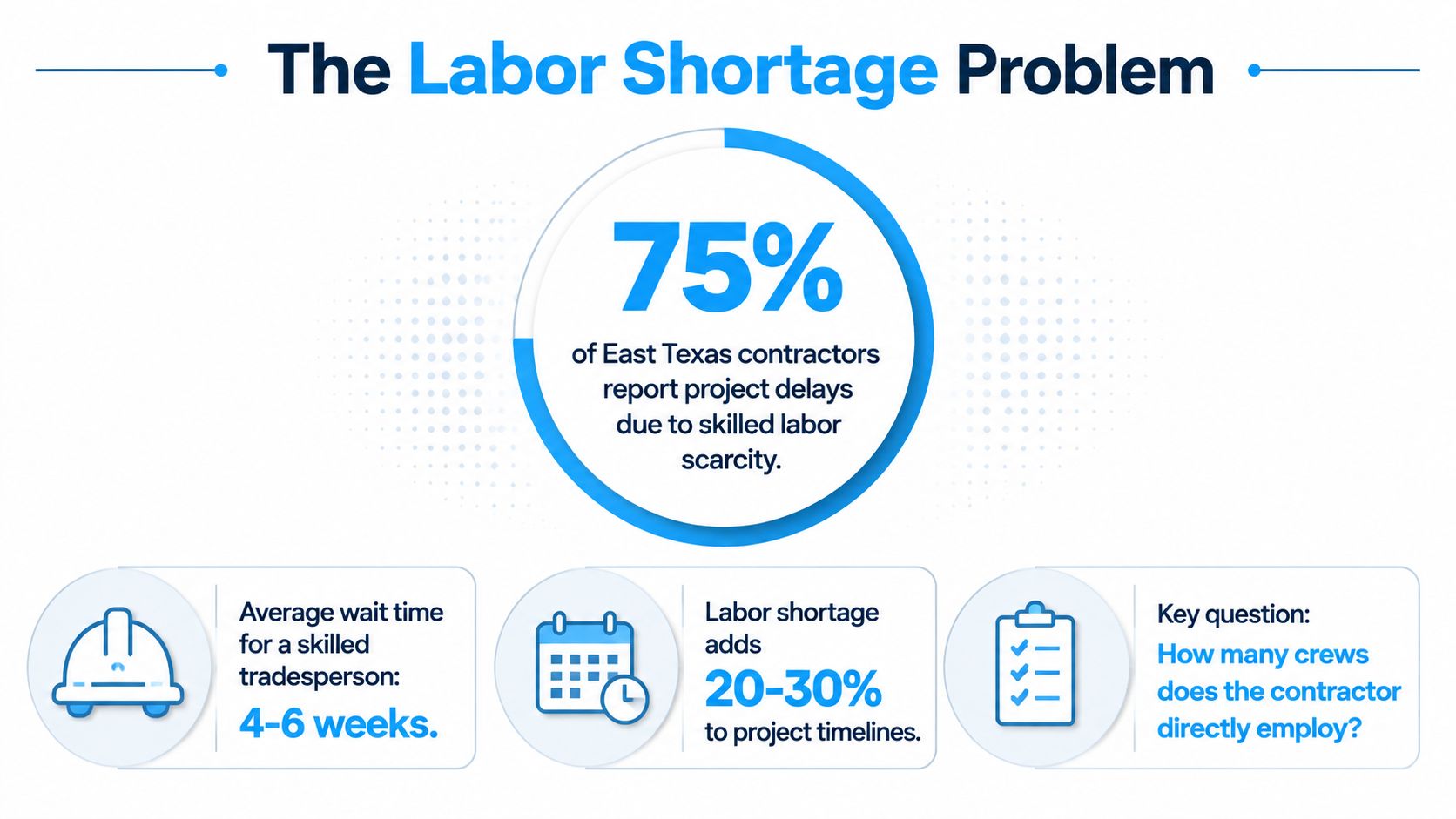
Labor scarcity is one of the biggest schedule risks in East Texas remodeling. The problem isn't limited to finding a good contractor. Your contractor may be capable and honest but still unable to keep the job moving if a framing crew, electrician, plumber, or finish carpenter isn't available when the sequence requires them.
Texas industry data reports that 76% of contractors struggle to fill hourly craft positions and 78% struggle to fill salaried positions, with specialty shortages affecting electricians and finished carpentry in particular (Texas construction labor shortage information). Those shortages affect kitchens, bathrooms, additions, roofing work, and finish-heavy renovations differently, but they all create pressure on production planning.
Test the schedule before you sign
A vague start window is a warning sign when the contractor also can't explain crew assignments. So is frequent crew rotation. If different workers appear every few days, the project manager may be filling gaps instead of following a planned sequence.
Ask directly:
- How many projects are active: A busy schedule is acceptable only if staffing matches commitments.
- Which crews are in-house: Direct employees can provide more control, though subcontractors can be reliable when relationships are established.
- Which trades are already booked: Ask whether critical partners have agreed to your project dates.
- What happens after a delay: Require a written response plan for missed trade windows and material disruptions.
- Who updates you: One named project contact should explain schedule changes and decisions.
Price matters, but labor capacity often predicts delivery better than a modest bid difference. A contractor who can demonstrate crew depth, trade relationships, and sequencing discipline deserves closer consideration than one who wins the estimate by promising an impossible start.
Your Contractor Vetting and Estimate Checklist
Use this checklist before you authorize demolition or sign a construction agreement. The purpose isn't to make the process difficult. It's to catch gaps while you still have negotiating power.
Before the estimate
- Check comparable work: Ask for references from Longview or Gregg County projects with a similar scope and contact those homeowners.
- Verify insurance: Confirm liability and employee coverage directly with the insurer, using independently obtained contact details.
- Confirm local requirements: Ask whether City of Longview registration applies and who will handle the permit package.
- Identify licensed trades: Get the names of the electrical, plumbing, and HVAC professionals assigned to the work.
- Review the portfolio: Look for additions, occupied-home remodels, roofing work, or commercial interiors that resemble your project.
During pricing
Demand a written, line-item estimate. It should separate labor, materials, permit costs, allowances, demolition, disposal, and approved contingency items. A single lump sum makes it difficult to compare bids and gives scope gaps somewhere to hide.
Ask the contractor to identify exclusions in plain language. “Cabinet installation” should explain whether hardware, trim, delivery, and finish adjustments are included. “Electrical” should clarify whether the price covers only fixture replacement or new circuits and panel work.
Before signing
Reject open-ended completion language. Require a start condition, a reasonable production schedule, payment milestones tied to completed work, and a written change-order process. Keep the first demolition day conditional on permit approval where permits apply.
Finally, ask for the crew plan in writing. Get the project manager's name, the primary carpenter or superintendent, and the expected trade sequence. A documented quality-control process, such as the one described in Home Pro's quality assurance process, can also show how a contractor tracks workmanship and corrections.
Home Pro's Remodeling & Repairs provides design-build remodeling, additions, roofing, exterior improvements, commercial renovations, and selected new construction across East Texas, with on-site consultations and project coordination. If you want a contractor conversation grounded in scope, staffing, permits, and schedule control, visit Home Pro's Remodeling & Repairs to request an estimate.