
You're standing in an empty office suite or a half-used retail space, and the clock is already working against you. Tenants want to stay open, employees need access, and every day the space sits in limbo costs goodwill. The contractor you hire in the next few weeks will either keep the work moving cleanly through phased construction, or turn the project into a long string of surprises, missed handoffs, and awkward calls about change orders.
That's why hiring commercial renovation contractors is different from picking a crew for a house remodel. In a large, fragmented market, the difference between a capable team and an underprepared one shows up fast in scheduling, trade coordination, and budget control. IBISWorld estimates the U.S. commercial property remodeling industry at $39.8 billion in 2026, with 29,469 businesses competing in the space, which says a lot about how many firms are chasing the work and how few are built for complex nonresidential jobs. IBISWorld's industry profile for commercial property remodeling makes the same point in a different way, by showing how much of the market is tied up in cost pressure and tight operational discipline.
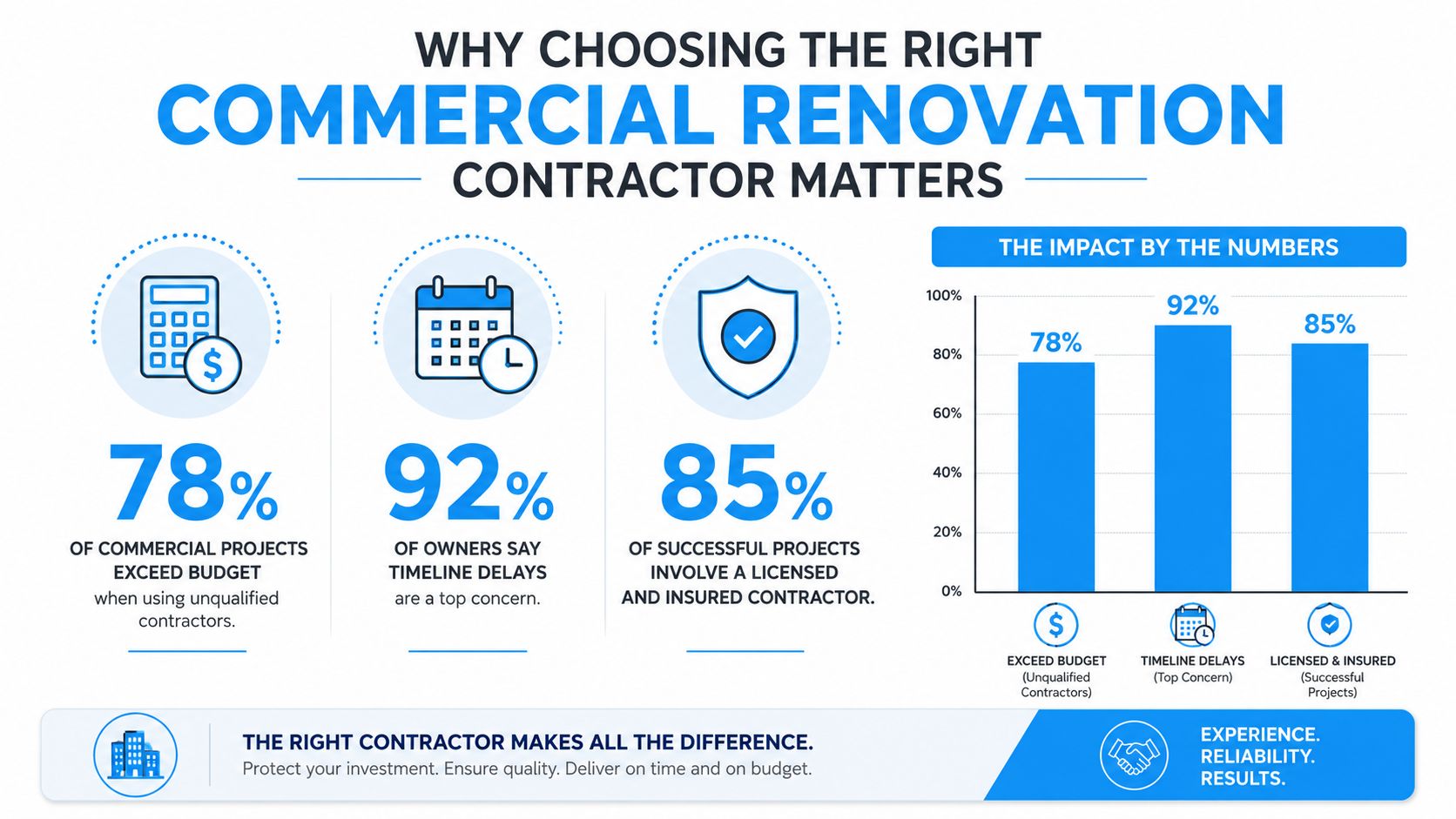
Table of Contents
- Why Choosing the Right Commercial Renovation Contractor Matters
- Verifying Licensing, Insurance, and Commercial Experience
- How Design-Build Workflows Prevent Budget Surprises
- Managing Occupied Renovations Without Shutting Down Operations
- Commercial vs Residential Contractors and Why the Difference Matters
- East Texas Considerations for Your Commercial Renovation Project
- Your Contractor Evaluation Checklist and Next Steps
Why Choosing the Right Commercial Renovation Contractor Matters
A Tyler property owner staring at a dated office suite usually does not need a sales pitch. They need a space that stays usable, finishes on time, and avoids expensive rework once the walls open up. That is the test in commercial renovation, because the job is not just demolition and finish work. It is coordination between trades, tenants, inspectors, and the daily reality of keeping business moving.
The market explains part of the risk. There are thousands of firms in commercial property remodeling, which means owners have a wide field of contractors to choose from, and those firms vary a lot in experience and discipline. Rising material costs have also made weak estimating and sloppy procurement more expensive than they used to be. A contractor who misses on labor sequencing or material lead times can burn through margin long before the project is halfway done.
A polished proposal does not guarantee the right fit. The trouble is usually not whether a contractor can do the physical work. It is whether they can phase the job around occupied space, hold the budget when design details change, and keep multiple trades from crowding each other out. The weak firms tend to win work with a low number, then make up the difference through change orders, vague allowances, and schedule extensions.
Practical rule: In commercial work, the contractor who asks better questions early usually saves more money later than the one with the lowest first number.
Harvard's Joint Center for Housing Studies found that scale and discipline have long separated the durable firms from the rest of the field, with roughly 10,000 general remodeling contracting firms generating $1 million or more in revenue in 2002 and nearly 13% of identified remodelers no longer operating a year later. Harvard's remodeling firm performance study is old, but the lesson still holds. The firms that last are the ones that understand cash flow, scheduling, and operational control, because those are the levers that keep a project from drifting into expensive corrections.
That matters even more in East Texas, where many projects happen inside active offices, retail units, or mixed-use properties that cannot shut down for weeks. A contractor who cannot plan staging, tenant access, dust control, and inspection timing will create daily friction for everyone in the building. If you want a useful benchmark for how permit questions should be handled early, not after demolition starts, use this permit guide for kitchen remodels as a reminder of how quickly paperwork and scope decisions affect the job.
Verifying Licensing, Insurance, and Commercial Experience
The first screening step is simple. Ask for the paperwork before you talk design, finishes, or price. A serious contractor won't hesitate, because licensing and insurance are the floor, not the finish line.
What to confirm before a site visit
Start with Texas licensing and business registration where applicable, then move to insurance. For commercial work, the important question isn't whether the contractor has a truck and a logo, it's whether they can lawfully work in your municipality, carry coverage appropriate for business property, and protect you if a worker or third party gets hurt on site. A contractor who deflects that request is telling you something useful.
Use this permit guide for kitchen remodels as a reminder of a bigger rule, permit questions matter early, not after demolition starts. Commercial work raises the stakes because the approval path usually involves more moving parts, more inspections, and more chances to stall if the paperwork is thin.
A clean certificate of insurance doesn't tell you everything, but missing insurance tells you enough.
How to read commercial experience
Don't accept a gallery of pretty finishes as proof of commercial capability. Look for projects that required real coordination, such as MEP tie-ins, phased work, permit sequencing, and final inspection sign-off in active spaces. Healthcare, retail, and manufacturing work all bring different code and operational demands, so the portfolio should show the contractor has experience in those environments, not just photographed them.
Ask for references that match your building type and operating style. If your property will stay open during construction, ask about occupied project work, after-hours scheduling, and whether the contractor had to solve access issues between tenants, employees, and inspectors.

Three questions usually expose the truth fast:
- Who coordinated the permits? If the answer is fuzzy, expect delays.
- Who handled the trades? If the contractor only supervised one crew, they may struggle with real commercial sequencing.
- What changed mid-project? Good commercial teams can explain how they handled surprises without losing control of the job.
How Design-Build Workflows Prevent Budget Surprises
Budget blowups usually start long before demolition. They start when someone treats the scope like a rough sketch, prices it like a complete plan, and hopes the missing details won't matter. That's why a structured design-build workflow is so useful in commercial renovation, it keeps design, estimating, and construction tied to the same reality.
Why target budget comes first
The cleanest projects begin with a target budget before design is finalized. That doesn't mean the budget is fixed in stone, it means everyone knows the ceiling and designs to it instead of designing freely and hoping the number works later. In the field, that difference matters because late-stage redesign is where owners get hit with avoidable cost drift.
Home Pro's Remodeling & Repairs uses a defined four-step design-build process, with a target budget agreed before design and on-site consultations that include finalized design details and an estimated production schedule. That kind of structure isn't glamorous, but it cuts down the biggest source of frustration I see on commercial jobs, which is a drawing set that looks nice and a bid that doesn't match it.
What a real workflow looks like
A professional process usually follows a simple sequence.
- Feasibility and site review. The contractor walks the space, checks conditions, and identifies constraints before anyone talks finishes.
- Design alignment. Plans and selections get narrowed to what can be built within the operating schedule.
- Budgeting with detail. The estimate should show the cost drivers, not hide them inside vague allowances.
- Construction planning. Trade sequencing, lead times, and access requirements are set before work starts.
- Handover and closeout. The contractor documents the finished work and resolves punch-list items.
Good estimating doesn't eliminate surprises, it makes the surprises smaller and easier to manage.
The point is control. If your contractor can't explain how design choices affect cost, or can't tie a finish decision to a schedule impact, you're not getting design-build discipline. You're getting a prettier version of bid shopping.
Managing Occupied Renovations Without Shutting Down Operations
Occupied renovations live or die on sequencing. The building still has to function while drywall comes down, trades rotate in and out, and inspections land on a schedule that doesn't care about your business hours. That's why the contractor's phasing plan matters more than a glossy render.
The work has to be choreographed
Good contractors don't just assign tasks, they choreograph movement through the building. The demolition crew shouldn't be in the same path as the electricians' material drop, and finish crews shouldn't arrive before dusty work is fully contained. If the sequence is wrong, the building spends more time being protected than being improved.
Dust control, noise control, and temporary utility reroutes need to be planned before the first wall is opened. In an occupied office, that may mean isolating work zones and scheduling loud trade activity for times that least disrupt tenants. In retail, it may mean setting up access routes that keep customers away from active construction while still letting the business operate. The contractor should be able to explain those choices in plain language.
What to ask before you sign
Ask direct questions about how they handle real-world disruption:
- How will crews move through the site? You want a phasing map, not a promise.
- What gets done after hours? Some work belongs in business downtime, not the middle of the day.
- How are dust and odors controlled? Containment is a practical issue, not a courtesy.
- What happens when a utility shutdown is needed? Temporary reroutes should be scheduled, not improvised.
If the contractor has done tenant improvement work, ask how they handled post-construction support too. The best firms don't disappear once the last fixture goes in. They stay available for punch-list items, adjustments, and final coordination so the space keeps working for the people using it.
Commercial vs Residential Contractors and Why the Difference Matters
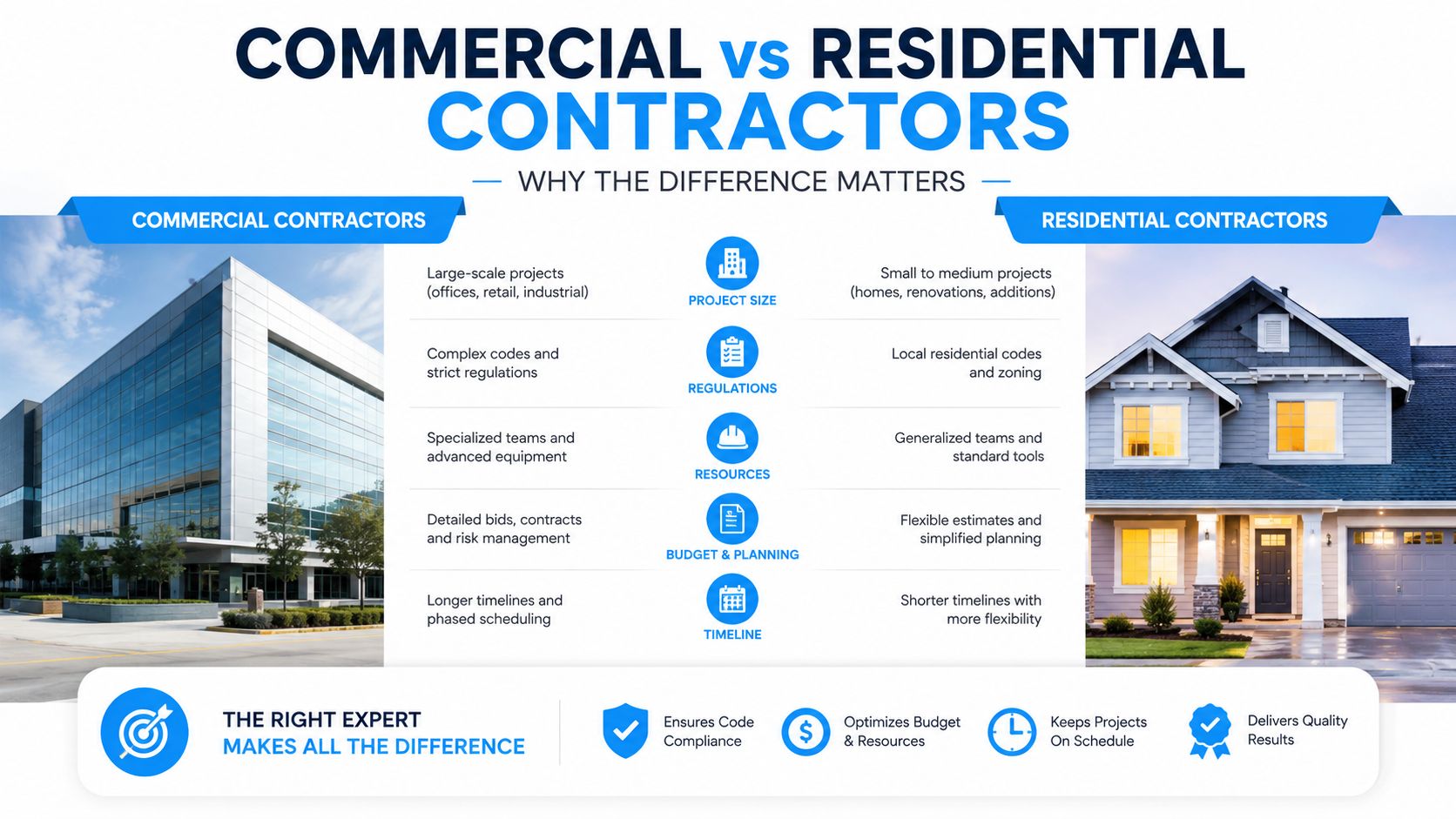
A residential remodeler can still be the wrong fit for a commercial build-out. The work may look similar from the curb, but the job changes fast once tenants stay open, the public keeps coming through the door, inspections stack up, and code requirements get tighter. Commercial projects often need a contractor who can keep architecture, structure, and MEP systems moving together while the site stays organized and the business keeps running.
Different jobs, different risks
Residential work usually centers on one owner, one household, and a simpler approval path. Commercial work brings more people to the table, more formal documentation, and more coordination around fire safety, ventilation, and occupancy rules. That is why a contractor who handles kitchens and baths well can still struggle with an office suite, clinic, or retail remodel.
The biggest failure point is usually project management. A commercial contractor has to coordinate multiple trades, track inspection timing, and keep the owner informed when one delay affects several other tasks. A residential-only shop may not have the systems to do that well every time, even if the craftsmanship is solid.
What separates the right fit
You can usually tell the difference in the interview.
A contractor who understands occupied commercial work talks about phasing, trade sequencing, tenant coordination, and how the job stays open while construction is underway. A contractor who mostly works on homes usually talks more about finishes, craftsmanship, and homeowner preferences. The gap shows up fast once you ask how they would keep employees, customers, or tenants moving through the building without crossing active work zones.
A good screen is to ask for a real example from a past project. If the contractor can describe how they handled noisy work, temporary shutoffs, after-hours tasks, and access control, they have probably lived through the mess before. If the answer stays vague, that is a warning sign.
For a closer look at how site access and perimeter work can change the flow of a project, see our guide to fencing contractors in East Texas. The same kind of practical planning shows up in commercial renovations too, especially where safety, staging, and business continuity all overlap.
Home Pro's Remodeling & Repairs is one example of a local firm that handles both residential and commercial remodeling work in East Texas, so the key test remains the same: whether the team can match its process to the project's complexity.
If you are comparing a commercial bid to a residential-style proposal, read the fine print closely. The proposal should explain how the contractor plans to manage access, inspections, and coordination, not just how they plan to install the visible finishes.
East Texas Considerations for Your Commercial Renovation Project
East Texas projects have their own rhythm, and local knowledge pays off quickly. A contractor who works in Tyler, Lindale, Flint, Bullard, Whitehouse, or nearby communities knows that logistics aren't abstract. They're tied to local permitting expectations, subcontractor availability, and how far materials need to move before they hit the site.
Local permitting and supplier reality
Municipal processes vary, and a contractor who knows the local approval path can save weeks of avoidable back-and-forth. That matters when the project sits in an active building and every delay affects tenants, customers, or staff. It also matters because many materials still move through regional supply chains, so procurement timing can change depending on what's stocked nearby and what has to be ordered.
A local contractor usually has a better feel for which subcontractors show up on time, which ones communicate clearly, and which ones are best avoided. That's not a small detail. On occupied jobs, one unreliable trade can throw off the entire sequence.
Climate and exterior work
East Texas humidity and storm exposure also affect exterior renovation choices. Roofing, siding, windows, doors, and outdoor structures need to be selected and installed with local weather in mind, or you'll deal with premature wear and recurring maintenance. Seasonally shifting temperatures can also affect scheduling and material handling, especially on jobs where moisture control matters.
Local experience doesn't guarantee a good job, but it does reduce the number of expensive unknowns.
If your project has exterior components, ask the contractor how they adapt to weather windows and what they do when conditions change mid-install. A crew with real East Texas experience should answer without guessing.
The smartest buyers in this market look for a contractor who works nearby, understands the approval environment, and can keep a project moving without relying on a dozen outside assumptions. That combination matters more than a polished website or a broad service map.
Your Contractor Evaluation Checklist and Next Steps
The easiest way to compare commercial renovation contractors is to separate the process into three moments, before the meeting, during the site visit, and before signing. That keeps the decision from getting hijacked by a single price number or a smooth sales conversation.
Before the first meeting
Ask for proof of insurance, relevant commercial experience, and examples of occupied-space work. If the contractor can't quickly show that they've handled projects like yours, move on. Also ask how they handle estimates when the scope is still being refined, because that's where low-ball numbers often hide their future pain.
During the on-site consultation
Listen for questions about phasing, access, utilities, and business continuity. A strong contractor wants to know who's using the space, what hours matter, and which parts of the building must stay live. If those questions don't come up naturally, the plan probably isn't commercial-grade yet.
Before you sign
Review the proposal for vague allowances, weak scope language, and missing closeout details. Use this final walkthrough checklist to make sure punch-list expectations and completion standards are clear before the work starts. That step is boring compared with picking finishes, but it's where a lot of disputes get prevented.
A useful way to compare bidders is to line up their proposals by scope, phasing plan, exclusions, and post-construction support. The lowest number usually looks attractive until you see what it leaves out.
Pick the contractor who can explain the work, not just sell it. If they can show how they'll protect the occupied space, align the budget, and manage the trades without improvising, you're probably looking at a team that can finish the job without turning it into a second project.
Home Pro's Remodeling & Repairs handles commercial remodeling in East Texas with a structured design-build process, so owners can get a clearer read on scope, schedule, and budget before work starts. If you're planning an occupied renovation or a commercial build-out in Tyler or a nearby community, visit Home Pro's Remodeling & Repairs to schedule a consultation and talk through the project in practical terms.