
You're standing in the driveway looking at two very different estimates. One contractor is showing you a solid wood privacy fence with a pair of swinging gates. Another is recommending vinyl panels and a sliding entrance. Both look good in a brochure, but neither option tells you how the fence will handle East Texas wind, shifting soil, muddy access, or your HOA's approval process.
That's the part many homeowners discover too late. Types of fences and gates aren't just a matter of color and curb appeal. The right system has to fit the lot, the weather, the driveway, the property line, and the way your household uses the entrance.
Table of Contents
- Why Fence and Gate Choices Matter in East Texas
- Comparing the Most Common Fence Materials
- Choosing the Right Gate Type for Your Property
- How Wind Load and Structure Affect Fence Performance
- Local Codes, HOA Rules, and Property Line Realities
- Matching Fence and Gate Types to Real Use Cases
- Planning Your Fence and Gate Installation
Why Fence and Gate Choices Matter in East Texas
A fence can look perfectly straight on installation day and still develop problems after repeated storms, wet seasons, heat, and soil movement. In the Tyler area and surrounding East Texas communities, the ground conditions can change from one part of a property to another. A low, open fence on level ground has very different structural needs from a tall privacy fence installed across a sloped backyard or near an exposed driveway.
Consider a typical homeowner who wants backyard privacy, a safe place for the dog, and a more finished front entrance. A six-foot solid fence may solve the privacy problem, but it also presents more surface area to wind. A decorative metal fence may look better at the street and place less demand on the structure, but it won't block views or contain every pet. A chain-link fence may be practical around a side yard, yet it may not satisfy an HOA that requires a particular finish or material.
The gate deserves equal attention. Gates are moving assemblies, not just fence sections with hinges attached. Their width, weight, hardware, posts, and clearance determine whether they stay aligned and latch reliably.
Practical rule: Choose the fence and gate as one structural system. A strong fence with undersized gate posts is still a weak installation.
Before selecting a material, identify the actual job:
- Privacy: Do you need a visual barrier around a pool, patio, or bedroom windows?
- Containment: Will the fence keep in a small dog, a large dog, livestock, or children?
- Security: Does the entrance need a lock, keypad, camera integration, or automated opener?
- Weather exposure: Is the property open to prevailing wind, or protected by trees and neighboring homes?
- Approval limits: Does the city, county, neighborhood, or HOA control height, placement, color, or gate operation?
The U.S. fencing market was estimated at USD 9.81 billion in 2025 and is projected to reach USD 14.90 billion by 2033, according to the American Fence Association industry index. That market activity reflects broad demand, but it doesn't identify the right system for your lot. Local conditions still make the final decision.
Comparing the Most Common Fence Materials
East Texas homeowners usually narrow their choices to wood, vinyl, chain link, ornamental metal, or a composite-style product. Each material handles privacy, moisture, impact, and wind differently. The least expensive material on paper may require more maintenance, while a low-maintenance option may need more careful structural support during installation.
| Material | Durability | Maintenance | Privacy | Best Use Case |
|---|---|---|---|---|
| Wood | Good when posts, drainage, and protective coatings are handled correctly, but boards can warp, split, or decay | Regular inspection, staining, sealing, or painting | Excellent with solid pickets or board-on-board construction | Backyard privacy, pool areas, and flexible custom layouts |
| Vinyl | Resists rot, insects, and moisture, but panels can crack from impact and catch wind | Usually cleaning and periodic inspection | Very good with solid panels | Low-maintenance suburban privacy fencing |
| Chain link | Reliable for containment and everyday use, with corrosion protection important on exposed metal | Low, with occasional tension, hardware, and coating checks | Limited unless privacy slats or screening are added | Pets, side yards, utility areas, and practical boundaries |
| Ornamental metal | Strong and long-lasting when the coating and connections are maintained | Cleaning, rust inspection, and coating repairs | Low because most designs are open | Front boundaries, visibility, and appearance-focused security |
| Composite | Resistant to many moisture-related problems, though system quality and framing still matter | Generally lower than wood, with inspection of connections and finish | Often good, depending on panel design | Modern privacy installations where uniform appearance matters |
| Decorative panel systems | Varies by metal thickness, finish, post design, and connection quality | Moderate, especially around fasteners and coating damage | Low to moderate | Curb appeal, pool boundaries, and partial enclosure |
Wood remains the easiest material to customize
Wood works well when the property has unusual corners, changing elevations, or a homeowner wants a specific look. Individual pickets can be adjusted more easily than rigid panels, and a damaged board can often be replaced without rebuilding the entire section. The trade-off is upkeep. Heat, humidity, rain, insects, and direct sun can all shorten the life of an unprotected fence.
If you choose wood, pay close attention to the posts and bottom clearance. A fence that holds moisture against the ground will struggle regardless of how attractive the pickets look. Homeowners planning to protect an existing or new wood fence can review these fence staining and sealing practices before choosing a finish.
Vinyl and composite reduce routine maintenance
Vinyl gives a clean, consistent appearance and doesn't need the painting or staining routine associated with wood. It can be a sensible choice for a homeowner who wants privacy without recurring finish work. However, vinyl isn't maintenance-free in the structural sense. The posts still need proper installation, and a damaged panel may need replacement rather than a simple repair.
Composite systems can offer a modern appearance and reduced exposure to rot-related problems, but the framing, fasteners, and manufacturer details matter. Don't judge the whole system by the panel alone. The posts and connections carry the load.
Metal and chain link prioritize visibility and function
Chain link is useful where containment, airflow, and practicality matter more than privacy. Ornamental metal provides a more finished street appearance and can support controlled access, but its open design leaves the yard visible. If the property needs privacy, landscaping, screening, or a different fence type may be more appropriate than ornamental metal by itself.
Choosing the Right Gate Type for Your Property
The gate is where a good fence layout can become a daily nuisance. A gate that drags, swings into the street, blocks a sidewalk, or can't open fully because of a slope will frustrate you every time you use it. Start with the driveway and operating area, then choose the gate style.
Swing gates suit clear, level approaches
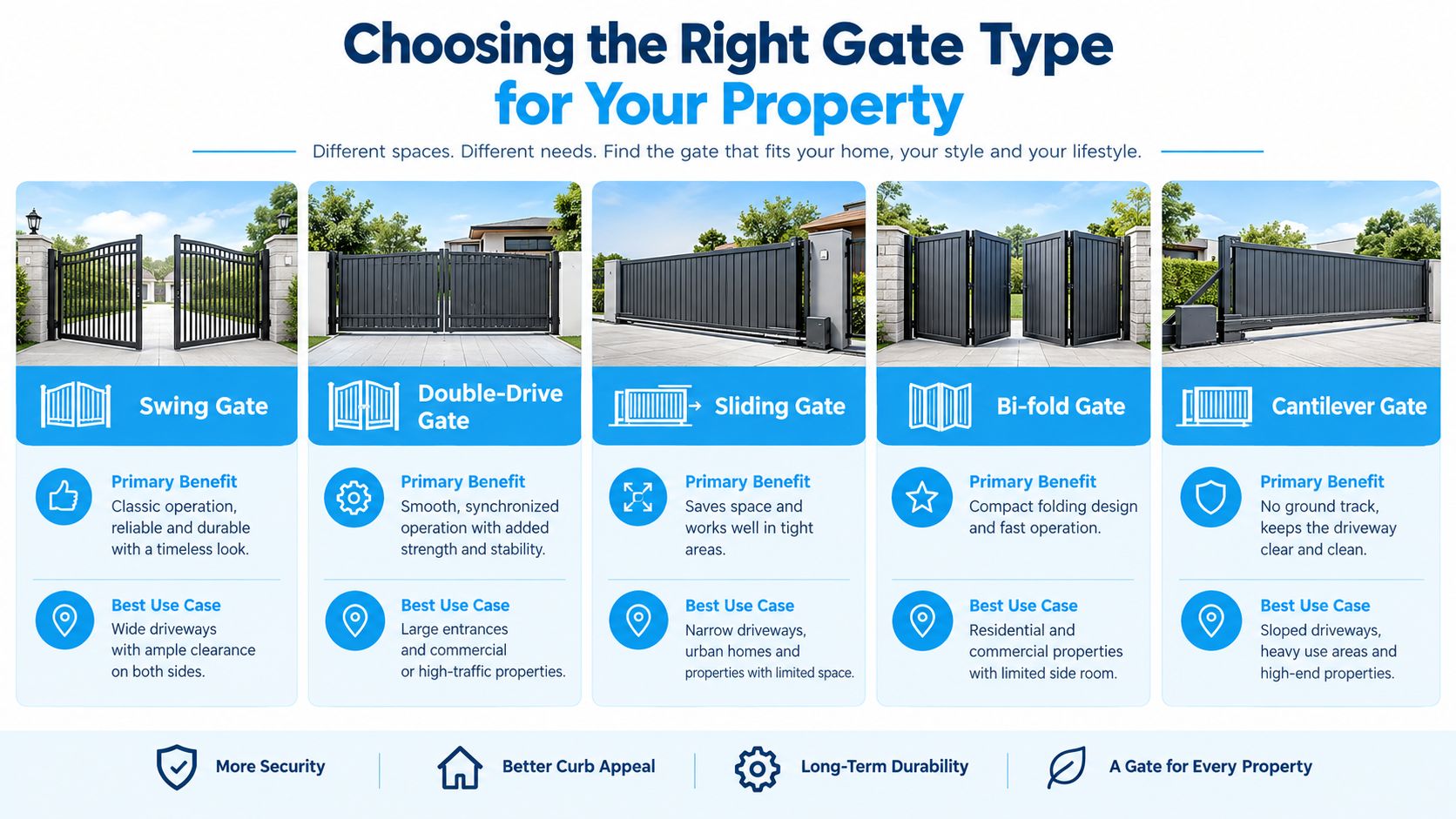
A single swing gate is straightforward and attractive when the opening is manageable and there's enough room for the leaf to swing without hitting vehicles, landscaping, or a slope. The hinges and gate posts absorb bending and twisting, so a heavy gate needs substantial support. A weak post can lead to sagging, latch misalignment, and a gate that stops closing cleanly.
Double-drive gates divide a broad opening into two leaves. That can reduce the weight carried by each hinge assembly, but it introduces a center meeting point that must stay aligned. The driveway needs room for both leaves to swing, and automation requires coordinated operators, stops, and safety controls.
Sliding gates conserve swing clearance
A sliding gate travels parallel to the fence, making it useful where the driveway slopes toward the property, vehicles sit close to the gate, or the interior swing area is limited. The system depends on a straight travel path, reliable rollers or a supported cantilever assembly, and lateral guidance that keeps the gate upright.
A cantilever gate doesn't use a ground track across the driveway. Its counterbalanced frame carries the gate behind the opening, which can help where debris, gravel, or drainage would interfere with a track. The hidden cost is the space required beside the opening and the need for carefully designed posts and support hardware.
Bi-fold gates solve tight operating conditions
Bi-fold gates fold back as they open, reducing the swing arc and allowing faster movement through a constrained entrance. They require more hinges, rollers, stops, and coordination than a basic swing gate. That complexity can work well for a busy residential or commercial entrance, but it leaves more components to inspect and adjust.
For industrial and commercial installations, ASTM F900 and ASTM F1184 gate standards define important technical scopes. F900 addresses single and double swing gates, while F1184 addresses horizontal slide gates, including posts, hardware, and accessories. The practical lesson is simple. Match the gate to the opening, daily use, clearance, and automation plan, then verify the post and hardware design instead of treating the gate as an accessory.
Before construction, measure the approach, identify where vehicles turn, check the finished grade, and decide whether a future opener, keypad, intercom, or camera will need power and mounting space. This gate installation guide can help organize those decisions before the posts are set.
How Wind Load and Structure Affect Fence Performance
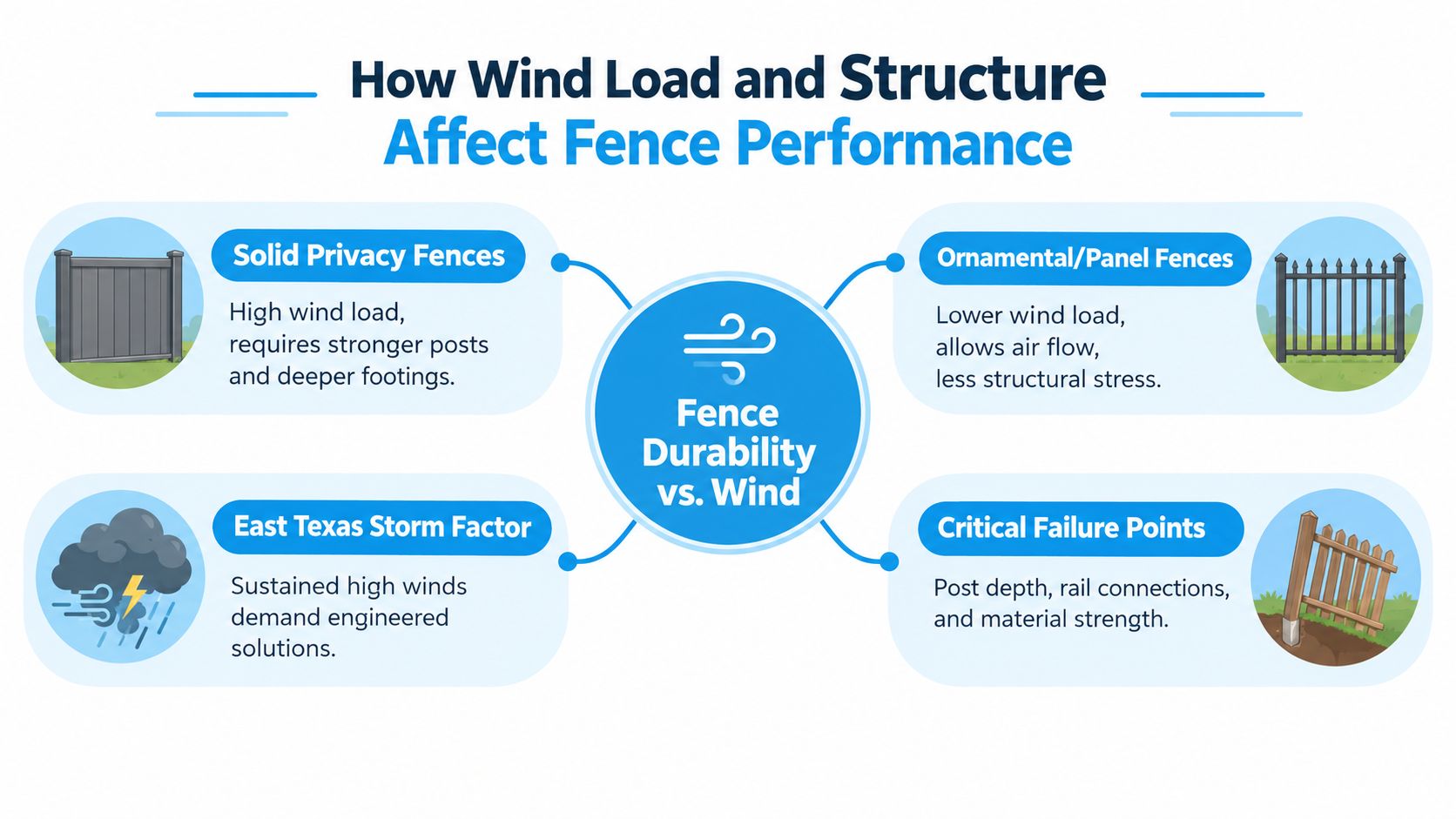
Wind doesn't care whether a fence is cedar, vinyl, or powder-coated steel. It pushes against the exposed area, transfers force into rails and posts, and eventually sends that load into the footing and soil. The more continuous the fence face, the more important the structure becomes.
Solid fences behave like lateral walls
A solid privacy fence catches wind across nearly the full panel surface. Taller sections and wide driveway gates increase the exposed area, so the installer may need larger posts, deeper footings, stronger rails, closer post spacing, and reinforced gate frames. The soil has to resist the resulting overturning force. A post set in a loose or poorly consolidated hole won't perform like the same post installed in stable, well-compacted material.
Vinyl deserves special attention because its smooth panels can form a continuous surface. The posts may need internal reinforcement or a design specified by the manufacturer. Wood privacy fences also need sound rail connections and posts that resist rotation, not just pickets that look straight from the street.
Open systems shed more air
Chain link and spaced ornamental panels allow air to pass through. The Chain Link Fence Wind Load Guide shows that open fence geometry materially reduces wind pressure compared with solid barriers, with example resistance factors around 0.67 to 0.57 across taller fence configurations. The same guide notes that fencing dynamic pressure may be taken as 900 N/m², roughly equivalent to a 38 m/s wind speed, where site-specific calculations aren't required.
Those values aren't a substitute for a site-specific design. They do explain why a porous fence often places less demand on posts and footings than a solid privacy barrier of similar height. Adding privacy slats or screening changes that behavior, so the installer should reassess the structure rather than assuming the original chain-link design still applies.
Inspect the load path, not just the finish
A reliable inspection follows the force through the system:
- Panel or fabric: Look for unsupported spans, loose fasteners, and damaged coating.
- Rails and connections: Check whether rails transfer load into posts without loose or undersized hardware.
- Posts: Confirm that posts are appropriate for the height, gate weight, and wind exposure.
- Footings: Look for adequate depth, concrete consolidation, and drainage conditions.
- Gates: Examine hinges, rollers, stops, braces, latches, and operator mounts as one assembly.
A fence rarely fails because one picket looked wrong. It fails when the load path, connection, or footing can't handle the force reaching it.
Local Codes, HOA Rules, and Property Line Realities
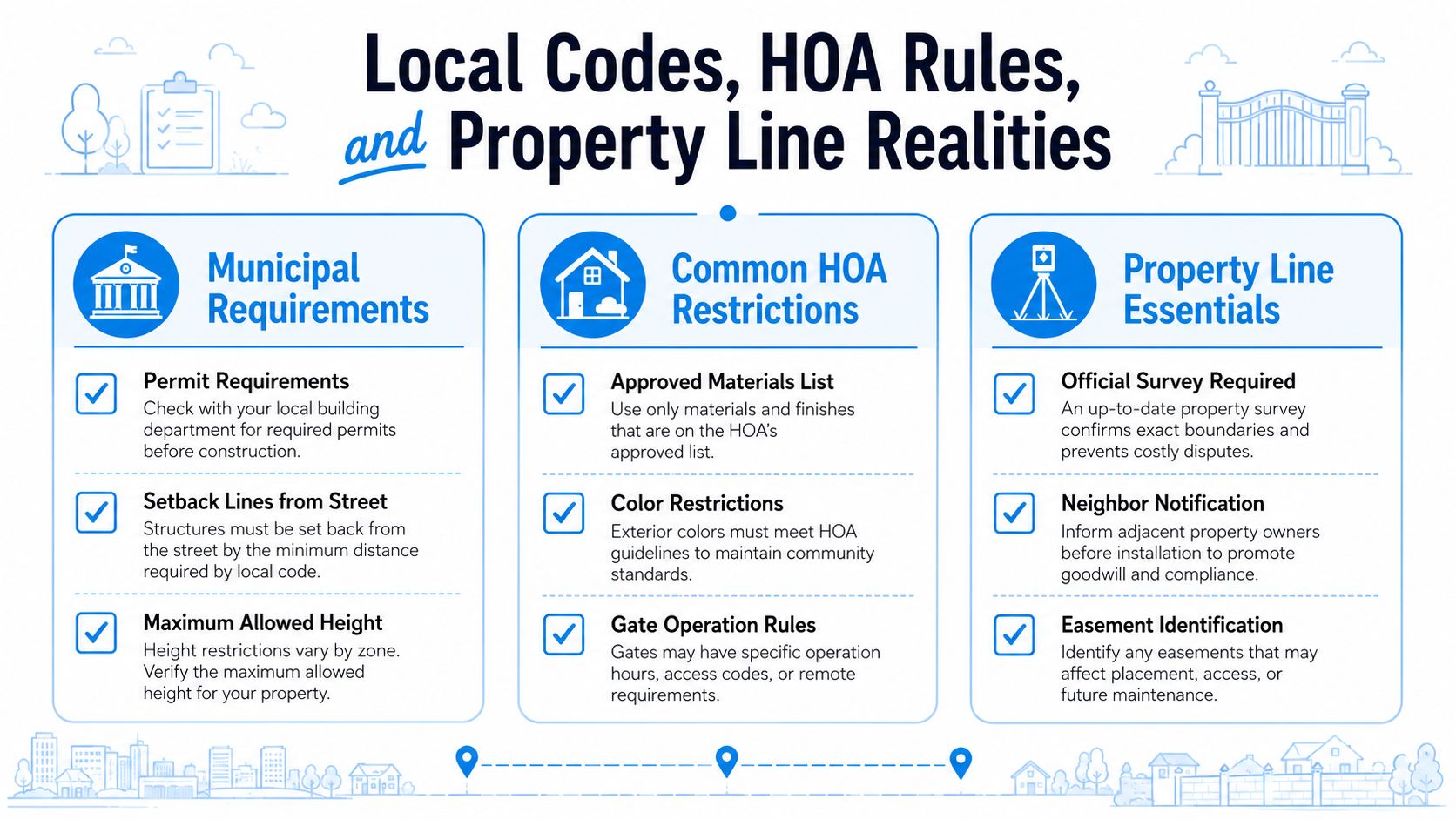
A fence project can be physically well built and still create a legal or financial problem if it crosses a property line or violates a neighborhood rule. Tyler-area homeowners should confirm requirements with the relevant city or county office before scheduling installation. Municipal rules may address permits, setbacks, height, visibility near intersections, drainage, easements, and placement along streets.
HOA rules add another layer. A neighborhood may restrict materials, colors, post caps, fence height, finished sides, or gate styles even when local regulations allow the design. Approval can also take time, especially when the association requires a drawing, site plan, material sample, or review by an architectural committee.
Complete the paperwork before materials arrive
Use a written checklist rather than relying on a verbal understanding:
- Municipal requirements: Confirm permits, setback lines, maximum height, corner visibility, and utility concerns with the governing office.
- HOA restrictions: Request the current rules, approved material list, color requirements, finished-side direction, and gate operation limits.
- Property boundaries: Use a recent survey or hire a qualified survey professional when the line isn't clear.
- Easements: Identify drainage, utility, access, and shared-use areas before setting posts.
- Neighbor coordination: Discuss a shared boundary, access needs, and gate locations in writing when the installation affects both properties.
- Site conditions: Mark slopes, low spots, buried utilities, driveway edges, and areas where water crosses the planned fence.
A fence installed a few inches over the line can become a dispute during a sale or future improvement. Guessing from an old chain, landscaping edge, or assumed boundary isn't a reliable substitute for documented information.
Commercial, agricultural, and rural properties may have different access, livestock, drainage, or security requirements than a residential backyard. The gate may need to accommodate trailers, equipment, deliveries, or emergency access. Those uses should be identified before the opening and posts are designed.
Matching Fence and Gate Types to Real Use Cases
The best system is the one that solves the property's main problem without creating a new one. A privacy fence that blocks wind poorly designed around a wide gate can become a maintenance burden. A decorative fence that looks excellent at the street may fail to contain a determined dog. Match the enclosure, gate, and structure to the use.

Backyard privacy
For a backyard patio or pool setting, solid wood, vinyl, or composite panels provide the strongest visual separation. Wood offers easier customization around trees, grade changes, and unusual corners. Vinyl or composite reduces routine finish work, but the posts and panel system still need a wind-conscious design.
A pedestrian gate should latch positively and swing away from hazards. Around a pool, confirm the applicable safety requirements with the local authority before choosing the fence height, opening direction, latch position, and hardware.
Pets and children
Chain link can be a practical containment choice where visibility and airflow matter. Wood or vinyl gives more privacy and can reduce distractions for some dogs, but gaps under the fence, weak latches, and climbable horizontal members deserve attention. A gate should have a latch that household members can operate while preventing accidental opening.
Rural acreage and outbuildings
Large properties often benefit from separate systems. Use agricultural or wire fencing for long boundary runs, then reserve wood, ornamental metal, or a reinforced gate assembly for the home entrance. A wide sliding or cantilever gate can work where swing clearance is limited, while a sturdy double-drive gate may suit a broad, level approach with room to open inward.
Security and curb appeal
Ornamental metal creates visibility and a finished entrance, which can suit a front yard or commercial property. If privacy is essential, combine it with landscaping or use a more solid fence in the rear. For controlled access, plan the gate frame, lock, hinges, operator, keypad, and power route together. Adding automation later is often possible, but it's easier when the posts and clearances were designed for it from the start.
Planning Your Fence and Gate Installation
Start with an on-site review, not a material order. Walk the boundary, confirm the intended gate opening, discuss soil and drainage, identify wind exposure, and bring HOA or municipal requirements to the conversation. A useful estimate should separate fence runs, posts, gates, hardware, demolition, grading, concrete, access control, and any repair work.
Compare contractors by licensing, insurance, local experience, written communication, and how clearly they explain structural choices. For a broader search, homeowners can review fencing contractors near me and ask each company the same questions about posts, gates, warranty coverage, and change orders.
Home Pro's Remodeling & Repairs provides fence and gate installation, repairs, on-site consultations, and detailed estimates for residential and commercial properties across East Texas. Visit Home Pro's Remodeling & Repairs to discuss your fence type, gate layout, property conditions, and next installation steps.