
You get home after a spring storm, step into the living room, and notice the ceiling stain has grown. Then you walk outside and find shingles in the yard. That's usually when homeowners ask the wrong first question.
They ask, “Can you patch it?”
Sometimes the answer is yes. A patch can be the smart move. But plenty of roofs in East Texas get patched when they should've been replaced, and that “save money now” decision turns into repeat leaks, interior damage, and a bigger bill later.
The question in roof replacement vs repair is simple: how many good years are left in this roof, and what are you paying for each of them? Upfront cost matters, but it's not the whole decision. A repair buys time. A replacement buys a new clock.
Here's the short version before we dig in: repair a younger roof with isolated damage. Replace an older roof with widespread damage, repeated leaks, or problems below the shingle line. If you're already spending a meaningful chunk of replacement money just to keep an old system limping along, stop patching and tear it off.
Table of Contents
- Spotting the Moment a Roof Decision Can't Wait
- Age, Material, and Damage Extent as the First Filter
- Repair vs Replacement at a Glance
- Cost Ranges and Cost Per Remaining Year
- How Storms, Insurers, and East Texas Weather Shift the Math
- When Repair Quietly Becomes the Expensive Choice
- Your Next Steps and Vetting a Local Contractor
Spotting the Moment a Roof Decision Can't Wait
A homeowner in Tyler sees a watermark after a March hailstorm. The next morning, there are torn shingles by the fence and a damp spot spreading across the sheetrock. The first instinct is predictable. Call someone fast, get a tarp on it, patch the obvious hole, and deal with the bigger decision later.
That works if the problem is small and isolated.
It does not work if the roof is already at the end of its run, or if water has moved past the shingles into the decking, insulation, or drywall. In that situation, “later” gets expensive in a hurry because the roof leak is no longer just a roof problem.
Problems that can usually wait a day or two
Some issues call for a normal inspection, not a panic response:
- One missing shingle after a wind event
- A small stain that isn't actively dripping
- Granules in the gutter with no interior water showing
- One damaged ridge cap or vent boot on an otherwise solid roof
Those are often repair situations, especially on a roof that still has real life left in it.
Problems that move this into urgent territory
Other signs mean the decision can't sit on the kitchen counter for a week:
- Daylight in the attic
- Active dripping or puddles indoors
- Sagging drywall
- Soft roof decking
- Water staining in multiple areas
- Shingles torn up across more than one section
Practical rule: If water is inside the house now, schedule emergency protection immediately and make the repair-versus-replace call right after inspection. Waiting only gives water more places to go.
A roof rarely fails all at once. It usually fails in stages. First a shingle lifts. Then underlayment gets exposed. Then decking takes water. Then your insulation, paint, trim, and ceiling get dragged into the same bill. Homeowners who make the right call early usually spend less than the ones who keep trying to buy “just one more season.”
Age, Material, and Damage Extent as the First Filter
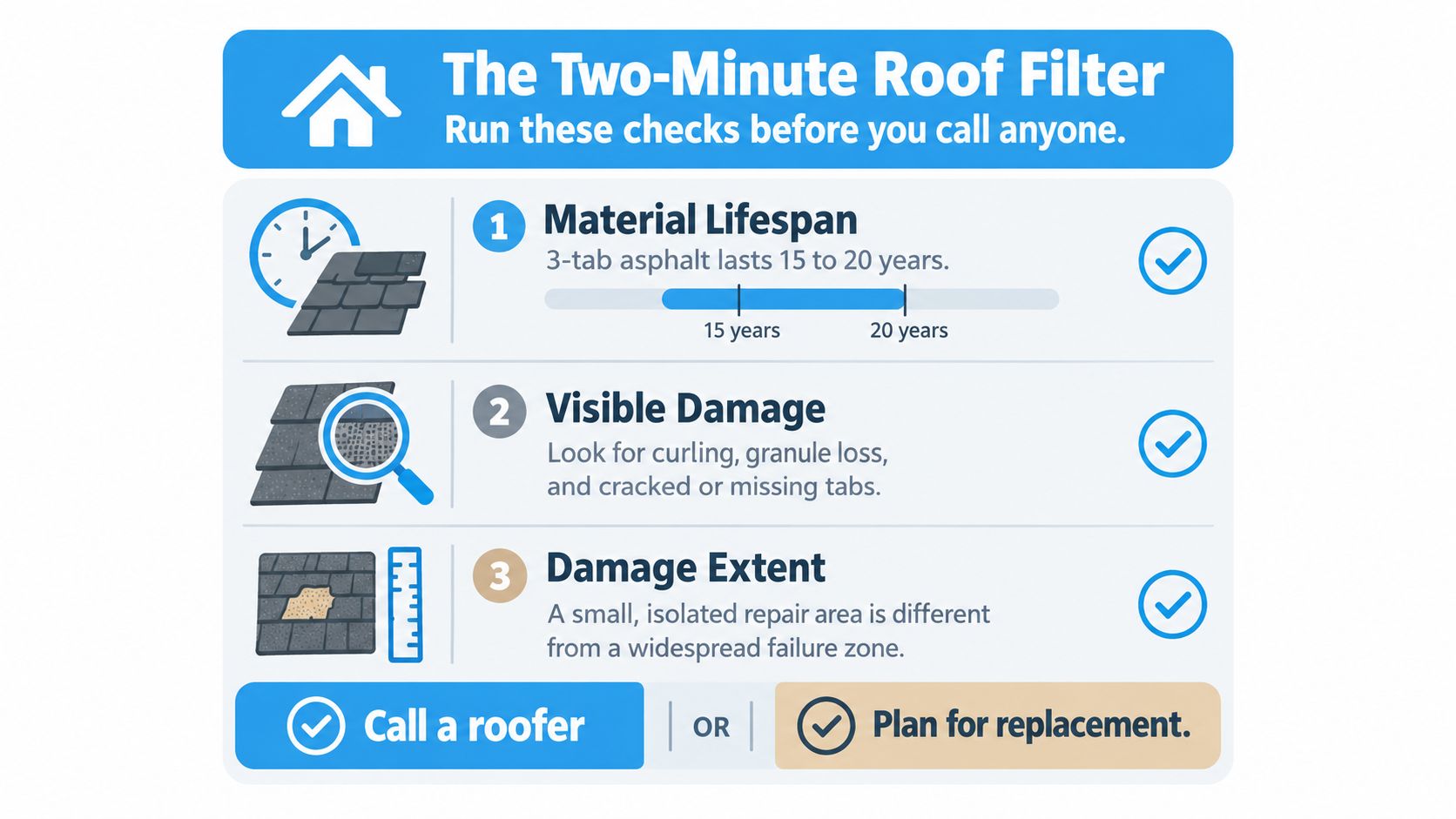
Start with the three facts that matter most. How old the roof is, what it is made of, and how far the damage has spread. Get those three right, and you can usually avoid wasting money on a repair that only buys a little time.
Start with age and material
Age changes the decision fast. A repair on a 9-year-old roof can be smart. The same repair on a 22-year-old asphalt roof is often money thrown at a system that is already near the end.
Asphalt shingles usually give you the shortest decision window. Metal gives you more room to repair if the panels and fastener system are still sound. Slate and other long-life materials play by different rules, because one broken area does not automatically mean the whole roof is worn out.
Use these thresholds:
- Asphalt roof under 15 years old: repair first, if the damage is isolated
- Asphalt roof 15 to 20 years old: examine closely, because repeated repairs start losing value here
- Asphalt roof past 20 years old: replacement should be the default conversation
- Metal roof with one leak source or one damaged section: repair is often the better buy
- Slate or tile with localized damage: bring in a contractor who works on those systems before anybody pushes full replacement
The reason is simple. You are not buying shingles. You are buying remaining service life per dollar spent. If a repair costs real money but leaves you with only a few years before the next major bill, the cheap option is not the cheap option.
Check how much of the roof is affected
Damage extent is the next filter. One trouble spot is a repair discussion. Several sections with missing shingles, lifted tabs, failing flashing, and visible wear across multiple slopes is a replacement discussion.
A practical field rule is the 30% threshold. If the repair bill is pushing roughly a third of what a full replacement would cost, replacement usually makes more sense, because the repair does not reset the roof age or start a new full-system warranty, as explained in CertainTeed's homeowner guidance on deciding between roof repair and replacement.
Here is the plain reading:
- One slope, one leak path, one storm-hit area: repair
- Multiple slopes with wear or storm damage: lean hard toward replacement
- Patchwork in several places from prior repairs: replacement is usually overdue
Look below the shingle line
Surface damage is only part of the call. Once water gets below the top layer, the math changes.
Check for soft decking, attic staining, rusted nail tips, wet or musty insulation, and visible sagging. Those are not cosmetic problems. They tell you the roof system has already been taking water past the shingles.
My rule is direct. If two of the three filters point the same way, follow them. An older asphalt roof plus widespread damage means replace it. A younger roof plus one damaged section means repair it. A roof with late age, broad wear, and signs of moisture below the shingles should not get another round of hopeful patching.
If the roof is old, the damage is spread out, and water has reached the layers underneath, replacement is usually the cheaper decision over the years, even if the repair estimate looks easier today.
Repair vs Replacement at a Glance
Most homeowners don't need a lecture first. They need a side-by-side look at what they're buying.
Repair vs Replacement Side-by-Side Comparison
| Factor | Repair | Replacement |
|---|---|---|
| Upfront cost | Lower upfront bill. Best for isolated problems. | Much higher upfront bill. Best when the whole system is wearing out. |
| Remaining service life | Adds some time to the existing roof, but does not reset the clock. | Resets the roof's service life from day one. |
| Best use case | Localized damage, younger roof, one leak source, one storm-hit area. | Widespread wear, repeated leaks, late-life roof, multiple damaged sections. |
| Disruption | Less noise, less mess, shorter job. | More noise, debris control, material delivery, tear-off, cleanup. |
| Warranty position | Usually limited to the repair work itself. Existing roof age still matters. | New material and workmanship coverage start over with the new system. |
| Appearance | Patch may not match older shingles well. | Uniform look across the whole roof. |
| Insurance interaction | Can work for minor covered damage, but may not satisfy a larger scope issue. | Often the required route when the carrier approves full replacement. |
| Long-term value | Good when the roof still has useful life left. Poor when used to prolong a failing roof. | Better when the old roof is already near the end and more repairs are likely. |
My direct recommendation
Choose repair if all three are true:
- the roof is still in the earlier part of its life,
- the damage is limited,
- and there's no sign the problem has moved into the decking or structure.
Choose replacement if any of these are true:
- the roof is old enough that the next major problem is probably close,
- damage is spread out,
- or you've already repaired it before and you're back at the same kitchen table again.
The biggest mistake I see is treating a whole-roof problem like a one-spot problem because the leak only showed up in one room. Water doesn't leak politely. It travels.
Cost Ranges and Cost Per Remaining Year
Homeowners fixate on the first invoice. I get it. Roofing isn't cheap. But the better way to judge roof replacement vs repair is to divide the cost by the years you expect to get out of that choice.
That gives you a cleaner number: cost per remaining year.
What national averages tell us
Verisk reported that average U.S. residential roof replacement cost reached $17,631 in 2025, while average repair cost reached $4,699 in the same year. Replacement was about 3.8 times the average repair cost, according to Verisk's roofing cost report.
That tells you two things right away. First, repair is still much cheaper upfront in many cases. Second, once repairs start stacking up, the gap closes faster than most homeowners expect.
Another practical framing from this cost analysis of repair versus replacement is that the decision shouldn't stop at the first invoice. It should include cost per remaining year of service life, especially when the roof already has repeated leaks or multiple damaged zones.
Cost-per-remaining-year scenarios for East Texas homes
| Scenario | Upfront Cost | Remaining Life | Cost/Remaining Year |
|---|---|---|---|
| Younger roof, isolated repair | Lower than replacement | Moderate to strong | Often reasonable if the roof is otherwise healthy |
| Mid-life roof with repeated trouble | Starts lower, then keeps recurring | Uncertain | Often worse than it looks once future repairs are included |
| Late-life roof needing significant work | Can still seem cheaper today | Short | Usually poor value because replacement is still coming |
| Full replacement on a worn-out roof | Highest upfront cost | Full new service life | Often the better long-term value |
I'm keeping those scenario rows qualitative for one reason. Your actual East Texas numbers depend on roof size, pitch, material, decking condition, and whether storm damage affects the insurance path. If you want a local pricing baseline, this breakdown of average roof replacement cost in East Texas is the kind of page I'd use before getting bids.
The decision math I trust
Here's the contractor version without the fluff:
- Estimate the years left if you repair.
- Estimate the years left if you replace.
- Divide cost by years.
- Be honest about whether another repair is likely.
A repair can absolutely be the better financial move. If a younger roof gets a localized leak around one penetration, paying a smaller amount to preserve several more years makes good sense.
But if you're putting meaningful money into a roof that is already in the back half of its life, your cost per remaining year usually gets ugly fast. You're not buying years at that point. You're renting months.
A cheap repair on a worn-out roof is often the most expensive roofing dollar you can spend.
How Storms, Insurers, and East Texas Weather Shift the Math
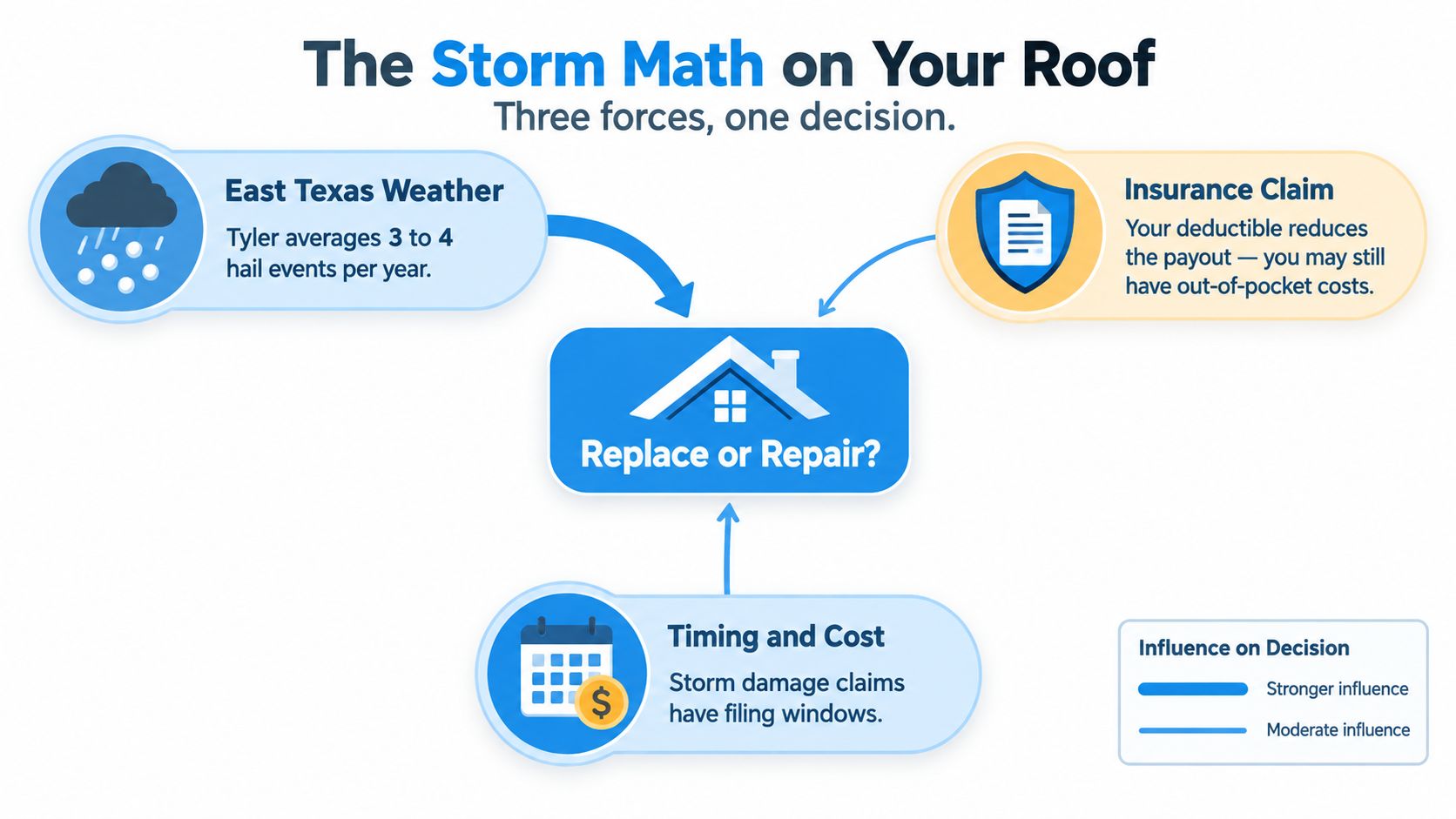
A roof can look salvageable and still be a replacement candidate once weather exposure and insurance pressure enter the picture. That's where a lot of online advice falls flat. It treats age, storm damage, and insurance as separate issues when they're tied together.
This visual lays out the decision pressure points.
Storm years don't have to be historic to be expensive
A lot of homeowners assume a quieter storm season means roofing decisions should get cheaper. That's not what the industry data shows.
U.S. roof repair and replacement cost value reached nearly $31 billion in 2024, and Verisk reported that was up about 30% since 2022. Even with softer storm activity, replacement costs still rose, which points to aging roofs, higher severity, and persistent cost pressure, as discussed in this insurance industry report on worsening roof losses.
That matters in East Texas because hail and wind don't have to destroy the whole roof in one afternoon to change the math. Repeated moderate hits on an older roof can make patching less rational than homeowners expect.
The three-trigger rule I'd use
I'd lean hard toward replacement when at least two of these are true:
- Recent storm damage: not just one missing shingle, but bruising, creasing, or repeated weather hits
- Insurance pressure: inspection requests, settlement disputes, or age-related concern from the carrier
- Roof age: the roof is already well along in its expected life
When those factors overlap, the practical question shifts from “Can this be patched?” to “Why put money into an aging roof right before the next weather event tests it again?”
For a quick explanation of how adjusters and contractors often look at storm-related scope, this short video is useful:
One more blunt point. If your roof is older and you've had recent hail or wind, get it inspected before you authorize non-emergency work. Temporary protection is one thing. A full repair before the claim picture is clear can muddy the conversation you need to have with your carrier.
When Repair Quietly Becomes the Expensive Choice
You spend $1,800 on a repair this spring. A leak shows up in a different slope by fall. Then wind lifts another section in the next storm. That is how a “cheaper” roof turns into the expensive one.
The question is simple. Are you buying useful years, or are you buying a few more months on a roof that is already near the end?
The 30% line is a real cutoff for older roofs
Use this rule: if a proposed repair is getting close to 30% of the cost of a full replacement, stop and price the replacement seriously. Many contractors and insurers use that range as a practical cutoff because a large repair does not restart the roof's service life. It only patches part of an aging system.
That 30% threshold matters even more for owners of roofs past mid-life. A big repair on a 16-year-old three-tab roof is not the same decision as the same repair on a 6-year-old architectural shingle roof. One likely has years to give. The other is usually asking for one more round of spending before the next problem.
Watch for these signs
Repair starts losing the argument when you see patterns like these:
- You are fixing leaks in more than one area. That points to system wear, not one isolated weak spot.
- Shingles are brittle, curling, or hard to match. Even a clean patch can leave surrounding areas ready to fail next.
- Flashing, vents, valleys, and field shingles are all showing age at once. Once multiple components are tired, spot work gets less efficient.
- You have already paid for two meaningful repairs on the same roof. By the third round, many homeowners are stacking invoices instead of solving the problem.
- You are repairing a roof you would not trust through the next hail season. If you already doubt it, act on that.
One short repair paragraph in a proposal is not enough. If you do choose repair, make the contractor spell out what is covered, for how long, and what is excluded. Review the terms the same way you would review a full replacement contract. This breakdown of roofing workmanship warranty expectations is a good standard to compare against.
My straight answer
If the roof is older, the repair bill is substantial, and this is not the first failure, replace it.
I would rather see a homeowner put one larger check into a full reroof with clear remaining life than keep feeding an aging roof in pieces while risking sheetrock, insulation, paint, and flooring every time the weather turns. That is the part people miss. The repair invoice is only one cost. Interior damage and repeat service calls are the other costs.
The first repair can be smart maintenance. After that, the math gets harsher fast.
Your Next Steps and Vetting a Local Contractor
A bad roofing decision usually happens in a hurry. The leak starts, a truck pulls up, somebody promises a quick fix, and you end up buying the wrong job for the roof you have. Slow the process down for one day, get the facts, then make the call.
Start with your own file before you talk to anybody. Take ground photos of every slope you can see, then check the attic for stains, damp insulation, moldy decking, or daylight coming through. Save storm dates, ceiling photos, and any debris photos. That paper trail matters if insurance gets involved, and it helps you compare contractor opinions against something real.
Then get two written estimates. Not verbal opinions. Written scopes.
Each estimate should answer three things clearly: what failed, what work is included, and how many useful years the contractor expects you to get after the job. If one contractor recommends a repair and the other recommends full replacement, make them explain the remaining service life in plain English. A $2,500 repair that buys two years is expensive. A $12,000 replacement that buys twenty years is often the cheaper decision.
Before you sign anything, read the contract like you expect trouble later. You want the shingle or roofing material listed by name, underlayment spelled out, flashing work defined, ventilation noted, cleanup and disposal included, payment schedule written down, and workmanship coverage in writing. If you want a practical checklist for estimate meetings, keep these questions to ask contractors before hiring on your phone.
Ask these direct questions at the table:
- Who will install the roof? Company crew, one subcontracted crew, or whoever is available that week?
- Are you replacing damaged flashing and pipe boots, or working around old metal?
- What happens if bad decking shows up after tear-off? Get unit pricing in writing.
- Are you proposing repair because the roof is repairable, or because replacement approval is harder with the insurer?
- How long do you expect this repair to last on this specific roof?
- Can I see recent local jobs that are at least a year old, not just one finished last Friday?
That last question matters more than homeowners realize. A roof can look good the day the crew leaves. The test is how it holds up after a Texas summer, hard rain, and the next round of wind.
I would walk away fast from these red flags:
- Storm chasing and same-day pressure to sign
- Large upfront payment demands
- Promises to “take care of insurance” without a written scope
- No proof of liability insurance
- No local references
- A one-page bid that leaves out flashing, decking, or warranty details
One practical option in East Texas is hiring a contractor that can handle the roofing scope and any related exterior repairs under one process. Home Pro's Remodeling & Repairs is a Tyler-based licensed and insured contractor that works on roofing and broader exterior projects. That matters when a roof issue is tied to fascia, soffit, siding, or interior leak damage, but the bigger point is simple. Compare scopes line by line, compare warranty terms line by line, and do not reward vagueness.
My advice is plain. If a contractor cannot explain the remaining life you are buying for the money, keep looking. Repair a roof that still has real years left. Replace a roof that is old, broadly worn, or one storm away from putting you back in the same spot.