
The average roof replacement cost in 2026 clusters around $9,500 to $10,000 for a standard asphalt-shingle roof, but it can range from $5,870 to over $46,000 depending on materials, size, and complexity. If you're using one national number to budget a real roof job, you're already off track.
Most homeowners get burned by the word average because it hides the roof they own. A simple ranch with one clean ridge, a steep two-story with valleys and dormers, and a premium metal reroof are not the same project, and they should never be priced like they are.
Table of Contents
- Why the Average Roof Replacement Cost Misleads Homeowners
- Roofing Material Costs Compared by Type
- How Roof Size and Pitch Change Your Final Price
- Hidden Line Items on a Roofing Estimate
- Regional Factors That Shift Roofing Prices
- Warranties and Financing Options Worth Considering
- When to Repair Instead of Replacing Your Roof
Why the Average Roof Replacement Cost Misleads Homeowners

A national average sounds helpful until you try to use it on a real roof. One benchmark puts the 2026 average at $9,530 with a range from $5,870 to $46,000, while another major benchmark puts the average at $25,840 with a range from $9,858 to $41,822. Both figures can be true at the same time, and both are still too broad to tell you what your roof will cost without knowing the roof type, pitch, and damage scope.
Insurance pricing and consumer pricing are not the same thing
Storm-driven replacement data pulls averages upward fast. Verisk reported an average insurance-related residential roof replacement cost of $17,631 in 2025, along with $23 billion in roof replacement cost value, and it also placed average roof repair cost at $4,699 (Verisk roofing realities report). That gap matters because insurance-related replacements usually involve broader scope, more labor, and more full-system work than a straight retail bid for a homeowner paying out of pocket.
The problem is not that the averages are made up. The problem is that they mash together storm losses, premium materials, complicated roofs, and basic asphalt jobs into one number that does not help you price your own project.
Practical rule: if your roof is a basic asphalt job, the national average may run high. If it is steep, damaged, or premium, the same average may run low by a lot.
For homeowners reading Home Pro's Home Renovation Guide, the right move is to stop asking, “What's the average?” and start asking, “What category does my roof fall into?” That one question keeps you from comparing a simple roof swap to a high-complexity replacement.
Roofing Material Costs Compared by Type
Material choice is the biggest lever you control. Roof size matters, sure, but the material decides whether you are paying for a short-cycle replacement or a long-haul system that may outlast several cheaper roofs. The average cost only helps a little here, because the bill changes fast once you move from basic asphalt to heavier or specialty materials.
What you're really paying for
HomeAdvisor's pricing puts the national average roof replacement cost at $9,602, with a normal range of $5,900 to $13,367 and a common installed rate of about $4 to $11 per square foot (HomeAdvisor roof replacement cost data). RoofingCalculator also says a typical asphalt-shingle replacement often lands around $8,000 to $16,000 for standard homes, which matches the spread most homeowners see (RoofingCalculator average roof replacement cost).
| Roofing Material Cost Comparison | Cost Per Sq Ft | Total Project Range | Expected Lifespan |
|---|---|---|---|
| Asphalt shingles | About $4 to $11 | About $8,000 to $16,000 for a standard home | About 15 to 20 years |
| Architectural shingles | About $4 to $11 | About $8,000 to $16,000 for a standard home | About 20 to 30 years |
| Metal roofing | Higher than asphalt | Higher than asphalt, often much higher on complex roofs | Long service life |
| Tile | Higher than metal in many jobs | Premium pricing on most homes | Long service life |
| Slate | Premium pricing | Premium pricing | Very long service life |
| Wood shakes | Premium to specialty pricing | Depends heavily on labor and detailing | Variable, often weather-sensitive |
How I'd read those numbers in East Texas
Architectural shingles are the default for a reason. They hold the line on upfront cost, they are familiar to most crews, and they give you a better service life than basic asphalt without jumping straight into specialty pricing. If you want the most practical middle ground, this is usually it.
Metal starts to make sense when longevity matters more than first-cost pain. It costs more up front, and that stings, but it can pay off on homes where you want to stay put and avoid another tear-off sooner than later.
Tile and slate are specialty products, not everyday replacements. They demand more labor, more structural attention, and more careful installation detail, which is why they belong in the premium bucket instead of the average one. Wood shakes sit in their own lane too, with labor and maintenance that can swing the project quite a bit depending on the roof and the look you want.
Bottom line: cheap material is only cheap once. If a roof will not match your time horizon in the home, you are just buying the next replacement sooner.
The rough rule I give homeowners is simple. Buy asphalt when budget is the priority, buy better asphalt when you want a more durable everyday roof, and move into metal, tile, or slate only when you are prepared for a specialty job and a higher total.
How Roof Size and Pitch Change Your Final Price
Two homes can look similar from the street and still produce very different estimates. Roofing is measured in squares, meaning 100 square feet of roof surface, and the roof surface is what matters, not just the home's floor plan.
Square footage is only the starting point
A standard roof replacement estimate usually assumes a fairly normal roof shape. A calculator built only on floor area will miss the actual bill by a wide margin because it does not account for roof pitch, waste, or the crew time needed to work safely and cleanly on the roof.
Pitch and complexity are the primary price drivers
A steep roof takes more time, more safety setup, and more hand labor. Valleys, dormers, chimneys, skylights, hips, and multiple roof planes all slow the crew down and force extra flashing and cuts, which means more material waste and more labor hours.
Here's the simplest way to judge your own roof:
- Simple roof: one main plane, few or no penetrations, easy access.
- Moderate roof: some valleys, one or two penetrations, ordinary pitch.
- Complex roof: steep pitch, multiple stories, several dormers, skylights, or a busy roofline.
A roof quote is not just a shingle quote. It's a labor quote, a safety quote, and a complexity quote.
The mistake homeowners make is comparing two bids that appear different only because one contractor priced the roof fairly and the other used a flat number. If your house has a complicated roofline, the lower calculator estimate is often the one that lies to you.
This video demonstrates how roof shape changes labor requirements, not just material costs.
Hidden Line Items on a Roofing Estimate
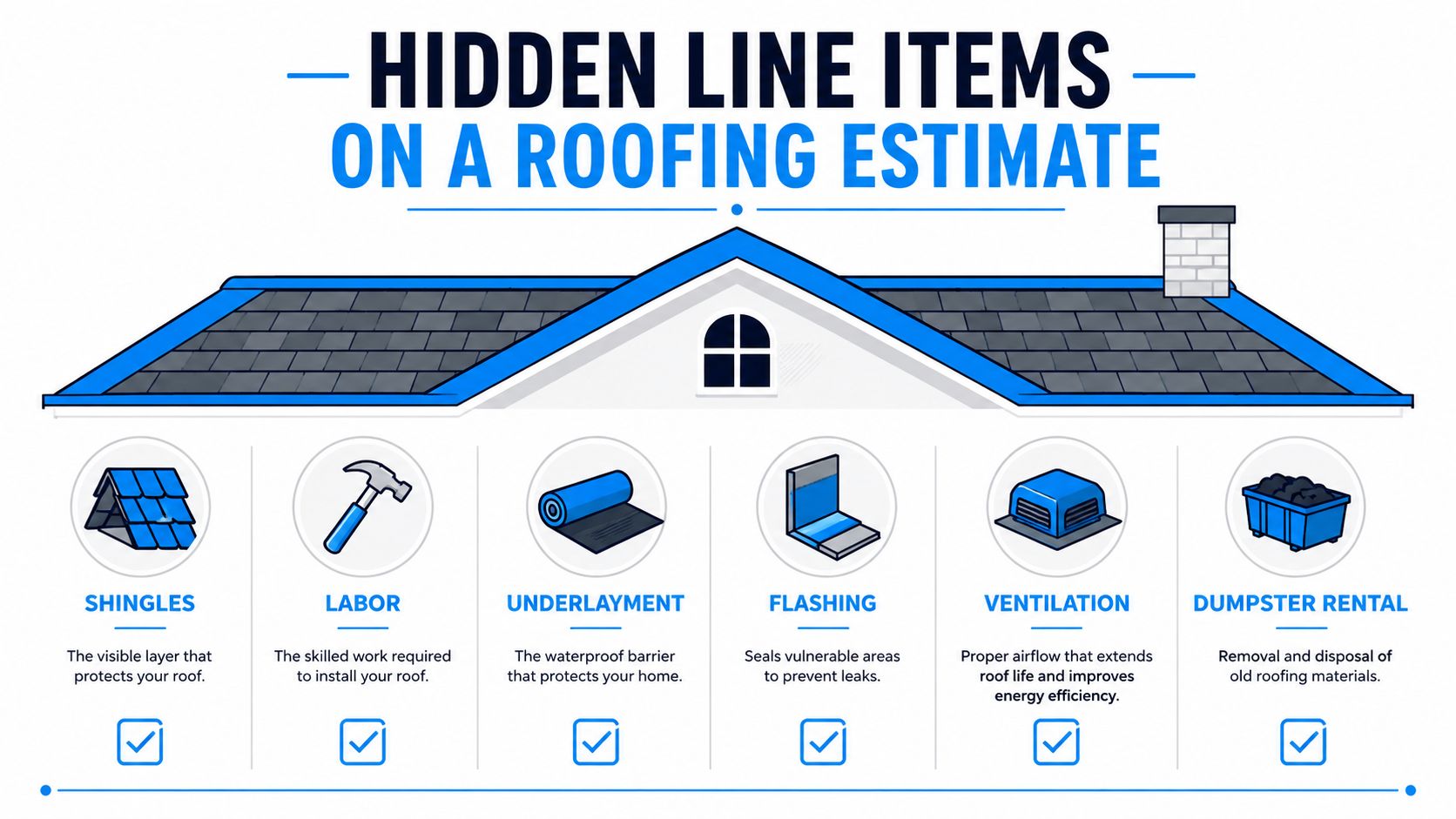
A serious roofing estimate should read like a scope of work, not a single mystery number. If the bid only says “roof replacement,” I'd be skeptical.
The pieces that usually get buried in the total
A complete estimate often includes tear-off, disposal, underlayment, flashing, ventilation work, drip edge, and permits. Those items aren't optional fluff. They're part of doing the job right and making the roof last.
- Tear-off and disposal: old shingles have to come off and get hauled away.
- Underlayment: the layer below the visible roofing material adds protection.
- Flashing: chimneys, valleys, and wall transitions need proper metal detail.
- Ventilation: airflow matters for heat and moisture control.
- Drip edge: helps direct water off the roof edge instead of into the fascia.
- Permits: local rules may require them, and that cost belongs in the bid.
What you can and can't defer
Some line items are essential if you want the roof to perform. Flashing and underlayment fall into that category on most jobs. Other items can sometimes be discussed, but I wouldn't cut corners just to make a bid look leaner if the roof needs those parts for code compliance or durability.
If your roofer finds damaged decking under the old shingles, expect the bill to move. That's not a surprise charge, it's the cost of uncovering the condition of the roof system underneath the surface.
For homeowners comparing quotes, one smart move is to ask every contractor to break out the same categories. If one bid includes disposal, ventilation, and flashing replacement while another leaves them vague, the cheap bid is not cheaper.
Regional Factors That Shift Roofing Prices
East Texas doesn't price roofs the same way as a quiet market with mild weather and steady labor supply. Tyler-area homeowners deal with heat, humidity, storm exposure, and a local labor market that can tighten up fast after severe weather.
Why your zip code matters
Insurance-driven work can lift local pricing because crews, materials, and disposal capacity all get stretched when storm claims surge. Building codes and permit rules also affect the final number, because a roof replacement has to match local requirements, not just the homeowner's budget.
That's why a Texas homeowner comparing national averages to a local quote often gets sticker shock. The national number may look fine on paper, but it doesn't reflect regional labor availability, storm season demand, or the extra coordination that comes with damaged homes.
For homeowners planning a broader exterior project, the same regional logic shows up in Home Pro's deck building cost estimate, where site access, materials, and local labor all shape the final price.
What I'd expect in a real East Texas quote
A strong local bid should reflect real field conditions, not fantasy pricing. It should account for ladder access, cleanup, haul-off, weather interruptions, and any roof issues discovered once the old material comes off.
If a quote feels too clean, it probably skipped something that will show up later.
Homeowners should expect pricing to move when a roof is old, storm-hit, or full of complicated features. That doesn't mean you're being overcharged, it usually means the job has real-world friction that a generic national calculator can't see.
Warranties and Financing Options Worth Considering
The cheapest bid is often the most expensive roof you'll ever buy. That's not a slogan, it's how failed workmanship turns into repeat labor, leak repairs, and frustration.
Warranty coverage changes the value of the job
Manufacturer warranties cover the material side of the roof. Contractor workmanship warranties cover installation. Those are different protections, and you want both if possible, because a strong shingle with sloppy flashing still leaks.
Premium systems sometimes bring stronger warranty packages, and that can justify higher upfront pricing if you plan to keep the home for years. The point isn't to overbuy. The point is to avoid paying twice for the same roof because the first job was done poorly.
Financing should protect the scope, not shrink it
Homeowners usually have three paths. They can pay cash, use contractor financing, or use a home-equity product if that fits their situation. Insurance claims can also shape the payment path when the roof damage is covered, but the claim process does not remove the need to compare scope carefully.
Home Pro's Remodeling & Repairs offers roof replacement work, so it belongs on the short list of contractors homeowners may compare when they want one local company to handle the estimate, installation, and project coordination. That matters most when you're deciding whether a roof job is a quick fix or a full system replacement.
If you want a roof that lasts, budget for the warranty and the financing plan together. A low monthly payment on a poor installation is still a poor deal.
When to Repair Instead of Replacing Your Roof
Repairs make sense when the damage is isolated and the roof still has life left in it. Replacements make sense when the roof has widespread wear, repeated leaks, or damage that reaches beyond one area.
Use the damage pattern, not emotion, to decide
Verisk's 2025 data shows average roof repairs at $4,699, while average replacements reached $17,631 (Verisk roof replacement report). That gap is exactly why patching looks attractive at first. The problem is that small repairs stop making sense when the roof keeps failing in different places.
A repair is usually the better call when:
- Damage is localized: one small leak or a limited patch area.
- Roof age isn't extreme: the system still has useful service life.
- Decking is sound: no broad rot or moisture damage underneath.
- The leak source is obvious: flashing or a small section needs attention.
A replacement is the smarter call when:
- Leaks keep moving: one fix buys you a short break, not a solution.
- Shingles are failing across the roof: the system is aging out.
- Storm damage is widespread: the whole roof system is compromised.
- The repair bill keeps creeping upward: you're feeding a roof that's already done.
For homeowners weighing the next step, Home Pro's roofing services are relevant because the same contractor can look at repair and replacement options without forcing one answer before the roof has been inspected.
The right rule is simple. Patch a roof that still has life. Replace a roof that's already telling you it's done.
If you want a straight answer on your own roof, get a local inspection and a line-item estimate instead of relying on a calculator. Home Pro's Remodeling & Repairs can walk you through roof replacement, roof repair, and the scope differences that change the final price, so you can budget the job accurately before the first shingle comes off.