
Most asphalt roofs should be planned for replacement about every 15 to 25 years, with architectural shingles nearer 20 to 30 years, and East Texas heat and hail can shorten those bands. Your roof's actual year isn't set by the wrapper, it's set by its condition after sun, humidity, wind, and storms.
That's where the most popular advice fails you. A seller says you've got a 30-year roof, so you file the paperwork and stop looking up. Then a Tyler summer cooks the attic, a spring hailstorm bruises the shingles, and a seal that looked fine from the driveway lets go in the next high wind. The opposite mistake is just as common. A roof hits an age someone mentioned online and gets torn off even though the shingles still flex, the seals still hold, and the attic is dry.
Think about roof replacement how often as a planning range, not an appointment. The calendar tells you when to look harder. What you find when you look tells you whether to repair, watch, or replace.
Table of Contents
- How Often Each Roof Material Needs Replacement
- Why the Label Misleads and Storms Set the Clock
- Signs That Mean Replace Rather Than Repair
- How to Inspect and Maintain Between Replacements
- Replacement Cost and When Waiting Costs More
- Decide Whether to Replace This Year
How Often Each Roof Material Needs Replacement
Most asphalt roofs are planned for replacement in the 15 to 25 year range, with architectural shingles nearer 20 to 30 years.
Start with the material, because that's your widest planning band. The U.S. Forest Service roofing-material overview lists organic three-tab asphalt shingles at approximately 10 to 15 years, fiberglass three-tab shingles at 15 to 25 years, and architectural asphalt shingles at 20 to 30 years. A conventional asphalt roof is usually a once-in-two-decades project. A well-installed architectural roof in good condition can remain serviceable for about two to three decades.
Those are ranges, not guarantees. In East Texas, heat, ultraviolet exposure, humidity, severe thunderstorms, wind, and hail often pull asphalt toward the short end. Poor attic ventilation and installation defects do the same. A roof with correct fastening, sound ventilation, effective drainage, and regular maintenance can outlast its nominal rating, while a neglected roof can fail well inside it.
Typical Roof Replacement Timing by Material
The Forest Service figures above cover the three asphalt rows. The metal, tile, wood, and low-slope figures below are planning estimates and aren't drawn from that overview.
| Material | Typical lifespan | East Texas adjustment | Condition that overrides age |
|---|---|---|---|
| Organic three-tab asphalt | 10 to 15 years | Heat and UV often push life to the low end | Curling, cracking, or widespread granule loss |
| Fiberglass three-tab asphalt | 15 to 25 years | Storms matter more here than cold-climate aging | Failed seals or exposed underlayment |
| Architectural asphalt | 20 to 30 years | Hail can end service before the rating | Brittle shingles or recurring leaks |
| Standing-seam metal | 40 to 70 years | Humidity ages coatings and flashings | Open seams, corrosion, or deck leaks |
| Exposed-fastener metal | 25 to 40 years | Screws and washers are the weak point | Loose fasteners or rust at penetrations |
| Clay or concrete tile | 50+ years; underlayment often 20 to 30 | Tile can outlast the layers beneath it | Broken tile plus soft decking or active leaks |
| Wood shake or shingle | 20 to 30 years | Humidity and shade speed rot and moss | Splitting, soft spots, or decay |
| Modified bitumen or TPO | 15 to 30 years | Ponding and UV punish low slopes | Blisters, open seams, or soft insulation |
How to Read the Table Without Misusing It
Standing-seam metal lasts longest on paper because there are no exposed screws backing out. Exposed-fastener metal usually needs attention sooner, since the screws and rubber washers age before the panels do. Tile confuses people the most. The visible tile may be sound at year 35 while the underlayment underneath, the layer that stops water, has dried out and cracked.
Wood suffers in damp shade, where it can't dry between rains. Low-slope materials such as modified bitumen and TPO don't forgive standing water, and ponding after an East Texas downpour shortens their life fast. If you're evaluating a low-slope section over a porch or addition, practical roofing advice for DFW contractors from Blue Lake Roofing Supply is a useful primer on how roll systems are put together before you talk bids.
First step: Write down your material and install year. If you don't know either, that unknown is your first finding, and it argues for an inspection rather than a guess.
Once you know where your roof sits in its band, stop asking only how old it is. Ask what shape it's in.
Why the Label Misleads and Storms Set the Clock
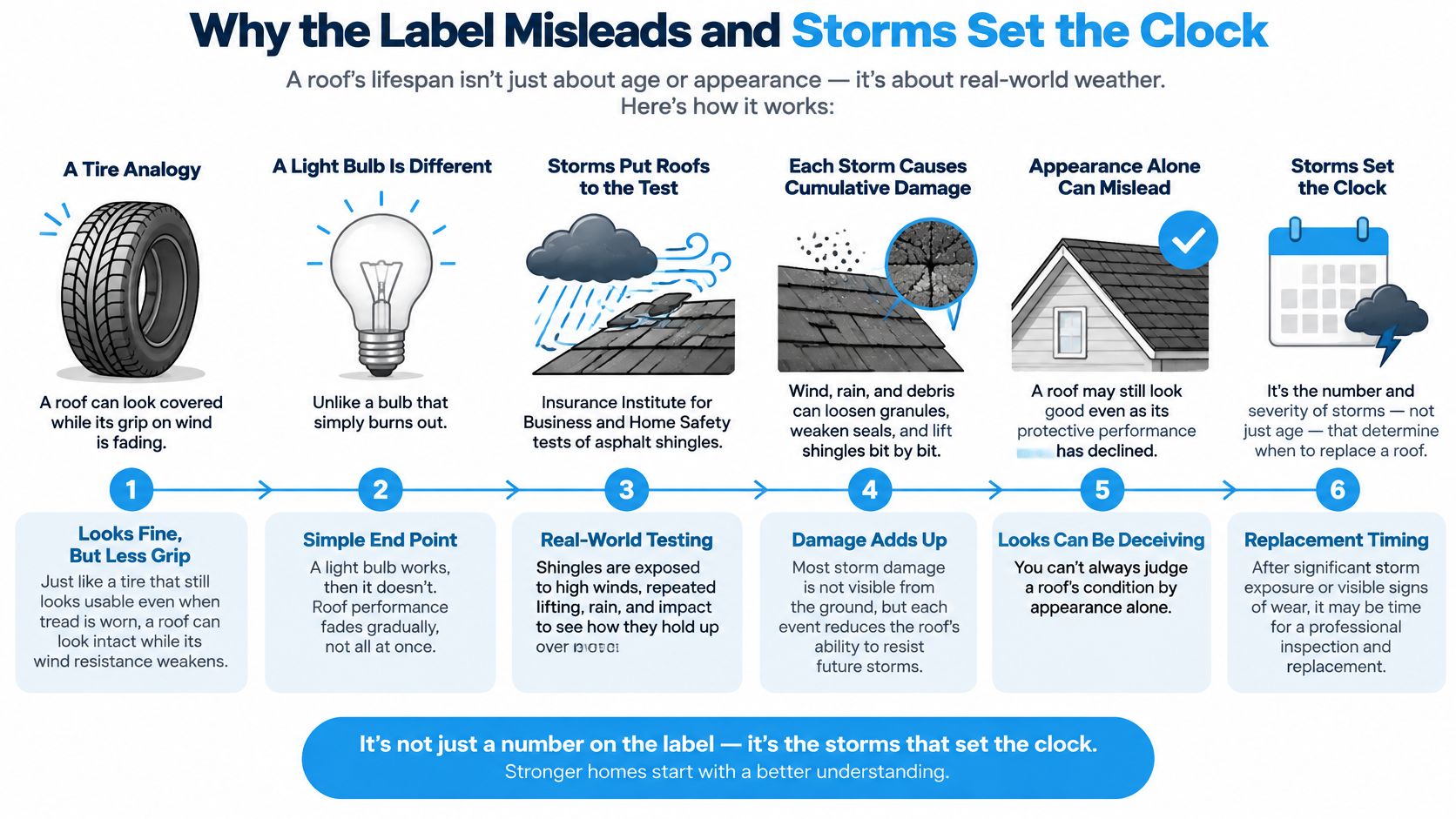
A roof doesn't fail like a light bulb, working perfectly one day and dark the next. It's more like a tire. The tire still holds air and looks round long after the tread has thinned and the rubber has hardened. You don't notice the lost grip until you brake hard on wet pavement. A shingle roof works the same way. It can look covered from the street while its grip against wind uplift is fading, and you don't find out until a storm tests it.
The timeline below lays out how that fading grip, not appearance, sets your real clock.
What Aging Tests Actually Found
The Insurance Institute for Business & Home Safety summary of its 10-year aging research describes asphalt shingles naturally weathered for 5 and 10 years at test sites in South Carolina, Wisconsin, and Ohio. Many products initially improved in wind resistance during their first several years, but most began declining between years 5 and 10, and the speed and severity of decline varied substantially by product.
Read that carefully, because it's easy to overreact. That finding isn't an order to replace every asphalt roof at year 10. It's evidence that measurable weakening often starts during the first decade, even while the roof still sheds rain and looks presentable. One product may hold its seal for years longer than another on the same street, depending on the shingle itself, slope, fastening, ventilation, sun exposure, and prior storm damage.
The label on the bundle doesn't sort this out for you. An Insurance Institute for Business & Home Safety report on real-world shingle performance found that warranties ranging from 20 to 45 years often don't accurately predict field service life, and aging alone can reduce the effective life of some products to roughly 10 to 15 years. A warranty is a manufacturer's promise about defects and prorated remedies. It isn't a promise that your roof, on your house, under East Texas sun, will perform for that many years.
A 30-year shingle is a product category, not a 30-year appointment you can safely ignore until year 29.
Why Storms, Not Birthdays, Should Trigger Inspections
Calendar-only guidance also ignores how often severe weather now interrupts the schedule. A congressional letter summarizing NOAA billion-dollar disaster data states that the United States averaged 23 billion-dollar disasters annually from 2020 through 2024, that 2024 recorded 27 such events causing an estimated $182.7 billion in damage, and that through June 2025, 14 billion-dollar disasters had already produced $101.4 billion in losses.
Those national totals don't mean every Tyler roof needs replacing sooner. They explain why a fixed interval is incomplete. A roof can pass its expected service age and still be sound, while one hailstorm can fracture shingle mats and break seals across a slope overnight, cutting years off a roof that was fine the week before. National numbers are context. Your roof's condition after your storm is evidence.
So replace the single date with a storm-triggered cadence:
- At installation: Record the date, product, and contractor, and photograph every slope from the ground.
- Around year 10: Book a professional assessment even without a leak, because that's when hidden wind-performance loss becomes plausible.
- After hail or unusually high wind: Inspect promptly, especially if neighbors are finding damage or debris hit your roof.
- After a tornado warning with nearby damage or a tropical-storm remnant: Check edges, valleys, and penetrations, where wind gets its first grip.
Prioritize roofs with older shingles, prior repairs, vulnerable rake edges, complex penetrations such as chimneys and skylights, or visible interior staining. Keep dated photos and a simple storm log with the date, what hit, and what you saw. That folder helps with an insurance conversation and reassures a future buyer that you maintained the roof rather than guessing.
Age starts the conversation. Measured condition, checked after the weather that tests a roof, finishes it.
Signs That Mean Replace Rather Than Repair
Say a windstorm lifts three tabs on one corner of a nine-year-old roof. The rest of the field is flat, flexible, and sealed, and the attic is dry. That's a bruise, and a repair makes sense. Now picture a roof where shingles on both slopes snap instead of bending, granules wash out after every rain, and two ceiling stains came back after patching. That's not a bruise. That's a worn-out system, and another patch buys you very little.
The Pattern Matters More Than the Spot
Repairs work when damage is isolated and recent and the surrounding field is still healthy. A single failing pipe boot, one loose flashing, or a handful of cracked tiles falls in that category. You're fixing a detail, not propping up a covering.
Replacement becomes the stronger call when the same weakness shows up across slopes. Curling, cracking, and brittleness everywhere mean the shingles have lost flexibility as a material, not in one unlucky spot. Sealant strips that no longer bond mean the roof's wind resistance is gone as a system. Spot-sealing a few tabs won't restore it.
Interior clues carry equal weight. Stains in several attic bays, damp insulation, daylight through the boards, or a spongy feel underfoot on the roof tell you moisture has moved past the covering into the structure. A new layer over rotten decking won't hold nails and won't stop the decay underneath. Hail deserves special caution because it can fracture the shingle mat and expose reinforcement without leaving an obvious hole or an immediate drip.
Roof Symptoms and Whether to Repair or Replace
| What you see | What it usually means | Repair or replace |
|---|---|---|
| A few lifted shingles after one storm | Localized wind damage | Repair if the rest of the field is sealed |
| One leak at a pipe boot or flashing | A penetration failure | Repair that detail, then recheck after rain |
| A handful of cracked tiles | Impact or foot traffic | Replace tiles if the underlayment is dry |
| Granules filling the gutters every season | Surface aging across the roof | Plan replacement |
| Curling or cracking on many slopes | Shingles have lost flexibility | Replace |
| Failed sealant bonds and lifted tabs | Wind resistance is gone | Replace rather than spot-seal |
| Exposed underlayment or reinforcement | The covering has worn through | Replace promptly |
| Hail bruises with a fractured mat | Impact damage even without a leak | Document and assess for replacement |
| Stains in several attic bays | Moisture past the covering | Inspect the deck; often replace |
| Soft decking or daylight through boards | Structural wetting | Replace the roof and damaged deck |
If you're torn between the two columns, our guide to weighing a roof repair against a full replacement walks through the cost and age trade-offs in more detail. Use it after you've sorted your symptoms, not instead of looking.
Isolated and recent can usually be repaired. Widespread, brittle, or wet underneath should be priced as a replacement.
That single sort, applied carefully, prevents most bad roof decisions in both directions.
How to Inspect and Maintain Between Replacements
You don't need to climb your roof to maintain it well. Most of what matters is visible from the ground, the gutters, and the attic, and that's exactly where you should stay. The checklist below summarizes the routine before the steps explain it.

A Ground and Attic Routine in Order
- Record your baseline: Write down the install year, material, and any prior repairs so the next look has something to compare against.
- Walk the perimeter each spring: Use binoculars to scan ridges, valleys, and pipe boots, and repeat within a few days after hail or high wind. Don't climb a steep or wet slope.
- Check gutters and downspout exits: A fresh, heavy load of granules signals surface wear across the roof. A light trickle after a new install is normal, but recurring piles season after season aren't.
- Look in the attic after a soaking rain: New stains, damp insulation, a musty odor, or pinpoints of daylight mean water is getting past the covering.
- Confirm ventilation is open: Make sure soffit and ridge vents aren't blocked by insulation or paint. Trapped attic heat cooks asphalt from below during an East Texas summer and shortens its life.
- Keep the surface clear: Trim limbs off the roof and clear leaves that sit in valleys holding water against the shingles.
- Fix small details while the field is sound: A cracked pipe boot, loose flashing, or a few displaced shingles are cheap now and expensive after they leak. For small flashing and seam details a contractor flags, it's reasonable to shop butyl sealing tape from Contractor's Den so the right material is on hand, rather than smearing caulk over a moving joint.
- Book a professional inspection around year 10: Do the same after a major hail event, even if no ceiling drip has appeared, because mat fractures and broken seals hide from the ground.
This short video walkthrough shows what a careful look at shingles, flashing, and attic signs involves.
Know the limits of maintenance, too. Don't coat or caulk a field that's already brittle, since that spends money on a covering that has lost its wind seal. When your gutter check or attic look turns up something worrying, sort it using the replacement criteria you just read rather than hoping a dry week means the problem left.
Replacement Cost and When Waiting Costs More
Start with a national anchor, then adjust for your house. A GAF roof cost guide citing Verisk's 2025 U.S. Roof Report puts the average U.S. roof replacement at $17,631 in 2025. That figure spans every size and material in the country, so read it like a regional weather forecast: it tells you the season, not whether it rains on your street.
Local reroof prices have climbed recently, and they move faster than most homeowners expect. A neighbor's price from last spring, or your own quote from two years ago, makes a weak budget today. For a local estimate, our breakdown of average roof replacement costs and what drives them adjusts for size, pitch, layers, and deck repairs.
Storms explain why so many East Texas roofs come off years before their labels expire. Verisk's 2025 U.S. roofing realities report found that in 2025, 57% of U.S. homes in high-hail states had roofs that were 9 years old or newer. In hail country, weather resets the clock, and a roof's age often says more about the last big storm than about anyone's 25-year plan.
Three Households, Three Different Answers
- The eight-year architectural roof: A few hail bruises, seals intact, attic dry. Document the damage, repair what's broken, and watch it. Replacing now would waste most of the roof's service life.
- The 16-year three-tab roof: Curled shingles across both slopes and attic stains that returned after patching. This one is a replacement, even if a brochure once implied a longer run. Every additional season risks deck rot.
- The 28-year tile roof: Tiles look sound, yet the underlayment beneath has failed and leaks show at the valleys. The waterproof layer is what's gone, so the job is a full system replacement: new tiles alone can't reach it.
Waiting rule: Waiting is cheap only while the deck stays dry. Once decking, insulation, or interior finishes get wet, you're no longer buying just a covering.
That framing also settles the upgrade question. A metal or premium architectural roof costs more up front, and the premium pays off only if you plan to stay long enough to use the longer interval. If you're selling in three years, a sound architectural roof serves you better than paying for decades you won't live under.
Decide Whether to Replace This Year
You now have one rule that handles most cases. Replace this year when shingles are brittle across slopes, leaks keep returning after repairs, attic moisture is widespread, the deck feels soft, or a recent hail or wind event broke the mat or the seals. Keep and monitor when damage is limited to one flashing, one pipe boot, or a few displaced pieces and the surrounding field still flexes and bonds.
If your roof is past year 10, sits at the short end of its material band, or took a hard storm this season, don't judge it from the driveway. Book a professional look before the next storm season. Bring your install year, dated storm photos, and notes on any attic stains so the recommendation rests on condition rather than a generic 20-year rule.
Choosing who does that inspection matters as much as the inspection itself, so read our guidance on how to choose a roofing contractor before you invite bids. We work with asphalt shingles, metal roofing, and flat roof applications, and we service up to a 60 mile radius around Tyler for roofing needs. Our quote request form lists Same Day Quotes, Free Onsite Estimates, and Financing Available, so you can get a condition-based answer without paying for the visit.
If your roof is past year 10, showing stains, or took hail this season, Home Pro's Remodeling & Repairs will inspect it from the covering to the attic and tell you plainly whether to repair, monitor, or replace. We handle asphalt shingle, metal, and flat roof work from inspection through installation, with free onsite estimates and same-day quotes across the Tyler area. Start your request at Home Pro's Remodeling & Repairs and bring your install year and storm photos so we can give you a decision based on your roof's condition, not its label.