
A Tyler family is comparing a new home in a master-planned community with a 1970s ranch on acreage. The new build offers a clean slate and modern systems. The ranch has the established setting they want, but its roof, HVAC, and layout need a closer look. The harder question isn't which house costs less. It's which option gives them the location, space, timeline, and monthly ownership cost they can live with.
I advise buyers to compare three paths, not two: a move-in-ready resale, a resale with prioritized renovations, and new construction. An older home can be the strongest choice when its lot and structure support the changes you want. That renovation ceiling matters as much as the asking price.
Table of Contents
- Staring Down Two Very Different Front Doors
- What Each Path Costs in 2025
- A Decision Matrix You Can Actually Use
- What to Inspect on an Older East Texas Home
- When a Barndominium or New Build Wins
- How a Design-Build Workflow Changes the Math
- Choosing Your Path With a Clear Head
Staring Down Two Very Different Front Doors
The Tyler family's choice sounds straightforward until they list what matters. The new subdivision house could be designed around their routines, but the construction schedule and neighborhood feel may not suit them. The ranch has mature trees and room to spread out, yet the family needs to know whether it can be updated without turning the project into a rebuild.
That's why the familiar new construction vs existing home debate often misses the best option. A resale property can be more than a move-in-ready compromise. If the foundation, lot, layout, utilities, and local permitting support the desired work, a buyer may be able to improve an existing home in stages and keep the location they value. If those fundamentals don't work, attractive finishes won't fix the problem.
For a useful comparison, treat each option as a different plan:
- Move-in-ready resale: Choose this when location and a faster move matter most, and the inspection supports living with the home largely as it is.
- Resale plus prioritized renovations: Choose this when the property has a strong renovation ceiling and you can tackle the most important repairs or improvements in a planned order.
- New construction: Choose this when you need a particular layout or integrated systems, have flexibility around the build schedule, and can secure terms that work for your finances.
The same framework applies whether you're looking around Tyler or exploring communities elsewhere. For example, buyers researching what planned-community inventory can look like may find new builds for sale in Maple Ridge useful as a reference point. The value is in seeing how a community's available homes and setting compare with the established streets, acreage, or mature landscaping you're considering locally.
Before choosing a front door, ask what must be true for each path to work. Can the resale support the renovation you have in mind? Can your household handle the construction timeline? Do the financing terms change the monthly cost? Those answers, not the label “new” or “existing,” should drive the decision.
What Each Path Costs in 2025
Sticker price lies to you in both directions. A resale that needs a roof, an HVAC system, and drainage correction can cost more per month than a new build with a higher asking price and a bought-down rate. Judge each path on the first five years of ownership: financing terms, taxes, insurance, utilities, repairs, planned remodeling, and what buyers will pay when you sell.
In the fourth quarter of 2024, the median new single-family home sold for $419,200, only $9,100 above the median existing home, against a historical average gap near $50,000 (National Association of REALTORS® on builder affordability strategies). By the third quarter of 2025, average mortgage rates reported for new-construction buyers sat at 5.27%, compared with 6.26% for existing-home buyers, and average down payments were 15.7% and 17.8%, respectively, per the same NAR report on builder affordability strategies.
That spread explains why a builder's rate buydown or closing-cost credit can outweigh a lower list price on an older home. Incentives shift by contract, loan program, builder, and location. Before you sign anything, ask three questions. What is the undiscounted rate? When does each incentive expire? Is that upgrade something you wanted, or a line item dressed up to make the deal look better?

Count what the headline price leaves out
On a resale, add the repairs and improvements you expect within the first few years, plus the cost of living through the work if the house isn't livable on day one. On a new build, read the full contract, price the lot prep and finishes the base number excludes, and account for the months between signing and move-in.
Neither path wins by default.
For a custom rural build or barndominium, compare the building scope against the site requirements instead of trusting a generic price label. A guide to barndominium expenses by state lays out the categories worth pricing. When you run the numbers on how much a barndominium costs, confirm the estimate and financing assumptions match your land, design, and intended finish level.
Here's my recommendation after years of pricing both. Compare net monthly ownership cost and cash required, not asking prices. A new home wins when the financing offer meaningfully drops the payment and clears near-term repair exposure. A resale wins when the price, lot, and repair scope leave budget for improvements that matter, and the renovation ceiling supports the spend. If the street or school zone caps what buyers will pay, money poured past that cap is a gift to the next owner. Put both scenarios on one worksheet before you commit.
A Decision Matrix You Can Actually Use
Use this matrix to start a discussion, not to produce a universal winner. “New construction” tends to lead when you want coordinated systems and control over the layout. “Existing home” often leads when the property's location, lot, or mature setting matters most. Your own priorities determine how much each advantage counts.
New Construction vs Existing Home: Decision Factors
| Factor | New Construction | Existing Home |
|---|---|---|
| Cost | Incentives may improve the financing picture; review the full contract. | A lower price may leave room for repairs, but only if the scope is understood. |
| Time | A home still under construction requires schedule flexibility. | A sound, move-in-ready property can suit buyers who need to settle sooner. |
| Personalization | Design choices can be coordinated before construction is complete. | Renovations can tailor a layout, subject to the home's structure and systems. |
| Energy performance | The builder can coordinate insulation, air sealing, HVAC, and ventilation before finishes conceal them. | Improvements depend on access and how much of the existing envelope and mechanical systems can be upgraded. |
| Risk | New systems and construction can reduce immediate repair exposure, but the contract and inspection still matter. | Condition varies; inspection findings and concealed issues can affect the project. |
| Resale | Market appeal depends on the home, location, and buyer demand. | Established locations and lot characteristics can be compelling, while renovation quality also matters. |
Read the trade-offs, not just the scores
New construction's clearest technical advantage is system integration. The builder can coordinate the foundation, framing, air barrier, insulation, windows, HVAC, ventilation, and electrical or plumbing layouts before walls and ceilings close. For an existing home, performance improvements depend on access and on how much of the envelope and mechanical system you can address without opening finished surfaces.
A move-in-ready resale can beat a new build when the buyer values an established neighborhood and needs a shorter path to occupancy. A renovation can be a stronger choice when the home's bones and location are right, but the owner wants a different kitchen, bathroom, addition, or interior layout. A review of whether renovating a house is worth it can help organize that question, but the property's actual condition should determine the scope.
For resale planning, don't treat renovation cost recovery as a promise. The National Association of REALTORS® and NARI benchmark estimated resale cost recovery of 100% for an insulation upgrade, 147% for refinishing hardwood floors, and 118% for new wood flooring on a representative home; those figures are not energy-bill savings and won't predict results for every Tyler property (2022 Remodeling Impact Report). Pick the two factors your household values most, then test each path against those priorities.
What to Inspect on an Older East Texas Home
An older house isn't just a collection of finishes. It's a building-performance question. Before choosing cabinets, flooring, or paint, a contractor should look for conditions that could change the project scope or make a cosmetic fix the wrong answer.
The age of the housing stock makes that inspection especially relevant. Harvard's Joint Center for Housing Studies reported that the median age of U.S. homes reached 44 years in 2023. It also found that, in 2023, average improvement spending on homes built before 1980 was 24% higher than spending on homes built since 2010, while maintenance spending was 76% higher (Harvard JCHS, Improving America's Housing 2025 press release). These are national findings, not a forecast for any single East Texas home, but they underline why a visible refresh shouldn't replace a condition assessment.
Start outside, then follow the systems
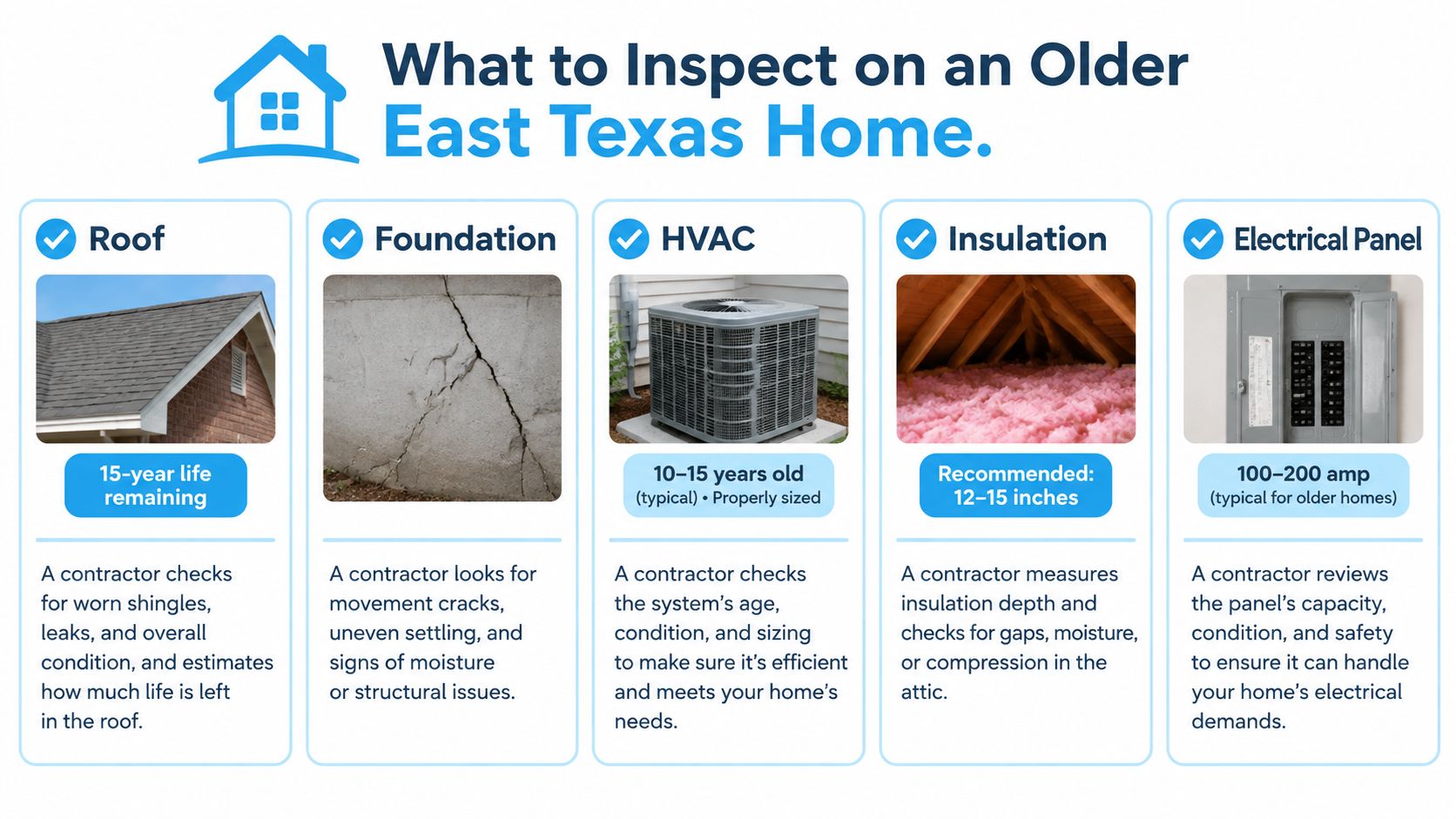
Roof and drainage: Look for signs of aging or damage, then check how water moves around the house. Poor drainage can affect the foundation and create moisture problems; roof condition also influences whether interior work should wait.
Foundation and structure: Note movement, cracking, sticking doors, or uneven areas. These observations don't diagnose the cause on their own, but they point to questions that should be answered before you commit to a layout change or addition.
HVAC, ducts, and insulation: Verify equipment age and sizing, inspect accessible ductwork for leakage, and check insulation depth and continuity in the attic. A new thermostat won't correct an undersized system or gaps in the building envelope.
Electrical and plumbing: Review panel capacity and wiring condition, and identify plumbing materials and signs of leakage or corrosion. If the renovation adds appliances, lighting, or fixtures, these systems need to support the intended design.
Practical rule: Get an envelope and HVAC assessment, then document a repair allowance before finalizing finish selections.
This sequence helps separate a worn surface from a deeper building issue. If the inspection points to outdated wiring, water intrusion, foundation movement, or mechanical limitations, price and plan those needs before choosing a remodel scope. A resale is only a practical alternative to new construction when its structure, systems, and site can support the outcome you want.
When a Barndominium or New Build Wins
A new build is the better fit when the household needs a layout the existing inventory can't provide, can tolerate construction, and wants the builder to coordinate core systems from the start. That may mean a conventional new home or a barndominium with large, open usable space. Raw land outside an HOA may also suit a buyer who wants more control over siting and design, subject to local requirements.

An existing home is often the stronger choice when the address matters more than a custom plan. Established streets, mature trees, larger lots, and proximity to the places your household already uses can be hard to reproduce in a new development. If the home passes a disciplined inspection and its renovation ceiling is high enough, targeted work can deliver the needed function without starting from a bare site.
Match the build to the household
Pick new construction when you want integrated insulation and HVAC, a specific floor plan, or a large clearspan area and you have room in your schedule for the build. Before choosing a barndominium, investigate the land, utilities, access, permitting, and intended use. The building shell is only part of the project.
Choose a renovated resale when you need to move sooner, want an established location, or prefer to improve a sound property rather than wait for a new build. That path loses its appeal if the lot, foundation, utilities, or layout prevent the changes you need.
A design-build contractor can coordinate the shell, envelope, mechanical systems, and finishes as one project, but coordination doesn't erase the need for clear decisions. Set the performance priorities and major layout choices before construction begins, and ask how inspections or commissioning will document the work.
The broader new-build market can also change the negotiation. In August 2025, 66% of builders reported offering sales incentives, and nearly 40% reported price reductions averaging 5%, according to Homes.com's report on new-home incentives. Those figures describe the reported market at that time, not a guaranteed Tyler offer. Ask builders whether a discount or incentive is available, then compare it with the cost of buying a resale and completing the improvements you need.
How a Design-Build Workflow Changes the Math
Delivery method changes what a project costs long before a crew shows up. When an owner hires a designer first and bids the plans afterward, the budget conversation happens late, after drawings already promise things the money can't support. In a design-build workflow, one team coordinates the design, budget, selections, and construction, and this overview of working with a design-build contractor explains how that coordination runs in practice. The owner discusses tradeoffs with the people who will build them.
That single-accountability setup matters most in the second of the three scenarios: resale plus prioritized renovations. A kitchen remodel priced against a hard renovation ceiling forces every selection to justify itself. One team owns both the drawing and the invoice.
Four decisions before construction
Consultation: Walk the site or home with the contractor and explain the problem to solve. For a remodel, that might be a kitchen that doesn't function for the household. For new construction, it might be the layout and spaces needed on a specific lot.
Target budget: Agree on a working budget before design starts. This gives the team a boundary for scope and keeps a polished plan from appearing without a realistic way to build it.
Design and selections: Make the major layout decisions and choose materials against the target budget. For an existing house, selections should follow the assessment of roof, structure, envelope, and mechanical systems, never precede it.
Scheduled construction: Review finalized design details and the estimated production schedule before the build. Resolved selections mean fewer mid-project stalls.
One team, fewer handoffs
My recommendation: if your scenario involves changing anything structural, hire the team that prices what it draws. Home Pro's Remodeling & Repairs, a licensed and insured contractor based in Tyler, provides design-build renovations, additions, exterior improvements, and selected new-construction services across East Texas. For a general sense of how pricing works under this model, browse design-build contract costs before you sign anything.
The payoff shows up in your net monthly cost. When one team controls the drawings and the build, scope changes get priced before they become change orders, and you can compare the finished monthly payment on a renovation against the payment on a new build using real numbers instead of guesses. If a project depends on a kitchen reconfiguration, an addition, a roof replacement, or an entirely new layout, ask who coordinates each decision and how changes hit the target budget and schedule. Get that answer in writing.
Choosing Your Path With a Clear Head
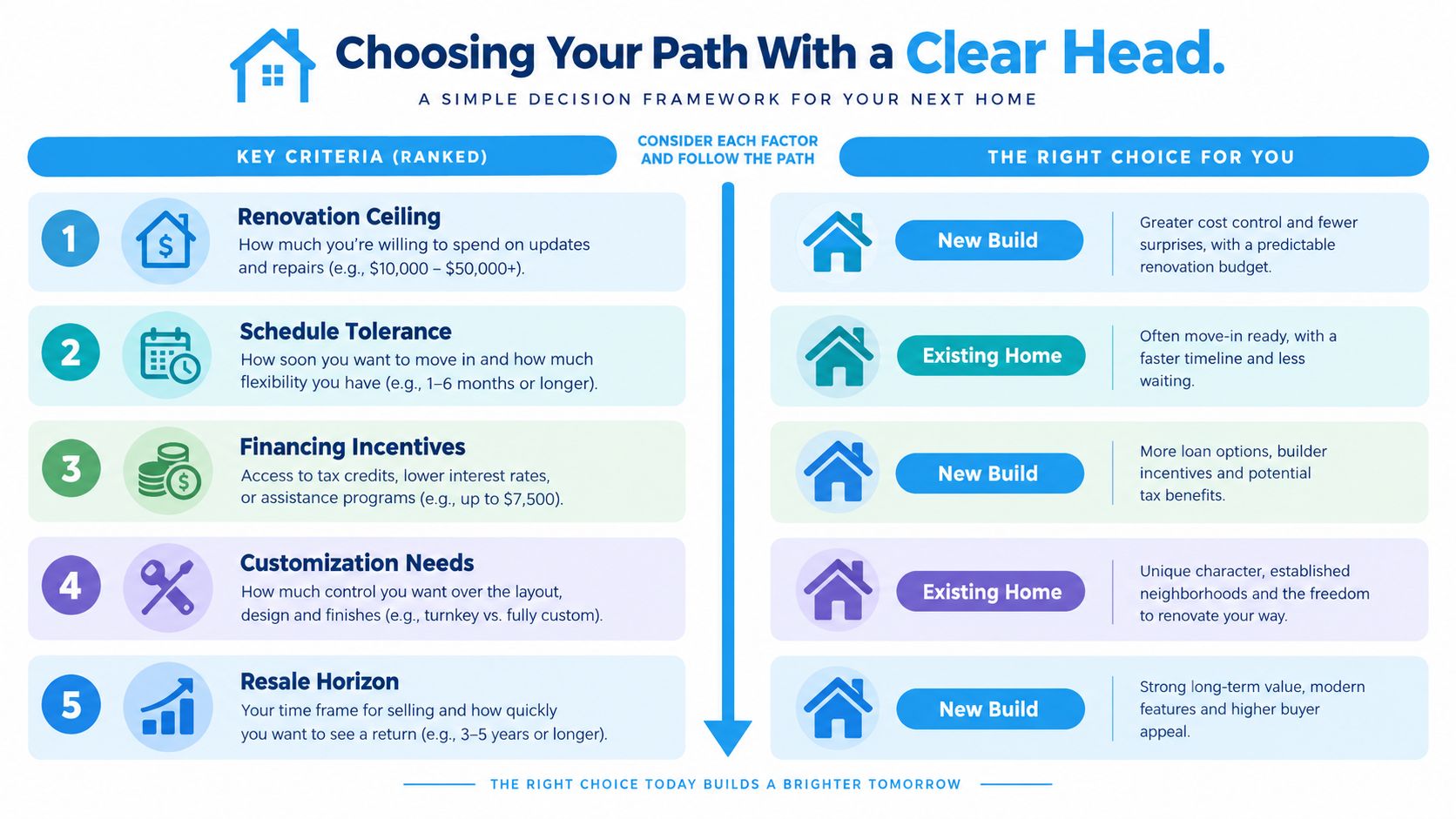
Stop asking which category is better. Rank the factors that will shape your ownership experience: renovation ceiling, schedule tolerance, financing incentives, customization needs, and resale horizon. Then compare the three scenarios against the two priorities at the top of your list.
Apply the framework to your situation
A young family that needs to settle near preferred schools may favor a move-in-ready resale if it meets their needs and passes inspection. A retiree downsizing may choose an existing home in a preferred established neighborhood, or new construction if accessibility and a layout designed for their use matter more than location. An acreage buyer seeking a large open space may find new construction or a barndominium fits better, provided the site and project scope work. An investor deciding between a make-ready and a build should price the repairs, improvements, and time to occupancy before choosing the purchase.
Before committing, write down your answers:
- Location and lot: Does the property offer the setting and space you want?
- True monthly cost: Have you compared financing terms, ongoing expenses, and near-term work?
- Inspection findings: Do the roof, foundation, HVAC, insulation, electrical, plumbing, and drainage support your plan?
- Financing incentives: Are the terms documented, and do they change the cost of ownership?
- Timeline: Can your household manage the build or renovation schedule?
- Resale outlook: Will the location and planned work make sense for the next buyer as well as for you?
The winning path is the one that clears your highest-priority constraints without asking you to ignore a serious compromise. If an existing home has a strong renovation ceiling and the lot is right, targeted work can beat a new build. If the layout, systems, or site can't deliver what you need, choose new construction and negotiate the full package, not just the price.
Home Pro's Remodeling & Repairs offers design-build renovations, additions, exterior improvements, and selected new-construction projects for homeowners across Tyler and East Texas. Bring your inspection findings, budget priorities, and timeline to an on-site consultation, then visit Home Pro's Remodeling & Repairs to discuss whether a prioritized renovation or a new build fits your property.