
A renovation is worth considering when it solves a problem you care about at a cost your home and finances can support. Homeowners often compare the full project cost with only its estimated resale value. That overlooks two other returns: lower operating or maintenance costs, and the everyday benefit of living with the improvement.
Use a three-part payback test
Resale recovery estimates how much of the project cost may show up in a future sale. It is not a promise. Annual savings includes lower energy use and repairs or maintenance you may avoid. Personal-use value is the practical benefit while you own the house, such as a safer bathroom, more storage, or a layout that suits your household.
Your expected holding period affects which return matters most. If you plan to sell soon, extensive work has little time to deliver personal-use benefits, and a high cost may be hard to recover. If you plan to stay, comfort, reliability, and utility savings can outweigh the resale estimate. Necessary repairs can make sense either way when delaying them risks more damage.
Start with the outcome: Decide whether you're renovating to sell, save, stay more comfortably, or prevent a larger loss. A project can serve several purposes, but know which benefit matters most.
Table of Contents
- Use a three-part payback test
- Why Renovating a House May or May Not Be Worth It
- How Resale Value Really Works by Project Type
- The Case for Smaller and Midrange Renovation Scopes
- Sell, Renovate, or Rent Out Your Property
- Why Worth Is More Than Resale Return
- Budget Realities That Decide Whether a Project Is Worth It
- A Practical Decision Framework for East Texas Homeowners
Why Renovating a House May or May Not Be Worth It
In East Texas, a dated kitchen may matter less than a failing roof, and an expensive upgrade can outpace what nearby buyers expect. Renovation is worth considering when it solves a real problem at a cost your home and finances can support. Judge the decision by three paybacks, not by one resale estimate: resale recovery, annual savings, and personal-use value.
Use a three-part payback test
Resale recovery estimates how much of the project cost may appear in a future sale. Treat it as an estimate, not a promise. The Zonda 2025 Cost vs. Value report cited in the introduction shows why returns differ by project. Annual savings covers reduced energy use and repairs or maintenance you may avoid. Personal-use value is the benefit you get while living in the house, such as a safer bathroom, more storage, or a layout that fits your household.
Your timeline determines how much each payback matters. If you plan to sell soon, extensive work has little time to deliver personal-use benefits, and recovering a high cost may be difficult. If you expect to stay, comfort, reliability, and lower utility costs can outweigh the resale estimate. Address necessary repairs before they lead to more damage.
Start with the outcome: Decide whether you're renovating to sell, save, stay more comfortably, or prevent a larger loss. One project can serve several purposes, but identify which benefit matters most.
For East Texas homes, compare the proposed work with the property's condition and nearby houses. A renovation that fits one neighborhood may over-improve a home in another. Conversely, a basic repair can be the right choice even if its resale recovery looks modest. If you're weighing renovation against buying or selling for investment, PropLab's flip market insights offer a perspective on evaluating property decisions beyond a single renovation figure.
Set the scope and budget around the payoff you need, then test both against your plans for the home. If resale recovery, savings, and personal-use value do not justify the cost, leave cosmetic work for later. A dated appearance alone is not a reason to start.
How Resale Value Really Works by Project Type
Resale recovery differs widely by project. Zonda's 2025 Cost vs. Value analysis found that garage-door replacement averaged $4,672 and was associated with $12,507 in added resale value, or 267.7% cost recovery. Steel entry-door replacement averaged $2,435 and added an estimated $5,270, recovering 216.4%. Manufactured-stone veneer averaged $11,702 and returned approximately $24,328, or 207.9%.
These exterior projects can make a strong first impression without relying on personal design choices. They may also improve a home's condition and function while keeping the scope in line with what buyers expect in the neighborhood.
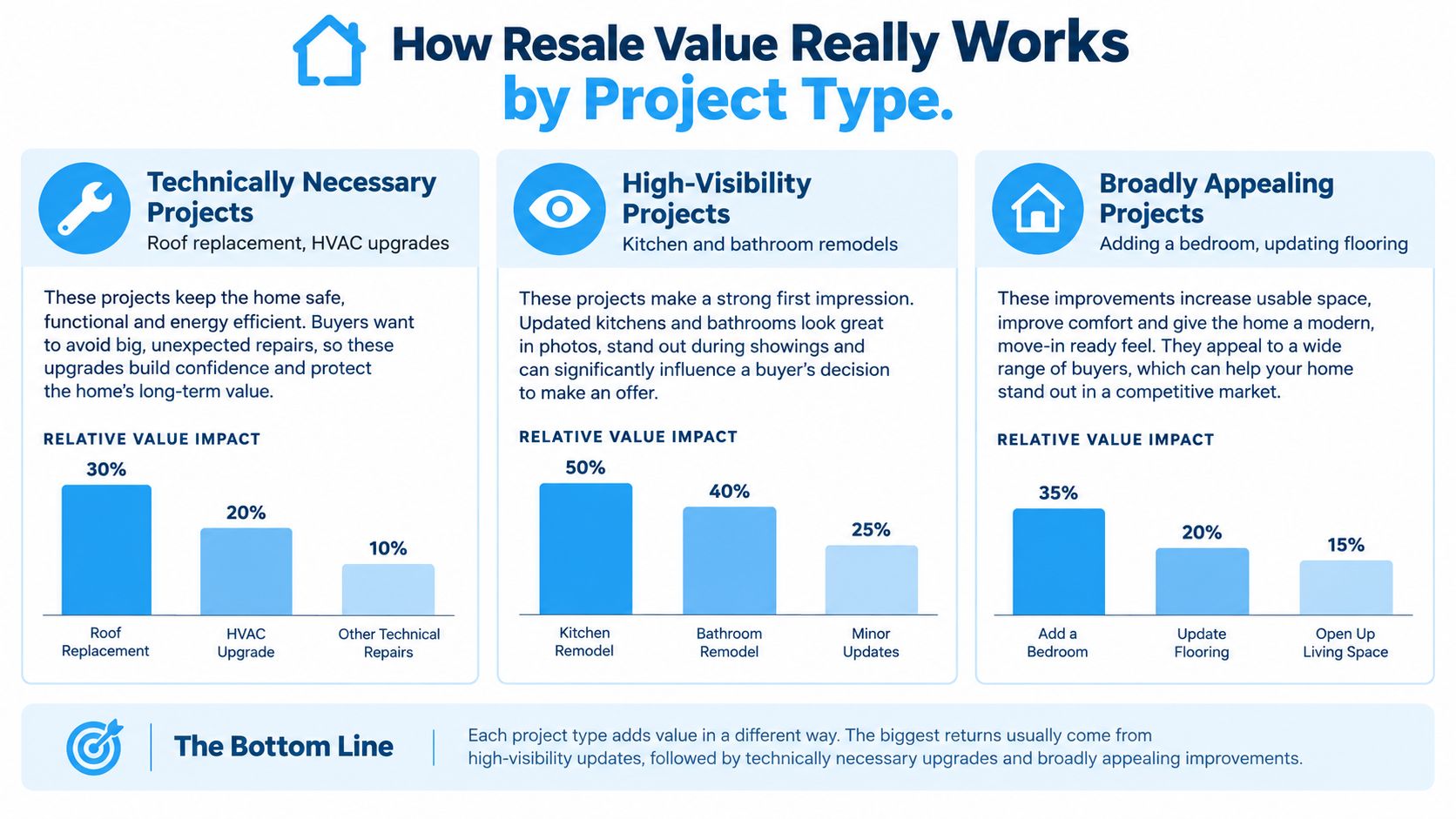
Interior renovations can recover costs, but scale matters. A minor midrange kitchen remodel averaged $28,458 and returned $32,141, or 112.9% recovery. By comparison, a midrange major kitchen remodel recovered about 51%, an upscale major kitchen remodel about 36%, and an upscale primary-suite addition about 32%, according to the same analysis. Larger, more customized work costs more and may add features buyers won't pay enough to value.
Treat recovery as a benchmark, not a profit forecast
A recovery figure above 100% means the analysis estimates that added resale value exceeds the modeled project cost. It does not promise a cash profit. Local labor costs, workmanship, timing, comparable sales, and transaction costs all affect the outcome.
For a Tyler-area homeowner, national averages are a starting point, not a decision. Check whether nearby sales support the project and whether the house needs the work. In East Texas, local conditions and the home's position among comparable properties should shape the decision. Visible, durable improvements with broad appeal can make a stronger resale case than expensive personalization, especially when nearby sales set a clear ceiling. Judge resale recovery alongside annual savings and personal-use value, rather than treating one benchmark as the whole payoff.
The Case for Smaller and Midrange Renovation Scopes
A dated kitchen, worn entry door, or failing garage door can make a house feel neglected. Addressing these issues with a focused project often makes more sense than funding a large addition that nearby buyers may not value.
| Project | Average cost | Estimated resale value | Recovery |
|---|---|---|---|
| Garage-door replacement | $4,672 | $12,507 | 267.7% |
| Steel entry-door replacement | $2,435 | $5,270 | 216.4% |
| Manufactured-stone veneer | $11,702 | $24,328 | 207.9% |
| Minor midrange kitchen remodel | $28,458 | $32,141 | 112.9% |
| Midrange major kitchen remodel | Not provided | Not provided | About 51% |
| Upscale major kitchen remodel | Not provided | Not provided | About 36% |
| Upscale primary-suite addition | Not provided | Not provided | About 32% |
Cost and estimated resale figures for the first four projects come from Zonda's 2025 Cost vs. Value analysis, cited earlier in this article. The recovery estimates for major projects come from the same report.
Use the figures as a comparison of project types, not as a promise about what your home will earn. For East Texas homeowners, a smaller scope can support the resale part of the payoff test while limiting the cash tied up in improvements. Annual savings and personal-use value still matter, especially if you plan to stay.
Start with problems that threaten the house or undermine other improvements, such as water intrusion, failing exterior components, or deferred repairs. Once those are addressed, consider moderate updates with broad appeal: a fresher kitchen, better lighting, or practical storage. These can improve daily use without relying on a future buyer to share your style.
Match ambition to the house and the block
Use this scope rule: fix what's broken, refresh what's dated, and add square footage only when nearby sales support it. Major expansions and high-end redesigns carry a greater risk of pushing the home beyond what its location can support. Keep the finished property in step with comparable homes.
For a kitchen refresh, compare cabinet refacing with replacement before committing to new cabinets. The choice depends on the cabinets' condition, the look you want, and the total installed cost. See this guide to kitchen cabinet refacing versus replacement when weighing those options.
Before approving a design, check what the work does for the home's condition, broad appeal, and everyday function. Then consider whether nearby sales support the proposed finished value. If costly features add little practical value or exceed what the area can bear, scale back. Choose the work that fits the house, the block, and how long you expect to use it.
Sell, Renovate, or Rent Out Your Property
When a home no longer fits, renovation is one option, not the default. Compare selling, renovating to stay, and preparing the property for rental by asking what each path requires upfront, how much uncertainty it brings, and whether it suits your next move.

| Option | Upfront cash | Main uncertainty | Most suitable when |
|---|---|---|---|
| Sell as-is | Avoids renovation spending, though selling still involves transaction costs | Buyers may account for visible defects in their offers | Your timeline is short, or improvements aren't supported by likely sale proceeds |
| Renovate and stay | Requires funding before benefits arrive | Scope changes and hidden conditions can expand the job | You want to remain and the work improves safety, function, or reliability |
| Make ready and rent | Requires repair and preparation spending before rental income | Property management, vacancy, upkeep, and rental performance | You can manage a rental property and the home suits local tenant demand |
Selling without a major remodel can be sensible if the house's problems are too costly to solve before a sale or if you don't want to manage the work. A focused make-ready may be enough: address clearly visible issues and improve presentation without assuming a full overhaul will return its cost.
If you want to stay, focus on the changes that will make the house work better for you. An addition can solve a genuine space problem, but estimate the full project and test it against local comparable sales. A guide to home addition costs can help you identify what to investigate before committing to an expansion.
A rental strategy needs a separate calculation. Don't treat rent as automatic payback. Consider the home's repair needs, the costs of getting it ready, and whether you're prepared to manage the responsibilities of ownership and tenancy. For context on that investor perspective, see renovation payback for rental owners.
A partial renovation followed by a sale can sit between the extremes. It may be a better fit when a few targeted repairs improve marketability but a full remodel would strain the budget or delay a move.
Home Pro's Remodeling & Repairs is one East Texas design-build option for homeowners evaluating a renovation; its process establishes a target budget before design and coordinates planning with construction. The choice among selling, staying, or renting should still come from your finances, timeline, and goals, not from the availability of a contractor.
A short video can also help you think through the choice among property paths:
Why Worth Is More Than Resale Return
A renovation earns its keep through three forms of payback: resale recovery, lower annual costs, and value from using the home. A project can make sense even if the sale price does not cover its full cost. Repairs can preserve existing value, reduce deterioration risks, improve safety, and make daily life more comfortable.
Older homes often need that broader test. U.S. spending on home improvements and repairs rose from $404 billion in 2019 to $611 billion in 2022, and Harvard's Joint Center for Housing Studies projected it would remain above $600 billion through 2025. The U.S. Census Bureau's 2021 American Housing Survey found a median age of 41 years for owned homes (Harvard Joint Center for Housing Studies' housing improvement outlook). Roofs, plumbing, electrical systems, windows, insulation, kitchens, and bathrooms may need attention as homes age, whether or not cosmetic updates would raise resale value.

Count benefits that don't show up in a sale estimate
For East Texas homeowners, roof condition, water management, air leakage, insulation, and cooling performance all affect how well a house works. Assess these as connected parts of the home: air sealing, attic insulation, duct improvements, efficient HVAC, and high-performance windows can work together to limit heat gain and improve comfort.
Start with diagnosis, not replacement. A blower-door test, duct-leakage test, attic inspection, moisture assessment, and HVAC load calculation can show what the house needs. If air leaks or poor insulation are the main problems, new windows alone may disappoint. Ask for a written scope that explains the assumptions behind modeled energy savings, maintenance requirements, warranties, and rebate eligibility.
A repair that prevents a larger failure can make financial sense even with modest resale recovery. Compare the project's cost with the cost and consequences of leaving the problem unresolved.
Federal HOMES rebates may improve the economics of eligible energy work. Under the program framework, qualifying improvements with at least 35% modeled whole-home energy savings can receive up to $4,000 or 50% of project cost for a single-family home. Deeper modeled savings may qualify for up to $8,000 or 80% of project cost, subject to program rules and availability (ENERGY STAR's HOMES program information). Confirm eligibility and local availability before including a rebate in your budget.
Budget Realities That Decide Whether a Project Is Worth It
A renovation's payback depends on more than its resale recovery. Weigh three returns: what the work may add at resale, what it may save each year, and the value you get from using the home. Then test whether the budget can hold up when demolition reveals problems. A 2025 survey of 1,002 U.S. homeowners found that 37% exceeded their original renovation budget. Respondents cited materials (58%), labor (40%), and unexpected repairs (20%) as contributors. 73% used personal savings, and 54% relied exclusively on savings (2025 How America Renovates report).
Those figures make a contingency reserve part of the payback calculation. A project that only works if every wall, pipe, wire, and roof deck is sound leaves no room for costly discoveries. Before signing, separate confirmed work from conditions that may remain hidden until demolition.
Build a budget that can survive discovery
Use this sequence to check whether the project remains financially workable:
- Define the known scope. List visible repairs and the work required to achieve your intended result.
- Ask about concealed conditions. Discuss possible wiring, plumbing, framing, moisture, or roof-deck problems, and how each could change the price.
- Protect a reserve. Set aside money for discoveries without using funds needed for household expenses.
- Stress-test financing. Check that payments remain manageable if work costs more or takes longer than expected.
- Phase if necessary. Handle safety, weatherproofing, or system work first. Add optional finishes later if the budget allows.
Budget rule: Don't judge a bid by its starting price alone. Compare the scope, assumptions, allowances, and terms for unforeseen work.
If finances are tight or hidden damage is uncertain, a phased project can be safer than a whole-house remodel. Borrowing can change the timing and cash-flow calculation, but interest adds to the project's total cost. Compare home improvement loan options with your full budget before choosing how to pay. Owners considering rental income should also assess renovation payback for rental owners, including how the work supports the property's use.
Market forecasts are not a reason to rush a project. Harvard's outlook, cited earlier in this article, projected owner-occupied improvement and repair spending to rise only 1.2% in 2025 and revised its estimated market size upward to $509 billion. Those figures describe expected market activity, not the return on a specific East Texas renovation. Start when the project's resale prospects, potential annual savings, personal-use value, scope, budget, and financing make sense together.
A Practical Decision Framework for East Texas Homeowners
Use this test before you commit. It's designed to keep a useful project from turning into an oversized one, and to make the alternatives visible while you still have choices.
Five checks before signing
1. Name the payback you need. Decide whether the project should support resale, reduce operating or maintenance costs, improve daily life, or prevent a larger loss. If you can't identify a meaningful benefit, pause.
2. Check the neighborhood ceiling. Compare the proposed finished home with nearby comparable properties. If the planned work would put your home well beyond the local market, trim the scope or reconsider the project.
3. Test the full budget. Include design, permits, financing, temporary housing if needed, and a reserve for concealed conditions. Don't rely on a price that assumes demolition will reveal no surprises.
4. Set the sequence. Prioritize water intrusion, roof or exterior failures, and safety or system concerns ahead of optional finishes. Once the house is protected and functional, decide which upgrades still fit.
5. Choose a process that fits the job. For a complex remodel, look for a contractor who can align design, scope, budget, and construction planning. For smaller repairs, make sure the proposed work and price are clear before approving it. Ask how the team handles changes, scheduling, and newly discovered conditions.
Renovation is most compelling when it prevents escalating damage, addresses a safety concern, supports aging in place, improves insurability, or makes the house work substantially better for the people living in it. These benefits don't require a guaranteed resale gain to matter.
Sell, rent, or hold instead when the necessary work exceeds a reasonable scope, local sales can't support the planned improvements, or your timeline is too short to capture the personal-use value. A short timeline doesn't automatically rule out repairs, but it does make a large, elective remodel harder to justify.
Common questions
Are kitchen or bathroom remodels worth it in 2026? They can be, but the scope and purpose matter more than the room. A modest refresh may make sense if it improves function or condition without over-improving the home. A major remodel is harder to justify for resale alone, so compare the complete cost with local sales and the value you'll get from using the space.
How long should I plan to stay to recoup a major project? There's no universal holding period that guarantees recovery. Estimate resale support using nearby comparable sales, then consider how long you'll benefit from comfort, convenience, or savings. If you expect to sell soon, limit elective work and focus on necessary repairs or improvements that solve clear marketability problems.
What signs suggest a renovation isn't worth pursuing? Be cautious if the budget has no reserve, the project depends on optimistic resale assumptions, or the proposed scope goes beyond what the neighborhood can support. The same applies when you can't define the benefit, financing would put essential expenses at risk, or the house needs more structural and system work than you can reasonably manage.
For a renovation decision grounded in your home's condition, target budget, and priorities, Home Pro's Remodeling & Repairs offers East Texas consultations and design-build services for remodeling, additions, roofing, and exterior improvements. Ask for an on-site assessment and a clearly scoped estimate before deciding whether to renovate, phase the work, or choose another path.