
You're standing in a kitchen that still works, but it looks tired. The doors are dated, the finish is worn, and every meal prep reminds you that the room needs help. In East Texas, that usually turns into one big question, do you freshen up what you've got, or start over with new cabinets?
| Option | What stays | What changes | Best fit |
|---|---|---|---|
| Cabinet refacing | Existing cabinet boxes and layout | Doors, drawer fronts, veneer, hardware | Good boxes, workable layout, faster update |
| Full replacement | Usually nothing from the old cabinet set | Entire cabinet system, often more of the surrounding work | Damaged boxes, poor layout, bigger redesign |
For most homeowners, this isn't just a style decision. One 2026 industry guide says cabinetry typically makes up 35%–45% of total kitchen remodel cost, so the cabinet choice can shape the whole budget (Eagle Woodworking). In Tyler, Lindale, and the rest of East Texas, I see the same truth every week. If the boxes are sound and the layout already works, refacing can be a smart, practical move. If the kitchen fights you every day, replacement is usually the honest fix.
Table of Contents
- Your Kitchen Cabinets A Makeover or a Total Reset
- What Is Cabinet Refacing vs Full Replacement
- Comparing the Costs Refacing vs Replacement in East Texas
- Project Timeline and Home Disruption
- Long-Term Value Design Flexibility and Durability
- When to Choose Refacing and When to Replace
- Getting a Professional Assessment in East Texas
Your Kitchen Cabinets A Makeover or a Total Reset
A homeowner in Bullard can walk into the same kitchen every morning and feel two things at once, the layout still works, but the room looks stuck in another decade. This is the cabinet dilemma. You're not always fixing a broken kitchen, sometimes you're deciding whether the finish is the problem or the whole cabinet system is.

The practical split
Cabinet refacing keeps the cabinet boxes in place and gives the kitchen a new exterior. Full replacement tears out the old cabinets and installs a new system from scratch. That difference sounds simple, but it changes cost, mess, timing, and how much of the kitchen gets touched.
Refacing tends to fit homes where the boxes are solid and the layout isn't the problem. Replacement fits kitchens with water damage, awkward storage, or a footprint that never worked right in the first place. The choice isn't really about which option sounds better on paper. It's about what your kitchen can support.
Practical rule: if you'd be happy cooking in the same layout after the cabinets looked new, refacing deserves a serious look.
In East Texas, that judgment matters because people don't want a remodel that drags on forever or blows up into a bigger job than they planned. The right answer depends on the condition of the boxes, the age of the finishes, and whether you're chasing appearance or functionality. If your cabinet system is structurally fine, a surface-level upgrade can go a long way. If the room already feels cramped or inefficient, a facelift won't address the underlying issue.
Why homeowners get stuck
As cabinet purchases are infrequent, the available options often blur together. Refacing sounds like a shortcut. Replacement sounds safer. In reality, both can be right, but for very different reasons.
A good contractor should be able to tell you quickly whether your kitchen is a candidate for a lighter refresh or whether you're wasting money trying to preserve a failing system. That's the lens I'd use from the start, not “What's cheapest?” but “What's still worth keeping?”
What Is Cabinet Refacing vs Full Replacement
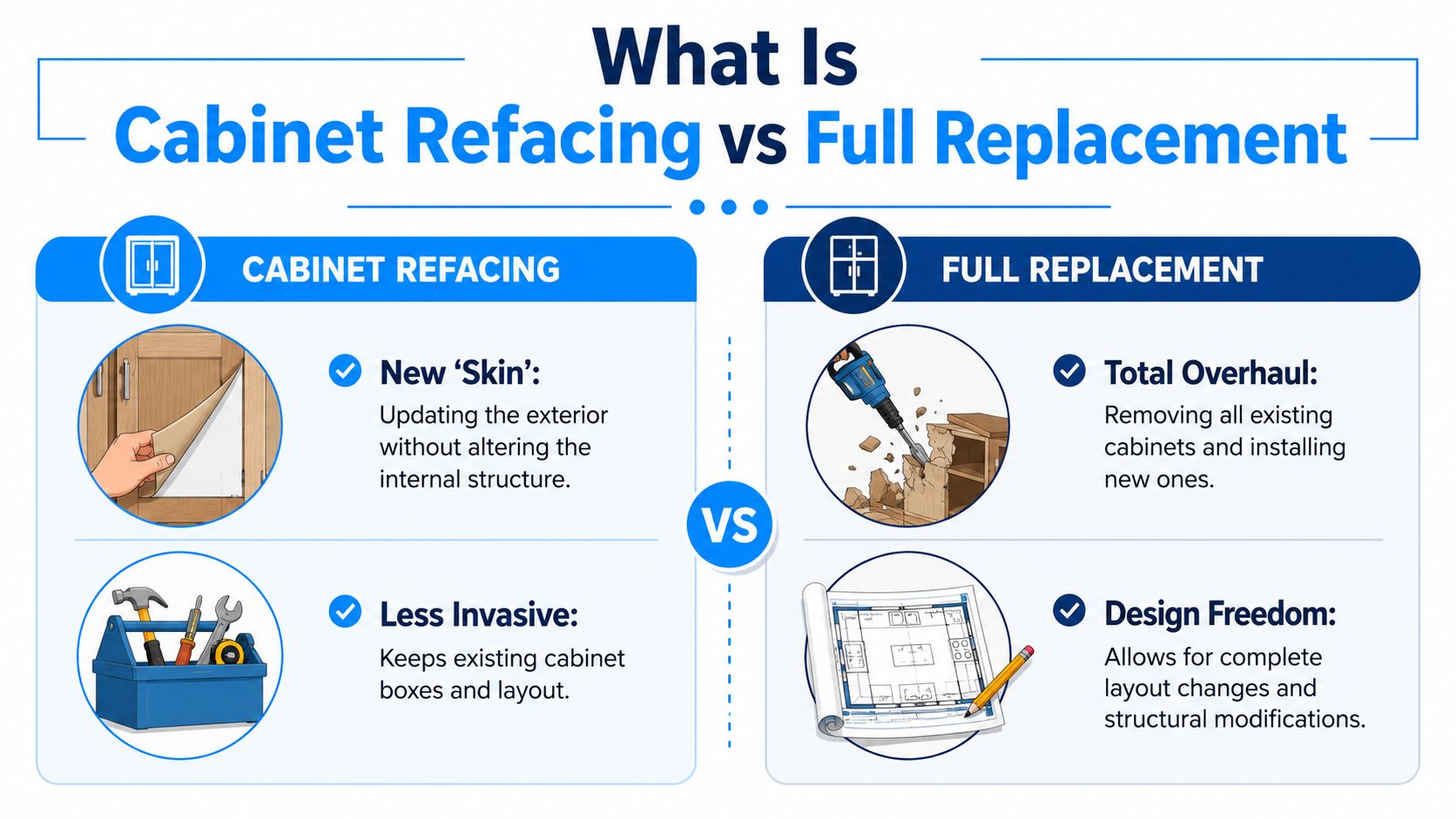
Refacing is like giving your cabinets a new jacket. The boxes stay, but the visible parts get replaced, usually the doors, drawer fronts, veneer, and hardware. Full replacement is more like buying a whole new wardrobe, because the old cabinet structure comes out and a new one goes in.
What stays and what goes
With refacing, the hidden structure remains in place. The kitchen keeps its footprint, and the job stays focused on the visible surfaces and operating parts. That makes it a structural-preservation upgrade, not a layout change.
With replacement, the cabinet system is removed. That opens the door to new sizing, new storage planning, and a different arrangement of the room. It also opens the door to more trade coordination, more demolition, and more opportunities for the project to expand.
The distinction matters because a refacing job can make a tired kitchen look new without changing the bones of the room. A replacement job changes the bones too. If your existing cabinet boxes are healthy and the plan is mostly cosmetic, refacing is usually the cleaner path. If the structure itself is part of the problem, replacement is the definitive fix.
Refacing solves a different problem than replacement. One updates the appearance, the other can reset the kitchen's function.
For homeowners trying to sort out kitchen cabinet refacing vs replacement, the easiest way to think about it is this. Refacing is a finish upgrade. Replacement is a rebuild. One preserves the cabinet shell and modernizes what you see. The other starts over so you can redesign what the kitchen does.
What the work looks like on site
A refacing crew usually works around the existing kitchen. They're matching finishes, installing new fronts, and making the old boxes look intentional again. Replacement crews are doing demolition, hauling debris, setting new cabinets, and then coordinating the rest of the kitchen around that new system.
That difference is why the two projects feel so different to live through. Refacing is contained. Replacement spreads out.
Comparing the Costs Refacing vs Replacement in East Texas
Price is where most homeowners start, and for good reason. Cabinets are one of the biggest checks in a kitchen remodel, so the difference between a reface and a replacement can decide whether the project stays manageable or turns into a larger financial commitment.
National numbers still frame local decisions
Multiple 2026 guides put average refacing around $4,000–$9,500, while full cabinet replacement is commonly reported at $8,000–$30,000+ (Modernize). That gap is why refacing is often described as the less expensive route. In many standard projects, it can cost about 30%–50% less than replacement, and some summaries describe savings of up to 78% when custom or semi-custom cabinetry would otherwise be needed (Modernize).
For East Texas homeowners, the pattern is the same even if the exact quote shifts with local labor, material choice, and kitchen size. A medium kitchen in a market like Los Angeles is cited at $5,000–$9,000 for refacing, which shows the basic economics stay consistent across large housing markets (Modernize). That doesn't mean East Texas prices copy a West Coast market. It means the cost structure behaves the same way, because the work being done is still the same kind of work.
What pushes each price up
Refacing gets more expensive when the doors, veneer, or hardware are upgraded. It also rises when the existing cabinets need more careful prep or the kitchen has more linear footage. Replacement climbs fast when the job moves into higher cabinet grades, more detailed installation, or a larger scope of demolition and installation.
One guide notes professional refacing is commonly quoted at $100–$250 per linear foot, while replacement can rise to $500–$1,200+ per linear foot for higher-end custom work (Eagle Woodworking). That spread is exactly why cabinet choice matters so much in a remodel budget.
| Estimated Cost Comparison Refacing vs Replacement | Cabinet Refacing | Cabinet Replacement |
|---|---|---|
| Typical project range | $4,000–$9,500 | $8,000–$30,000+ |
| Per linear foot | $100–$250 | $500–$1,200+ |
| Cost position | Lower-cost path | Higher-cost path |
| Main reason for difference | Reuses cabinet boxes | New cabinet system and broader scope |
If you're pricing a kitchen in Tyler, Lindale, or anywhere nearby, use that table as a reality check. Refacing is usually the better budget conversation when the structure is sound. Replacement is the right conversation when the room needs a deeper reset. For a local remodel estimate, it helps to start with a kitchen-specific consultation like the one outlined at Home Pro's kitchen remodeling services.
Project Timeline and Home Disruption
A lot of homeowners can handle spending money. What they really dread is losing their kitchen for weeks. That's where refacing has a real advantage, because the scope is narrower and the disruption stays smaller.
How refacing changes the daily routine
Refacing is a structural-preservation upgrade, so the existing cabinet boxes stay in place. There's typically no plumbing rework and no electrical rework, and a standard-size kitchen can remain livable during the typical 3–5 day turnaround (HomeScabinet). That matters in real life. You can usually still move through the room, store dishes, and keep the household functioning while the work is happening.
Replacement is a different animal. Once the old cabinets come out, the kitchen opens up to demolition, installation, and whatever incidental adjustments the new layout requires. That often means more moving parts and more time before the room feels normal again.
A shorter job isn't just about convenience. It lowers the number of trades, interruptions, and chances for the project to drift.
For families in East Texas, that can be the deciding factor. If the kitchen is the center of the home, a few days of disruption is one thing. A longer shutdown is another. Refacing is popular because it lets people keep living in the house without turning every meal into a workaround.
Where replacement adds friction
The more a project changes the room, the more it tends to touch other pieces of the house. Demolition can reveal problems. New cabinets can trigger countertop changes. A different layout can create sequencing issues with other trades. That's normal on a replacement job, but it's also why timelines stretch.
If you're comparing kitchen cabinet refacing vs replacement and your schedule matters as much as your budget, the question becomes simple. Do you want a cleaner, faster job that preserves function, or are you willing to live through a bigger disruption to get a new layout? For interior projects that need to be coordinated carefully, it's worth reviewing a broader remodeling plan like Home Pro's interior remodeling services.
Long-Term Value Design Flexibility and Durability
A good cabinet decision shouldn't stop at the invoice. The finish matters, but so does whether the kitchen still makes sense five years from now. That's where refacing and replacement separate in a more permanent way.
Design flexibility has a hard ceiling
Refacing updates the look, not the footprint. If the cabinet layout already works, that's fine. If it doesn't, refacing won't move walls, shift appliances, or create new storage zones. Replacement gives you a blank slate, which is why it's the better option when the kitchen needs a true redesign.
That flexibility can matter more than homeowners expect. A prettier kitchen that still feels awkward will keep frustrating you. A replacement can solve that, but only because it starts over.
Durability depends on what you're keeping
Refacing is only as strong as the cabinet boxes underneath it. If those boxes are sound, the finished result can look sharp and hold up well. If they're already compromised, you're building on a weak base. That's why the condition of the existing structure matters more than the door style.
Replacement gives you new materials throughout the cabinet system. It's also the natural path when you want features the old setup can't support, like more customized sizing or a different storage plan. The downside is that you're paying for more than appearance. You're paying to remove the old system and install a new one.
Homeowner rule: if the problem is “ugly but usable,” refacing has a strong case. If the problem is “unusable or failing,” replacement is the safer spend.
Resale and perceived value
In the market, kitchens still sell homes, but buyers notice different things. A refaced kitchen can present well if the design is clean and the finish is consistent. A replacement tends to carry more perceived permanence because it reads as a full renovation, not a surface upgrade.
That doesn't mean every house needs replacement. It means the right choice depends on how the kitchen will be used and how long you plan to keep the home. If you're staying put and the room already functions, a refacing project can deliver a meaningful visual reset without forcing a bigger commitment. If you're preparing a home for long-term ownership or a complete repositioning, replacement may make more sense even though the upfront cost is higher.
When to Choose Refacing and When to Replace
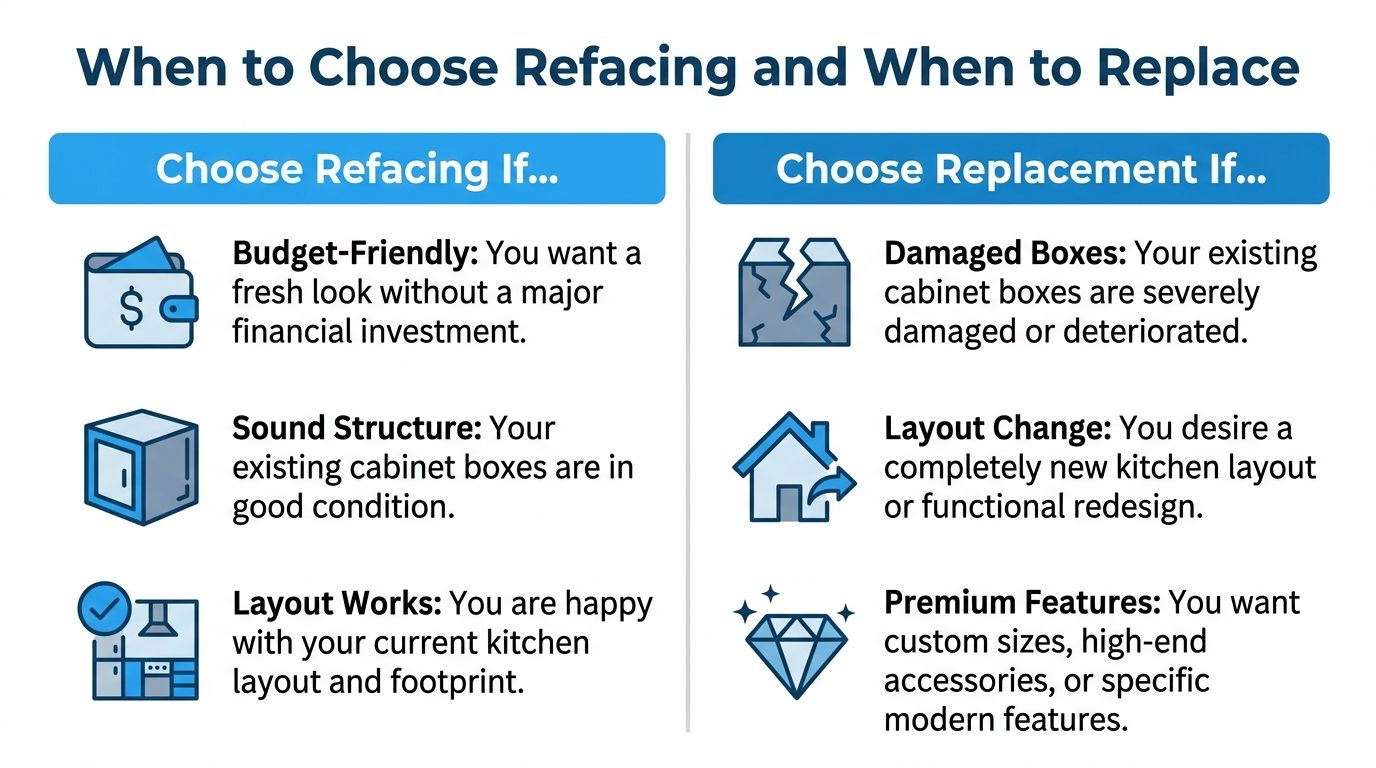
The cleanest way to decide is to be brutally honest about what's wrong with the kitchen. If the cabinets are structurally fine and the layout still works, refacing is often the smart move. If the room is functionally wrong, replacement is usually the better investment.
Choose refacing if
- Budget matters most: You want a fresh look without paying for a full tear-out.
- The boxes are solid: The cabinet structure is still in good shape.
- The layout works: You don't need to move cabinets or redesign the footprint.
Choose replacement if
- The cabinets are damaged: Water damage, deterioration, or structural issues are already showing.
- The kitchen doesn't function well: The workflow, storage, or footprint needs a real redesign.
- You want premium features: Custom sizing, major accessory upgrades, or a more complete modern setup belong in a replacement scope.
Refacing is cheaper because it reuses cabinet boxes, but it can't change cabinet location or fix underlying structural damage or layout problems, which creates a risk of hidden costs later if the boxes aren't in excellent condition (Kitchen Magic). That's the part many homeowners miss. They compare the upfront number, not the condition of what stays behind the veneer.
So the decision isn't really “Which option is better?” It's “Which problem are you solving?” If the issue is appearance, refacing often makes sense. If the issue is function or damage, replacement is usually the honest answer.
Getting a Professional Assessment in East Texas
Cabinet decisions look clearer after someone measures the room, checks the boxes, and looks at the actual condition of the kitchen. Photos help, but they don't replace an on-site assessment. That's especially true in older East Texas homes, where hidden wear, uneven walls, and past repairs can change the recommendation fast.

A good first visit should cover the cabinet boxes, the layout, the finishes, and the rest of the kitchen scope, not just the doors you can see. That's the only way to tell whether refacing is a real solution or just a cheaper-looking one. For homeowners in Tyler and nearby communities, a consultation should also tie the recommendation to budget and timeline before anyone commits to a direction.
If you're ready to get a grounded opinion, use the contact form at Home Pro's contact page and ask for an on-site estimate. Bring a few photos, note what feels wrong about the kitchen, and be clear about whether you want a visual update or a full redesign. That makes the conversation useful right away.
If you're weighing kitchen cabinet refacing vs replacement in Tyler or anywhere in East Texas, reach out to Home Pro's Remodeling & Repairs for a practical on-site assessment and a clear next step.