
About $610 to $612 per project is the 2026 national average for drywall repair, with most jobs landing between $150 and $2,000. The final price depends on the repair's scope, finish, access, and cause, not just the size of the hole. (Carolina Renew's 2026 drywall repair guide)
You find the damage on an ordinary Tuesday. Maybe a doorknob punched through the hallway wall, a seam opened above the doorway, or a yellow-brown stain appeared on the ceiling after a storm. The hole may look small enough to fix with a tub of compound, but the price can still surprise you once setup, sanding, texture matching, and paint enter the picture.
That's why the question “how much does drywall repair cost” doesn't have one simple answer. A nail pop and a water-damaged ceiling are both drywall repairs, but they involve very different work. This guide breaks down the pricing logic in plain language so you can build a realistic budget, decide whether DIY makes sense, and recognize what a professional quote includes.
Table of Contents
- What to Expect for Drywall Repair Costs Today
- How Drywall Repair Pricing Really Works
- Key Cost Drivers That Move Your Drywall Repair Estimate
- DIY vs Hiring a Pro for Drywall Repair
- How Long Drywall Repair Takes and What the Process Looks Like
- How to Get an Accurate Onsite Estimate and Save on Costs
- Planning Your Drywall Repair With Confidence
What to Expect for Drywall Repair Costs Today
A small hole can carry a surprisingly large professional bill. Homewyse's cost database places many professional drywall repairs around $295 to $928 per project, while some standard service estimates begin near $297 to $472. (Homewyse drywall repair cost data)
The reason is simple: contractors price the visit and finishing work, not just the piece of board. A drywall sheet may cost roughly $10 to $25, tape about $4.50, and joint compound around $5 to $15. Those supplies are only one part of the job. (HomeAdvisor's drywall repair pricing guide)
Why the first quote may seem high
A contractor still has to travel to your home, protect nearby floors and furniture, inspect the damage, prepare the patch, apply compound, wait for coats to dry, sand the surface, and blend the finish. The work resembles sending a tailor to your house to repair one small tear. The fabric may be cheap, but the visit and careful stitching still take time.
That fixed work explains why a tiny patch can cost nearly as much as a medium repair. The amount of drywall changes, but travel, setup, drying time, sanding, and cleanup do not disappear. Texture matching can add another layer, especially when the wall has orange-peel texture, knockdown texture, a specialty finish, or paint that has faded over the years.
A smooth patch may look obvious beside a textured wall, even when the hole itself was repaired correctly. Matching the surrounding surface often requires a careful hand and another visit or finishing step.
Practical rule: Judge a drywall quote by the complete finished surface, not by the amount of board installed.
What changes the budget
The most useful questions are:
- What caused the damage? A nail pop requires different work from a leak or impact hole.
- Where is it located? Ceiling work usually means harder access and more demanding overhead finishing.
- Does the drywall need replacement? Soft, swollen, or crumbling material generally cannot be treated like a simple surface blemish.
- What finish must be matched? Taping, mudding, sanding, texturing, priming, and painting can drive the labor.
- How many repairs are being completed? Several patches may make one visit more efficient than separate service calls.
A reliable estimate starts with those details. Square footage helps with larger work, but it cannot show whether the contractor must match texture, repair hidden moisture damage, or spend extra time finishing a ceiling.
How Drywall Repair Pricing Really Works
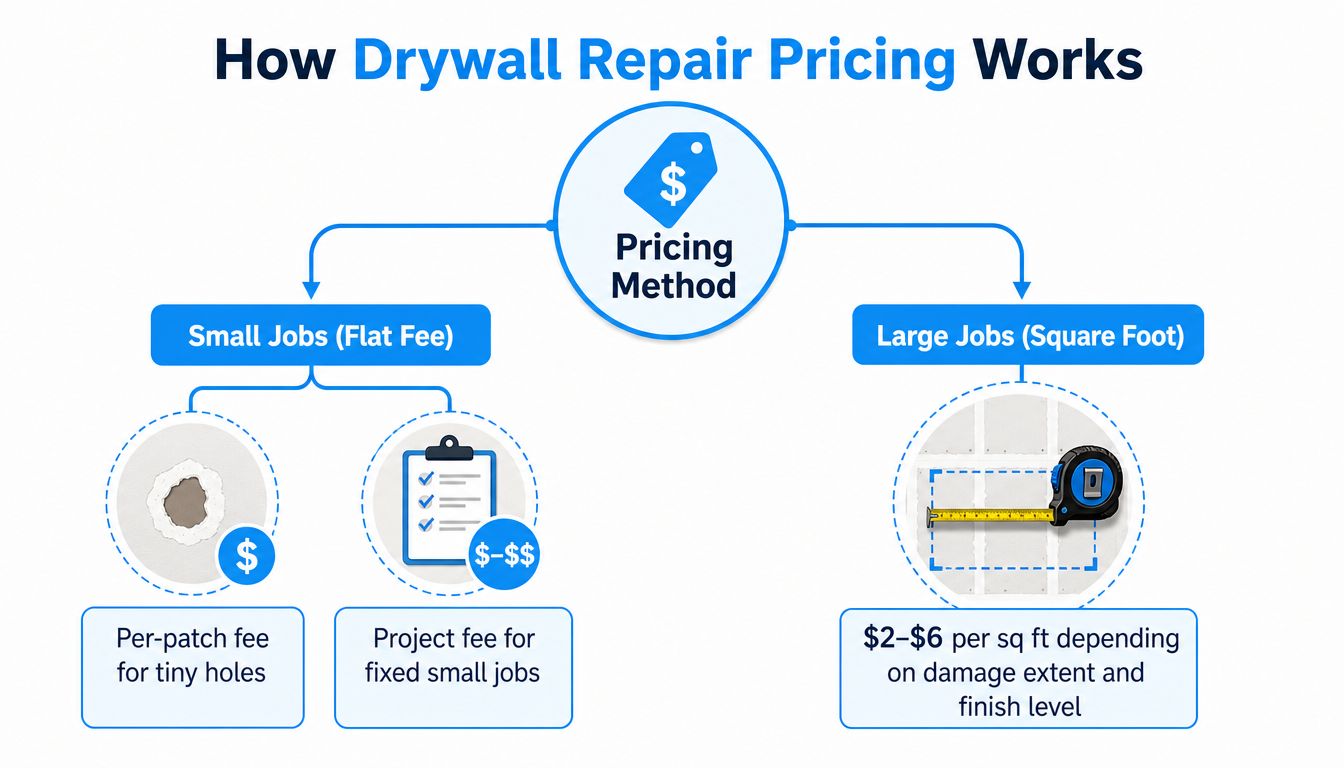
A two-square-foot patch can surprise homeowners because the board itself may be inexpensive, while the service still requires a complete repair process. Contractors generally use a flat project or per-patch price for small jobs, then shift toward square-foot pricing as the work grows. That approach reflects how labor and materials behave at different project sizes, as outlined in Faircloth Drywall's 2026 cost-per-square-foot guide.
Small jobs usually carry a minimum
Suppose a contractor repairs a two-square-foot section. The gypsum board may represent only a small part of the materials, but the worker still has to travel, protect the room, cut out the damage, install backing or a patch, tape the seams, apply compound, sand, match the texture, and prepare the surface for paint.
That is why a small project under 50 square feet can effectively reach $50 to $125 per square foot. The figure describes the total repair divided by a small area. It does not mean the drywall board itself costs that much. The difference comes from fixed service work that remains nearly the same whether the patch is tiny or somewhat larger.
A flat fee works much like a plumber's minimum trip charge. The customer pays for the visit and the work required to complete it, not only for the few minutes spent handling the visible material. A per-patch price can also make the scope clearer because it states what the contractor will complete during that service call.
Larger work spreads overhead
As the repair expands, travel, setup, protection, and preparation are distributed across more board and more seams. The same guide places medium projects around $2.50 to $3.50 per square foot, with large projects around $1.50 to $2.50 per square foot. Larger areas can therefore show a lower unit price even though the total invoice is higher.
The difference is similar to paying for a single delivery versus filling an entire delivery route. The trip still happens, but its cost is shared across a broader scope of work.
How to read a quote
Ask whether the price includes:
- Surface preparation, including removal of loose or damaged drywall
- Replacement and fastening, if a patch or section must be installed
- Taping and joint compound, including additional coats
- Sanding and dust control
- Texture matching
- Primer and paint, or a clearly stated exclusion
- Cleanup and disposal
If the scope changes after work begins, ask how added work will be approved and priced. Understanding what a change order means in construction can help prevent confusion if hidden moisture, loose material, or a broader damaged area appears after the wall is opened.
Key Cost Drivers That Move Your Drywall Repair Estimate
A small living-room patch can look simple until the contractor starts matching the wall around it. The board itself may be inexpensive, while the service call, access, texture, and finishing work determine much of the estimate. That is why a tiny repair can come close to the cost of a medium patch.
Labor often runs around $60 to $90 per hour, with more complex water-damage or ceiling work reaching roughly $90 to $100 per hour. The hourly rate is only part of the calculation. A contractor still has to protect the room, prepare the opening, apply compound, allow drying time, sand, and clean up.
The main cost movers
| Cost Driver | Typical Impact | Why It Matters |
|---|---|---|
| Minimum visit or setup | Can make a tiny patch cost more than expected | Travel, protection, setup, and cleanup take time regardless of hole size |
| Damage type | Surface blemishes stay simpler, while replacement work costs more | Water damage or crumbling board may require cutting out and rebuilding the area |
| Ceiling access | Usually adds difficulty | Overhead work can require ladders, additional protection, and slower finishing |
| Taping and mudding | Adds repeated labor stages | Seams need compound, drying, sanding, and often another coat |
| Texture matching | Can add meaningful finishing time | The repair must blend into the existing orange-peel, knockdown, or other surface |
| Primer and paint | May expand the scope beyond patching | A repaired area can remain visible without proper sealing and color blending |
| Local labor market | Changes the final quote | Rates and minimum charges vary by location |
Materials are modest, but finishing isn't
A drywall sheet, tape, compound, screws, and a patch may cost less than the skilled labor. The work still involves measuring, cutting, reinforcing, fastening, and feathering compound beyond the damaged area.
Texture matching explains much of the difference between a basic patch and a polished repair. A smooth wall is easier to blend. Orange-peel and knockdown finishes require the contractor to reproduce the pattern, let it dry, sand carefully, and check the result under the room's normal lighting. Per-square-foot finishing prices can vary, so the scope should state whether taping, texturing, primer, and paint are included.
Texture matching often separates a repair that disappears from one that catches your eye. The patch may be small, but the contractor must recreate the surrounding pattern and blend its edges into the original wall.
Damage can change the entire approach
A nail pop may need limited compound and touch-up work. A water-damaged section may require the leak to be addressed first, damaged material removed, new drywall installed, seams finished, and the surface repainted. Market guidance places water-damaged sections around $600 to $1,550 or more, depending on the scope. (Carolina Renew's 2026 drywall repair guide)
Before accepting an estimate, identify which cost driver applies to your wall. Ask whether the quote includes texture and paint, or stops after the patch is sanded. That distinction explains why two estimates for similarly sized holes can differ substantially, especially when one contractor is pricing a finished, blended surface and the other is pricing only the board repair.
DIY vs Hiring a Pro for Drywall Repair
A small nail hole in a quiet hallway may be a sensible weekend project. A tiny patch beside a bright window, on a textured wall, or above your head can take nearly as much professional effort as a medium repair. The area is small, but the visit still involves setup, minimum service time, texture matching, sanding, and finishing.

When DIY is reasonable
For a minor surface repair, you may need a putty knife, sanding sponge, joint compound, primer, matching paint, and possibly a small texture product. Material costs can stay modest if you already have the tools and leftover paint.
The trade-off is time and finish quality. A patch can feel smooth under your hand yet remain visible after painting if the edges are not feathered, the compound shrinks, or the texture pattern differs from the surrounding wall. You may need several rounds of coating and sanding. Those finishing steps are why a professional's minimum charge can make a tiny job cost almost as much as a larger one.
DIY tends to fit when:
- The damage is superficial. Nail pops and tiny dents usually do not require structural replacement.
- The wall is accessible. A straightforward wall is easier to reach than a ceiling or stairwell.
- The finish isn't highly visible. A utility area hides minor variation better than a front entryway.
- You can allow drying time. Rushing compound can leave ridges, soft spots, or visible seams.
When professional work protects the result
A professional brings tools and experience for cut-outs, seam finishing, and texture blending. That skill matters under strong side lighting, where a shallow ridge can cast a noticeable shadow. It also helps when the repair must match an existing orange-peel or knockdown finish rather than remain a flat patch.
Call a pro when drywall is soft, stained, sagging, or repeatedly cracking. Water damage may require attention to the leak and affected material, not a coat of compound over the stain. Ceiling work deserves care because overhead access makes both the repair and the finishing more difficult.
Homeowners can contact contractors serving Tyler and East Texas to assess whether the work suits a small handyman visit or a broader remodeling scope. Compare quotes by checking whether they include taping, texture, primer, paint, cleanup, and the minimum service charge. The lowest initial price may leave you with unfinished blending or a repair that needs to be redone.
How Long Drywall Repair Takes and What the Process Looks Like
Drywall repair often takes longer on the calendar than it does in active labor. Compound needs time to dry between coats, and a careful finisher won't bury a damp layer under sanding, texture, or paint.

The typical sequence
- Assessment and preparation. The worker checks the damage, protects nearby surfaces, and determines whether the existing board can be patched.
- Cut-out and installation. Loose or compromised drywall is removed, and the replacement piece is fastened securely.
- Taping and the first coat. Tape covers the seams, followed by joint compound that extends beyond the patch edges.
- Drying, sanding, and recoating. The surface is smoothed and additional compound is applied where needed.
- Texture matching. The finisher recreates the surrounding pattern rather than leaving a flat island on a textured wall.
- Priming and painting. Primer seals the repaired compound, and paint completes the visual blend.
The assigned process visual describes a two-to-three-day total timeline for the full sequence, with drying periods influencing the schedule. (Drywall repair timeline infographic source)
Humidity, ventilation, compound thickness, and custom textures can extend the work. A small patch may receive attention during one visit and still need a return visit for sanding, texture, or paint.
A rushed repair often reveals itself after the paint dries. The seam may sink, the texture may stand proud, or the patched area may absorb paint differently from the surrounding wall. Paying for proper drying and finishing helps prevent those problems.
You can also use this video to see the general sequence in action:
How to Get an Accurate Onsite Estimate and Save on Costs
A small wall dent can look like a quick patch, yet the estimate may approach the cost of a medium repair. The reason is that contractors still have setup, travel, minimum service, and finishing time. Texture matching and paint blending can take nearly as much care as covering the opening itself, so square-foot guides often miss the actual work.
Online averages can set expectations, but an onsite inspection gives you a clearer budget. A contractor can check whether the drywall is only dented, whether moisture has weakened the backing, and whether the existing texture or paint requires blending beyond the damaged spot.

Prepare useful details before the visit
Take close photos and wider room views. Record when the damage appeared, whether the area feels soft, and whether a plumbing, roof, appliance, or foundation problem may be nearby.
Share details that can change the scope:
- Damage location: Say whether it is on a ceiling, beside a corner, behind a fixture, or in a room where the repair will be highly visible.
- Surface finish: Identify a smooth surface, orange-peel, knockdown, or another texture.
- Possible moisture: Point out stains, bubbling paint, musty odors, or discoloration that returns.
- Desired result: Confirm whether the quote covers patching only or a finished, paint-ready surface.
- Other repairs: Mention nearby drywall, trim, or paint work so the contractor can consider one coordinated visit.
Compare scope, not just totals
A low quote may leave out primer, paint, texture blending, disposal, or work revealed after the cut-out. A higher flat price may include those steps. Ask each contractor to list labor, materials, preparation, finishing, cleanup, and exclusions.
Ask, “What will I see when you're finished?” The answer should describe the wall's final appearance, not only the hole's measurements.
Quote check: A complete estimate should explain what happens to the wall, how damaged material is handled, and what happens if the visible repair extends beyond the original opening.
Bundling nearby work can reduce repeated setup. If one room has several nail pops, a damaged corner, and a patch that needs paint, request one grouped scope. A discount is not automatic, but one visit may be more practical than separate small appointments.
Before approving the work, confirm insurance, the written scope, payment terms, and the process for unexpected conditions. Those details matter when hidden moisture or a difficult texture changes the repair.
Planning Your Drywall Repair With Confidence
A drywall estimate becomes easier to judge when you follow the work in order: find the cause, define the finished appearance, then compare written scopes. That sequence explains why a tiny patch can cost nearly as much as a medium repair. The board may be inexpensive, but a contractor still has travel, setup, minimum service time, taping, sanding, texture matching, and cleanup to cover.
For a small blemish, minimum service fees often matter more than the amount of drywall used. A larger opening may make square-foot pricing more useful, yet finishing labor still shapes the total. Ceiling work, water damage, difficult access, texture matching, and repainting can place similar-sized repairs in different budget categories.
A practical decision path
Start with the cause. A leak, plumbing issue, roof problem, or shifting structure should be addressed before the wall is closed. Otherwise, the new patch can hide a problem that returns.
Next, judge the finish. A homeowner may handle a small, reachable blemish with basic tools. A ceiling, damaged corner, recurring crack, or stained and soft area deserves a closer inspection because the surface must be made sound before it can look right.
Then request an onsite estimate with a written scope. Ask whether it covers cut-out, replacement, tape, compound, sanding, texture, primer, paint, cleanup, and disposal. Use a clear final walkthrough checklist before payment to confirm the repair matches the agreed result.
Home Pro's Remodeling & Repairs handles interior remodeling and drywall work for homeowners across Tyler and East Texas. The company offers free onsite estimates and financing options, and can coordinate related painting, trim, water-damage, or room-update work.
If your wall has a hole, crack, ceiling stain, or damaged texture, request an onsite evaluation from Home Pro's Remodeling & Repairs to clarify the repair scope and budget. The team serves Tyler and East Texas with interior remodeling support, free onsite estimates, and financing options for qualified projects.