
By late August, a Tyler homeowner can watch a front bed turn crispy, then blame the heat, the sprinkler schedule, or the soil. The problem is usually the plant list, because the wrong species can't handle East Texas conditions or the way a house gets used around a deck, patio, fence line, or new addition.
The practical fix is east Texas native plants that already belong in the local climate and pattern. East Texas is one of Texas's richest plant regions, with the Illustrated Flora of East Texas documenting 3,402 species and 3,660 taxa, about 67–70% of all native and naturalized vascular plant species known from Texas, and 82% of that flora is native species, not introduced material (Illustrated Flora of East Texas). That matters in remodel work because a yard doesn't just need to survive, it needs to frame outdoor living areas, soften hard edges, and keep looking intentional after the construction dust settles.
These eight picks earn their place around East Texas homes because they do more than fill space. They can cool a west-facing patio, screen a fence, stabilize a slope, or anchor a foundation bed that has to look good from the kitchen window and the back deck at the same time. East Texas also has real conservation weight, with about 2,300 native plants in the Pineywoods and at least 50 species needing immediate conservation attention (Native Plant Society of Texas symposium proceedings).
Table of Contents
- 1. Texas Red Oak (Quercus buckleyi)
- 2. Flowering Dogwood (Cornus florida)
- 4. Possumhaw (Ilex decidua)
- 4. Possumhaw (Ilex decidua)
- 6. Yaupon Holly (Ilex vomitoria)
- 6. Yaupon Holly (Ilex vomitoria)
- 7. Coralberry (Symphoricarpos orbiculatus)
- 8. Fragrant Sumac (Rhus aromatica)
- 8 East Texas Native Plants Comparison
- From Plant List to Finished Landscape
1. Texas Red Oak (Quercus buckleyi)
Texas Red Oak is the kind of tree that makes a remodel feel finished instead of merely built. Put it where a west or south side needs afternoon relief, and it starts doing design work and comfort work at the same time. It also fits the East Texas habit of building outdoor living spaces that are meant to be used, not just admired.
The tree's value goes beyond shade. East Texas is home to 163 Texas endemic species in the flora record, including 26 found naturally only in East Texas itself, which is a good reminder that locally adapted plants aren't interchangeable with generic stock (Illustrated Flora of East Texas). A native oak brings that regional logic to a backyard where a deck, patio, or seating wall needs a real canopy over time.
Practical rule: keep compacted construction traffic out of the root zone. If you're pouring concrete, setting posts, or grading near the tree, protect the soil first and plant later.
For remodeler-style placement, think in layers. A Texas Red Oak can frame an outdoor room from a distance, then cool the hardscape edge without crowding the seating area. It works especially well when a deck or patio needs a softer boundary than a privacy fence, and it's strong enough to become the visual anchor of a whole exterior upgrade.
A few field-tested notes keep it useful rather than troublesome:
- Plant with room to grow: give it enough space for a full canopy instead of wedging it into a narrow strip.
- Use it as a shade anchor: place it where late-day sun hits hardest.
- Avoid routine overpruning: the natural branch structure usually looks better than a forced shape.
- Plan around access: keep it clear of rooflines, utility runs, and future additions.
See how outdoor living spaces are planned around real site constraints
2. Flowering Dogwood (Cornus florida)
Flowering Dogwood changes the feel of a yard without swallowing the space. That makes it a strong choice for homes where the new patio, addition, or front walk needs a lighter touch than a large shade tree can provide. Its form suits East Texas foundation plantings because it reads as finished and refined rather than bulky.
This is a tree for the right light, not for stubborn full sun. East Texas design work often has to solve the awkward middle ground under larger trees or along the edge of a covered porch, and dogwood fits that job when the site drains well and gets dappled afternoon shade. In a remodel, that usually means tucking it near the transition from hardscape to planting bed, where it softens the straight lines of masonry, decking, or siding.
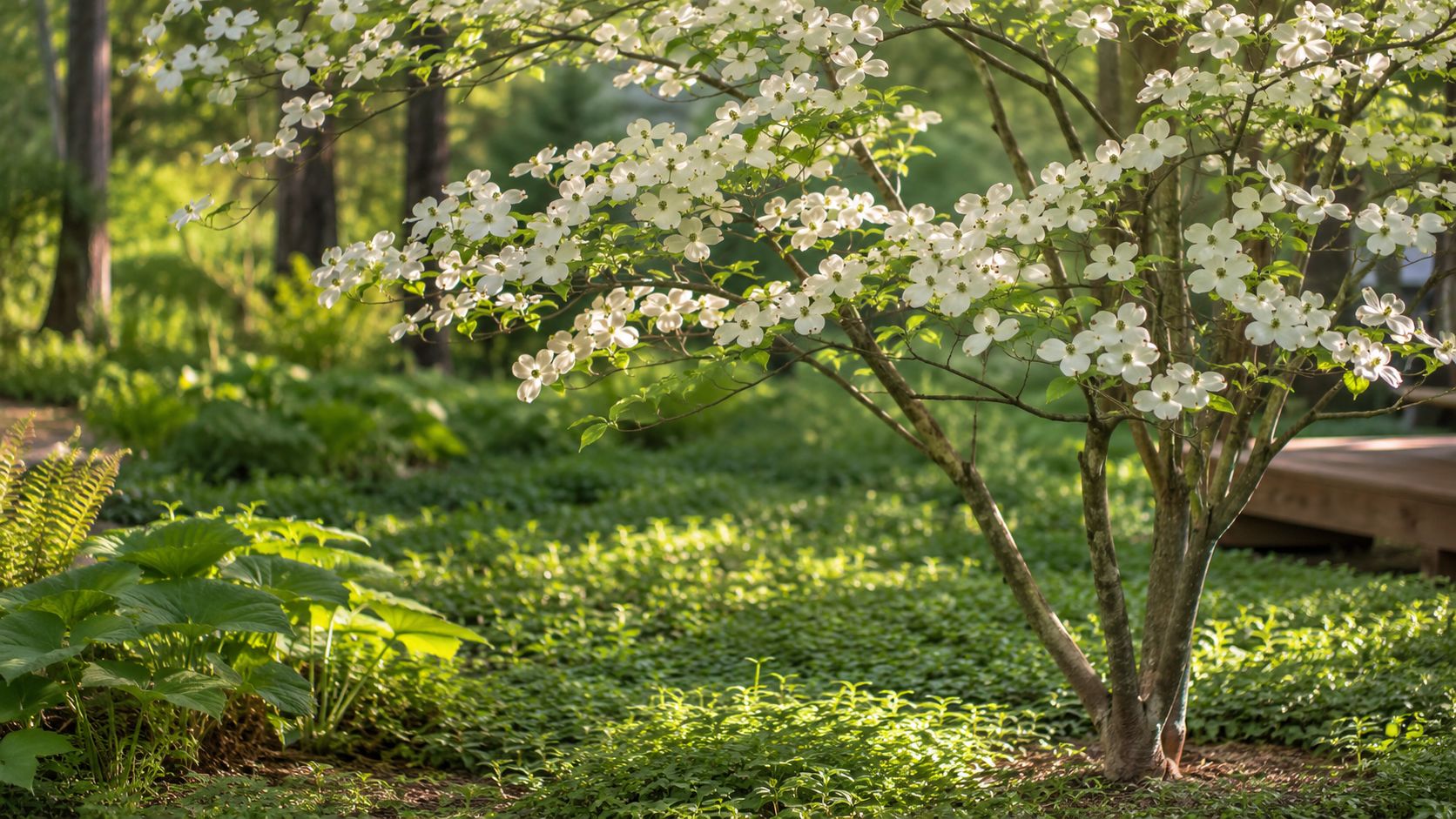
Dogwood also works as a sightline plant. From a kitchen window, it gives spring bloom, summer structure, and fall color without blocking the view the way a denser screen would. That's useful when a homeowner wants the yard to feel layered, not closed in.
A couple of choices matter more than fancy fertilizer:
- Give it dappled shade: harsh afternoon sun is the usual failure point.
- Keep the soil well drained: organic matter helps, but standing water is still a problem.
- Place it where spring light reaches it: nearby deciduous trees can create the right balance.
- Skip late-season pruning: that's when you invite avoidable disease pressure.
When dogwood is used well, it doesn't compete with the house. It makes the porch, path, and foundation read as one composed exterior.
4. Possumhaw (Ilex decidua)
Possumhaw earns its place in a remodeled yard because it keeps working after the rest of the planting bed goes quiet. Once the leaves drop, the red berries stay on and give a patio, fence line, or side yard real shape in winter, which is when many East Texas properties feel bare. Around decks and outdoor living spaces, that visual weight matters, because the hardscape stays visible and the planting has to carry more of the design load.
It also fits the regional conservation story without turning the discussion abstract. East Texas still depends on native plants in real yards, not just in preserves, and that matters for the choices homeowners and builders make every time they refresh a foundation bed or rework a back fence. Native hollies belong in that conversation because they hold up in the kinds of spaces people live in, and they support the wider plant community that keeps showing up in local nursery shelves, county plant sales, and field projects.
Possumhaw is especially useful where the yard needs a winter focal point with some depth behind it. A back deck that looks empty in January feels more finished when a small group of possumhaws is visible from the seating area. Near a foundation or along a side yard, it gives a softer edge than a solid wall of evergreen shrubs, and it does that without trying to dominate the house.
It works best in groups. One specimen can function, but a small cluster gives better berry impact and a fuller read from the porch or from a window. That grouping also helps it read as part of the overall exterior plan, the same way a well-planned fence layout can frame a yard without making it feel boxed in.
4. Possumhaw (Ilex decidua)
Possumhaw earns its keep in winter, which is when many East Texas yards start to feel unfinished. After leaf drop, the red berries hold on and give a patio view, fence line, or side yard some structure when most other shrubs fade into the background. Around remodels, that matters because the hardscape stays visible, and the planting has to do more of the design work.
Possumhaw also fits the local plant story in a practical way. East Texas conservation work is not only about rare plants in preserves, it is also about keeping native plants available for real yards where homeowners, builders, and land managers can still use them. The Native Plant Society of Texas reports only 4 East Texas native plants are listed as federally endangered, but at least 50 species in the region warrant immediate conservation attention because they are in very small numbers or risk extirpation from native habitats (NPSOT symposium proceedings). That is one reason native hollies deserve a place in design plans instead of being treated as filler.
Possumhaw is especially useful where the yard needs a winter focal point. A back deck that looks bare in January feels more finished when a cluster of possumhaws can be seen from the seating area. Near a foundation or along a side yard, it gives a softer edge than a wall of evergreen shrubs, and it does that without crowding the house.
One plant can work, but a small group gives better winter presence.
Use female plants for the berry show, and make sure a male pollinator is part of the planting plan. That detail matters more than the nursery label, because without it the winter display will not give the site what it needs. If a screen is part of the plan, the planting can work beside a well-planned fence layout instead of competing with it.
6. Yaupon Holly (Ilex vomitoria)
Yaupon Holly is one of the most useful evergreens for East Texas outdoor living spaces because it can read formal or relaxed without losing its structure. A patio that feels open in winter benefits from a plant that keeps its body through the cold months, and yaupon does that while still handling shearing if the design calls for a tighter line.
It also has a practical place in East Texas that many homeowners overlook. Regional native plant work depends on collecting, propagating, and reintroducing local ecotypes instead of filling a job with whatever happens to be in stock, a point the East Texas Natives Project has made clear through its restoration and seed-source work. Yaupon fits that approach well because it is durable, adaptable, and useful in mixed residential plantings that need year-round screening.
For remodels, this shrub or small tree often makes sense behind a seating area, beside a side-yard walkway, or along a property edge where privacy matters. It also layers well behind lower shrubs, which helps a patio bed hold its shape through winter without looking stiff or overbuilt.
The trade-off is simple. Yaupon can look too sparse if it is planted as a single specimen and left to do all the visual work. It performs better when the site gives it room to develop into a screen or a grouped backdrop, especially where a remodel has created new views that need softening without adding more hard surface.
A few details make it perform well:
- Use it as a screen, not a spotlight plant: it works best in rows or boundary groupings.
- Give it spacing for overlap: dense coverage comes from patient layout, not crowding.
- Let the form stay natural: over-shaping takes away the texture that makes it useful.
- Reserve it for difficult edges: it is especially practical where soil and exposure are less forgiving.
6. Yaupon Holly (Ilex vomitoria)
Yaupon Holly is one of the most versatile evergreens for East Texas outdoor living spaces because it can be formal or relaxed without losing its structure. A patio that feels exposed in winter benefits from a plant that keeps its body through the cold months, and yaupon does that while still taking shearing if the design calls for it.
It also has a broader place in East Texas than many homeowners realize. The region's flora is heavily native, and the East Texas Natives Project exists because restoration work depends on collecting, propagating, and reintroducing local ecotypes rather than just choosing whatever is available on a retail bench (East Texas Natives Project article). Yaupon fits that philosophy well because it's durable, adaptable, and useful in the kinds of mixed residential plantings that need year-round screening.
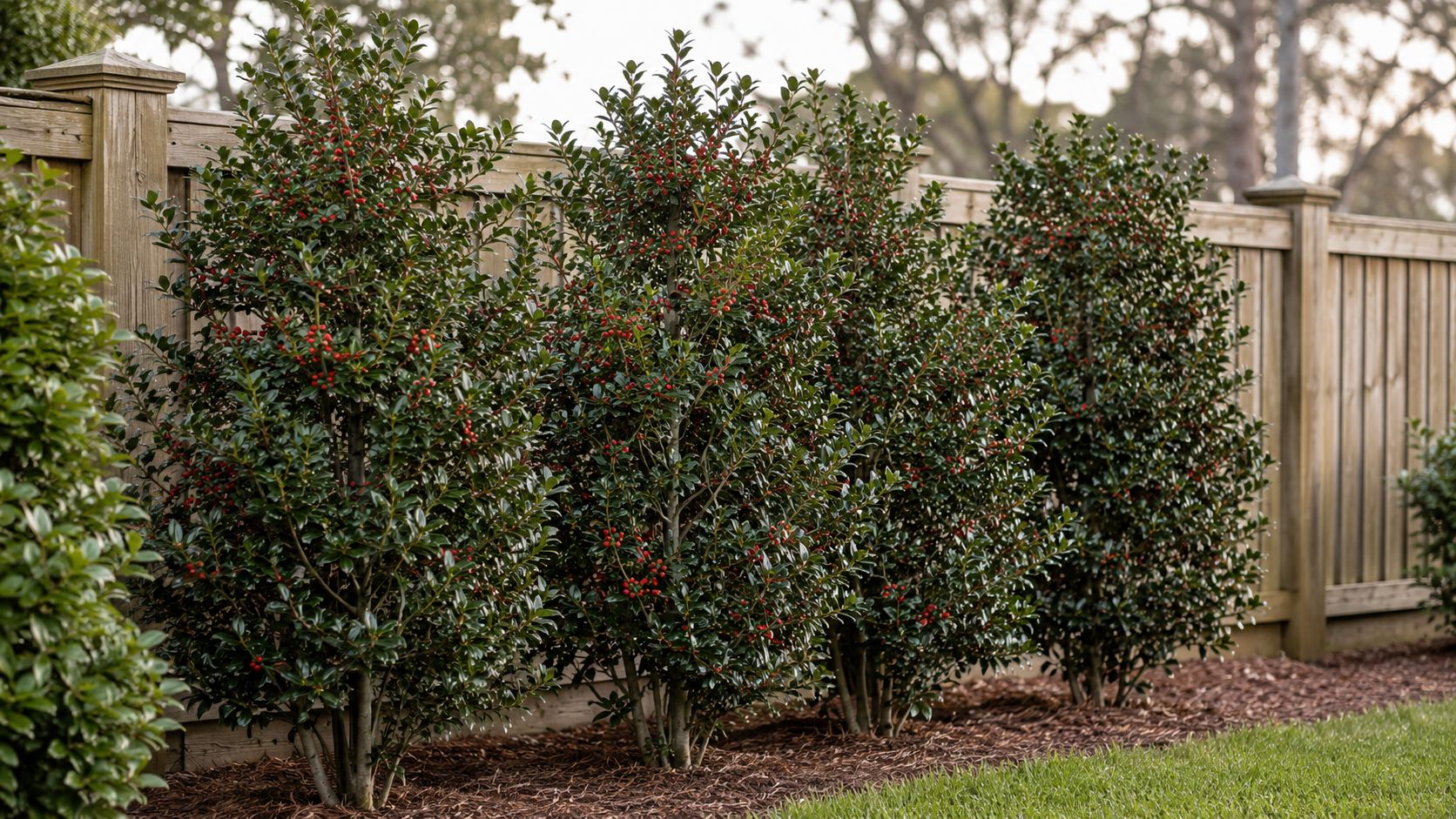
For remodels, this shrub or small tree is often the right answer behind a seating area, beside a side-yard walkway, or along a property edge where visual privacy matters. It can also be layered behind lower shrubs to give a patio planting bed some winter backbone.
The trade-off is simple. Yaupon can be clipped into a clean screen, or it can be allowed to read more naturally, but either way it wants space to do its job. If you're adding it near a deck or fence, decide early whether the plant is meant to be formal architecture or loose screening, because the spacing changes with the goal.
A useful way to think about it is this. Yaupon is not just filler between hardscape features, it's part of the room. The best installations make the plant feel like one more structural material, right alongside the railing, pavers, and fence line.
An embedded video can help homeowners see the shape and habit in motion.
7. Coralberry (Symphoricarpos orbiculatus)
Coralberry is the kind of shrub people overlook until they need something to solve a bad corner. It's low, spreading, and happy in shade or sun, which makes it useful under tree canopies, along the base of a deck, or around a foundation where taller plants would feel clumsy. In remodel work, that low profile is a strength because it softens hard edges without hiding them.
It's also one of the best East Texas natives for the awkward places left behind by construction. A narrow strip beside a walkway, a shaded drainage path, or the bare ground below a porch can all benefit from a plant that doesn't demand perfect light or perfect soil. Coralberry fits the practical reality that some parts of a yard will always be a little rougher than the rest.
The wildlife value is a bonus, but the design value comes first. Those coral to dark red berries keep the shrub from disappearing visually when the flowers are gone, and the plant's habit can read almost like a loose groundcover if you space it properly. That means it can bridge the gap between a shrub bed and a planting that's supposed to feel more natural.
Best use case: place coralberry where a homeowner wants a soft edge but doesn't want a shrub that blocks windows, pathways, or the lower line of a porch rail.
It's not the plant for someone chasing rigid symmetry. It may spread more than expected if you give it room, and that's part of why it works. In a yard that needs to feel established and easy rather than over-designed, coralberry brings just enough structure.
8. Fragrant Sumac (Rhus aromatica)
Fragrant Sumac solves slope problems better than most decorative shrubs ever will. Put it on a bank, along a problem edge, or between deck support posts where mowing is awkward, and it starts doing the work of holding soil and softening the grade. That's why it deserves a place in East Texas remodel planning, especially where outdoor projects alter runoff patterns or leave exposed transitions.
The East Texas native plants aren't just about pretty beds, they include erosion-prone areas, shaded swales, and mixed moisture conditions that need plants chosen for function first. A Wildflower Center resource on East Texas native plant use notes the region needs erosion control, shade-tolerant groundcover, and species matched to water needs, not just bloom color, because native doesn't automatically mean low-maintenance everywhere (Wildflower Center expert guidance). Fragrant Sumac fits that more realistic design logic.
This shrub is also one of the easiest ways to make a trouble spot look intentional. Its fall color gives a strong seasonal cue, and the low, spreading shape makes it useful where the planting bed has to do more than decorate. Around a remodel, that often means a slope beside a new patio, a strip beside a driveway, or a transition zone between hardscape and lawn.
A few site notes keep it practical:
- Use it on slopes: that's where its spreading habit earns its keep.
- Keep it off high-traffic paths: the foliage can irritate skin.
- Plant where it can expand: crowding defeats the ground-holding value.
- Treat it as a utility plant with style: it's functional first, ornamental second.
Fragrant Sumac is the opposite of a fussy accent plant. It's a problem-solver that still looks good when the rest of the yard is trying to behave.
8 East Texas Native Plants Comparison
| Species | 🔄 Implementation complexity | ⚡ Resource requirements | 📊 Expected outcomes | 💡 Ideal use cases / tips | ⭐ Key advantages |
|---|---|---|---|---|---|
| Texas Red Oak (Quercus buckleyi) | Moderate, long establishment, large spacing | Low–moderate water once established; deep, well-draining soil; large planting area | Large shade canopy, long-term cooling/energy savings, strong wildlife support | Best for large yards, framing decks/patios, erosion control; plant fall/early spring, space 40–50 ft | ⭐⭐⭐⭐⭐ Long-lived, drought-tolerant shade tree |
| Flowering Dogwood (Cornus florida) | Moderate, sensitive to site (needs dappled shade) | Moderate water; well-draining, amended soil; disease monitoring | Early spring floral display, understory interest, attracts birds | Small yards, foundation plantings, shaded patios; avoid full sun, plant near deciduous canopy | ⭐⭐⭐⭐ Spring blooms, fine ornamental understory |
| American Beautyberry (Callicarpa americana) | Low, adaptable but spreads via rhizomes | Low–moderate water; tolerates varied soils and light | Vibrant purple berries late summer–winter, strong wildlife food, informal screen | Wildlife corridors, privacy screens, rain gardens; prune in spring, space 4–6 ft | ⭐⭐⭐⭐ Versatile, wildlife-attracting berry display |
| Possumhaw (Ilex decidua) | Moderate, dioecious (male + female required) | Moderate water; tolerates wet and dry soils; may need specialty sourcing | Persistent red winter berries (female), winter structural interest, bird food | Winter interest near patios/decks, riparian buffers; plant male pollinator with females | ⭐⭐⭐⭐ Outstanding winter ornamental and wildlife resource |
| Texas Privet (Forestiera texana) | Low, easy to plant, occasional pruning for form | Low water; tolerates poor/alkaline/rocky soils | Dense semi-evergreen screening, low-maintenance boundary | Natural hedge or windbreak, space 3–5 ft; plant fall for best establishment | ⭐⭐⭐⭐ Tough, low-maintenance privacy screen |
| Yaupon Holly (Ilex vomitoria) | Moderate, dioecious and sometimes specialty-sourced | Low–moderate water; adapts to many soils; tolerates pruning | Year-round evergreen screen, red berries (with male pollinator), edible leaves | Evergreen privacy screens, formal/informal hedges, yaupon tea production; plant male + female | ⭐⭐⭐⭐⭐ Evergreen, multi-functional (privacy + cultural use) |
| Coralberry (Symphoricarpos orbiculatus) | Low, very tolerant, can spread | Low water; tolerates compacted/poor soils | Low-profile cover, erosion control, fall/winter berries for wildlife | Foundation plantings, understory, erosion-prone sites; space 2–3 ft, prune if aggressive | ⭐⭐⭐⭐ Extremely hardy and site-flexible |
| Fragrant Sumac (Rhus aromatica) | Low, simple to establish, containment may be needed | Low water; thrives in poor, rocky soils | Excellent erosion control, brilliant fall color, wildlife cover | Slopes, bluffs, between deck supports; plant fall–early spring, allow spread but avoid high-traffic areas | ⭐⭐⭐⭐ Superior for slope stabilization and fall color |
From Plant List to Finished Landscape
I've seen the difference on East Texas homes more than once. The best east texas native plants do more than survive. They solve site problems, frame outdoor rooms, and make a remodel feel finished from the curb to the back fence. That starts with a simple sequence, first a soil test, then a sun map, then plant sourcing from regional growers who can tell you what's available, what's local, and what will establish in your conditions.
Planting timing matters too. Fall and early spring are the safest windows for most natives because roots can settle before summer heat starts pushing the system hard. Mulch comes next, but not piled against trunks or stems, just enough to cool the soil and hold moisture without creating rot. After that comes disciplined watering during the first two years, because establishment takes longer than many homeowners expect, especially where the summer heat and sandy or clay soils put stress on new plantings.
That sequence matters even more when the planting area is tied to hardscape. A deck, patio, fence, or outdoor kitchen isn't separate from the planting plan, it sets the sightlines, shade patterns, drainage, and access routes the plants have to live with. If the plan gets coordinated late, homeowners end up forcing trees into utility runs, screens into narrow strips, or slope plants into the wrong exposure. I've had to correct that kind of mismatch on more than one property, and it usually costs more than getting it right at the start.
A planting plan integrates best when the exterior project is planned as one system. Hardscape and planting zones should be laid out together, because each one affects the other. Home Pro's Remodeling & Repairs works across Tyler and East Texas on outdoor living spaces, fencing, additions, and exterior upgrades, so the planting work can be aligned with the remodel instead of patched in after the fact. If you are comparing how much structure the yard needs before plants go in, a deck building cost estimate can help frame the rest of the exterior budget.
The long-term payoff is straightforward. A yard planted with the right natives gets easier every year, not harder. The beds fill in, the screening matures, the shade gets better, and the whole property starts working like part of the house instead of a leftover project. That is the advantage of native plantings around East Texas homes; they hold the plan together after the remodel crew leaves.