
A typical East Texas deck runs roughly $30 to $60 per square foot installed, so a 200-square-foot deck lands around $6,000 to $12,000 before upgrades, with the final number driven by materials, elevation, and site access. In actuality, that first number usually changes once you measure the yard, look at the soil, and decide whether the deck needs stairs, railings, or permit work.
Table of Contents
- Why Your First Deck Quote Almost Never Holds
- Per-Square-Foot Ranges You Can Actually Plan Around
- What a Line-Item Deck Estimate Actually Contains
- Material Choices That Move the Number the Most
- Site Prep, Permits, and East Texas Conditions
- Sample Estimates for Common East Texas Decks
- Financing, Payment Schedules, and Getting an Accurate Bid
- Smart Tips Before You Sign a Deck Contract
Why Your First Deck Quote Almost Never Holds
A Tyler homeowner calls about a simple backyard deck and hears a number that sounds manageable. Then the written estimate comes back higher, because the contractor measured the slope, counted the stair runs, and priced the railing instead of guessing from the patio photo. That gap feels frustrating until you see how a deck building cost estimate is really assembled.
The first number is usually a placeholder
A square-foot guess can help you decide whether the project is even in reach, but it can't capture the parts that make a bid real. A deck estimate needs to include surface materials, framing, labor, railing, stairs, permits, demolition, cover options, and contingency, because those items are what turn a sketch into a buildable scope. A calculator that ignores those pieces will almost always mislead you.
Practical rule: treat the first online number as a planning range, not a commitment.
The spread can get big fast. A 16×20-foot deck, which is 320 square feet, can land in very different price bands depending on whether it's built in pressure-treated lumber, mid-grade composite, or a luxury package with upgraded railing and drainage features. That's why a bid that looks “high” on paper may be the more honest one once the line items are visible.
East Texas adds its own variables
Around Tyler, the yard itself matters. Clay soil, drainage issues, tree roots, and access through a narrow side yard can all change the labor and foundation work, even when the deck footprint stays the same. Humidity also pushes some homeowners toward lower-maintenance materials, because they'd rather pay more up front than keep up with staining and sealing.
The right way to judge a contractor's number is simple, ask what's included and what's not. If the quote is one lump sum with no detail, it's not really a finished estimate, it's a starting conversation. A solid bid should let you compare scope, not just price.
Per-Square-Foot Ranges You Can Actually Plan Around

National planning guides put a typical new deck at about $8,000 to $14,000, with a common range of $4,000 to $20,000 depending on size, materials, and complexity, and several sources cluster around $30 to $60 per square foot for professionally built decks. NerdWallet's national average lands at $14,000 with a typical range of $9,000 to $20,000, while Angi reports an average of $8,214 with a range of $4,342 to $12,546. Those numbers are useful because they give homeowners a sane middle ground before any site visit happens.
What those ranges mean in East Texas
A 200-square-foot deck at $30 to $60 per square foot comes out around $6,000 to $12,000 before major upgrades, which lines up well with the way many East Texas projects start. Once you add railings, stairs, or a tougher site, that number moves. Once you choose composite or PVC, it moves again.
The cleaner way to plan is by material tier. A basic pressure-treated deck often sits near the lower installed range, while composite or PVC pushes toward the top because material, clips, trim, and finish details all cost more. For early budgeting, I'd use $25 to $50 per square foot for pressure-treated wood and $45 to $85 per square foot for composite when railings are part of the job.
Why same-size decks can price very differently
Deck size is only one variable. A flat, ground-level platform is a very different build from a raised deck that needs longer posts, more bracing, and stairs. Nationally, labor alone commonly runs $8 to $22 per square foot, so even if material costs stay fixed, site conditions and crew productivity can shift the final number.
A good benchmark is the 200-square-foot deck, because it's large enough to show real construction costs without becoming a full outdoor room. At that size, the difference between a simple wood platform and a more finished composite build can be large enough to change the decision entirely. Use the range for budgeting, then insist on a line-item quote before signing.
A fair estimate should let you see where each dollar goes, not hide the project behind one tidy total.
What a Line-Item Deck Estimate Actually Contains
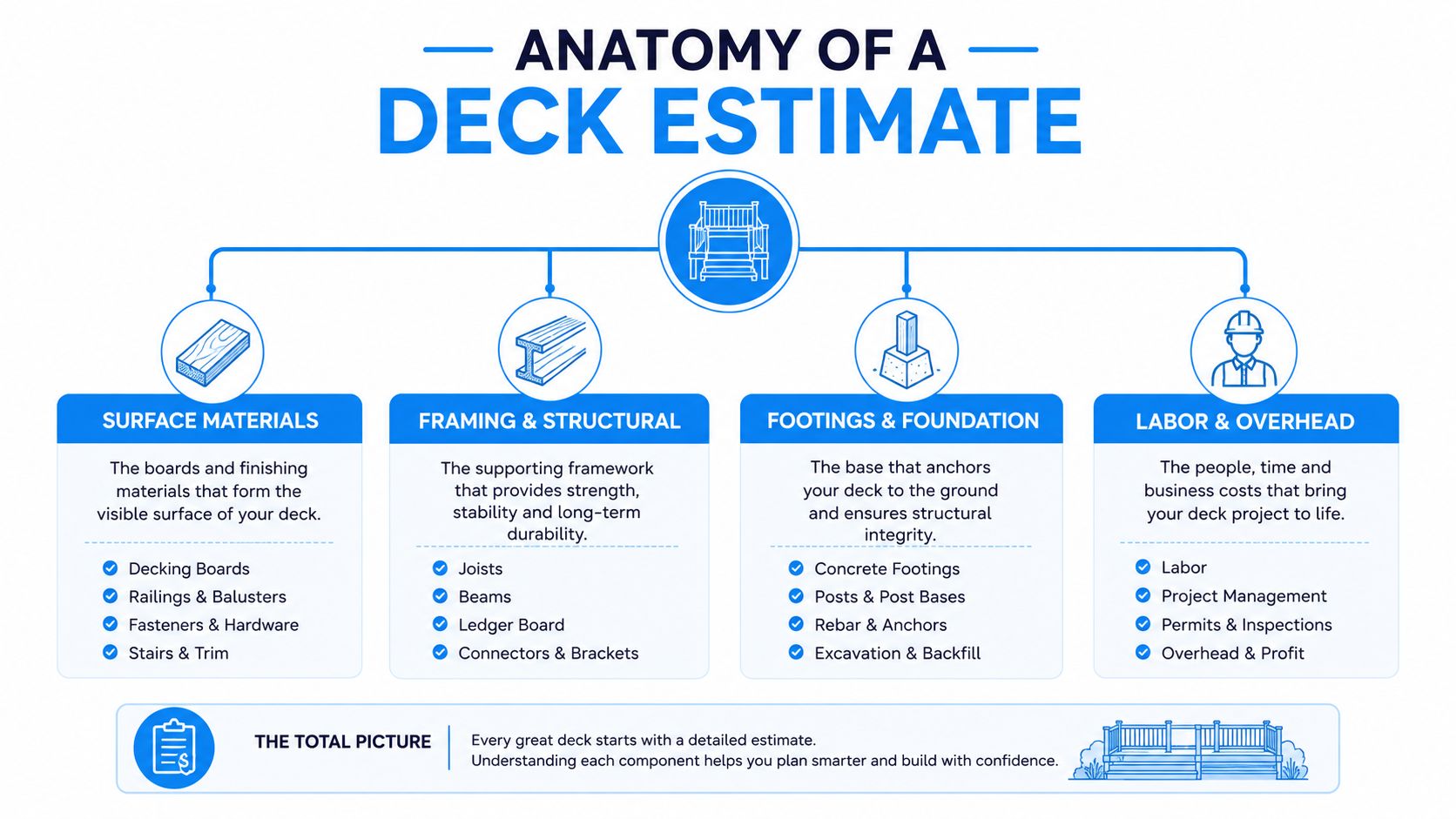
Video walkthrough of deck estimating basics
A real deck building cost estimate starts with the hidden structure, not the pretty boards. One industry breakdown attributes roughly 38% of total cost to substructure material and labor, 30% to decking and railing labor, 12% to railing material, and 20% to decking material and fasteners. That's the point many homeowners miss, because the visible boards are only part of the expense.
The pieces that belong on the page
A defensible estimate separates the job into distinct lines. That usually means surface materials, framing and substructure, labor, railing, stairs, permits, demolition, cover options, and contingency. When those items are broken out, you can see whether a quote is heavy on labor, light on structure, or missing a scope item entirely.
Practical rule: if the bid only shows a single total, ask for the missing line items before you compare it to anything else.
The hidden cost problem usually comes from omission. Permits get skipped, demo gets buried, railing lengths get undercounted, and stair pricing gets treated like an afterthought. That's how a quote that looks competitive on day one becomes expensive once the project is underway.
How to sanity-check a written bid
A written estimate should tell you what the contractor is building, what it includes, and what would trigger a change order. If the quote doesn't name the decking type, the railing type, or the footing plan, you're still not looking at a true build sheet. In East Texas, that matters because soil conditions and access can change the amount of digging and concrete faster than a homeowner expects.
A useful habit is to compare the quote against the actual deck anatomy. You want to see posts, beams, joists, decking, railing, stairs, permit fees, and disposal described in plain language. If those parts aren't there, the number is incomplete, even if it looks neat on the page.
Material Choices That Move the Number the Most
The fastest way to change a deck estimate is to change the material tier. For a 16×20-foot deck, recent guides show a pressure-treated build averaging about $9,600 to $12,800, a mid-grade composite build around $12,800 to $22,400, and a luxury package with features like aluminum railing, lighting, and water-management systems around $19,200 to $32,000. Another benchmark cited in 2025 puts a national-average wood deck addition at $18,263 and a composite addition at $25,096, which shows a premium of roughly 37% for composite in that dataset, according to the 2025 Cost vs. Value deck benchmark summarized by Ergeon.
Wood, composite, and premium packages
Pressure-treated lumber is still the workhorse for homeowners who want the lowest entry price. It's familiar, easy to source, and straightforward to repair, which keeps labor more predictable. The trade-off is maintenance, especially in East Texas humidity, where staining and sealing become part of ownership.
Composite changes the math. The surface boards cost more, but many homeowners like the lower-maintenance profile and the cleaner finished look. Premium packages go further, adding items such as aluminum railing, lighting, and water-management systems, which can push the estimate well beyond a plain platform.
| Material Tier | Typical Range | Best For |
|---|---|---|
| Pressure-treated wood | $9,600 to $12,800 for a 16×20 deck | Budget-conscious builds and simple platforms |
| Mid-grade composite | $12,800 to $22,400 for a 16×20 deck | Lower maintenance and a more finished look |
| Luxury package | $19,200 to $32,000 for a 16×20 deck | Premium outdoor living spaces with extras |
Why East Texas homeowners often upgrade
Heat and humidity make low-maintenance materials more attractive here than in a drier climate. Composite and PVC don't erase all upkeep, but they reduce the kind of routine attention that untreated wood demands. That's why I often see homeowners start with a wood budget, then decide they'd rather pay for durability and fewer chores.
The other upgrade path is railing. Aluminum and PVC systems cost more up front, but they clean up the look and avoid some of the maintenance that wood railings bring with them. If you're comparing bids, don't just ask what the deck boards are, ask what the railing system is and whether hidden fasteners are included.
Site Prep, Permits, and East Texas Conditions
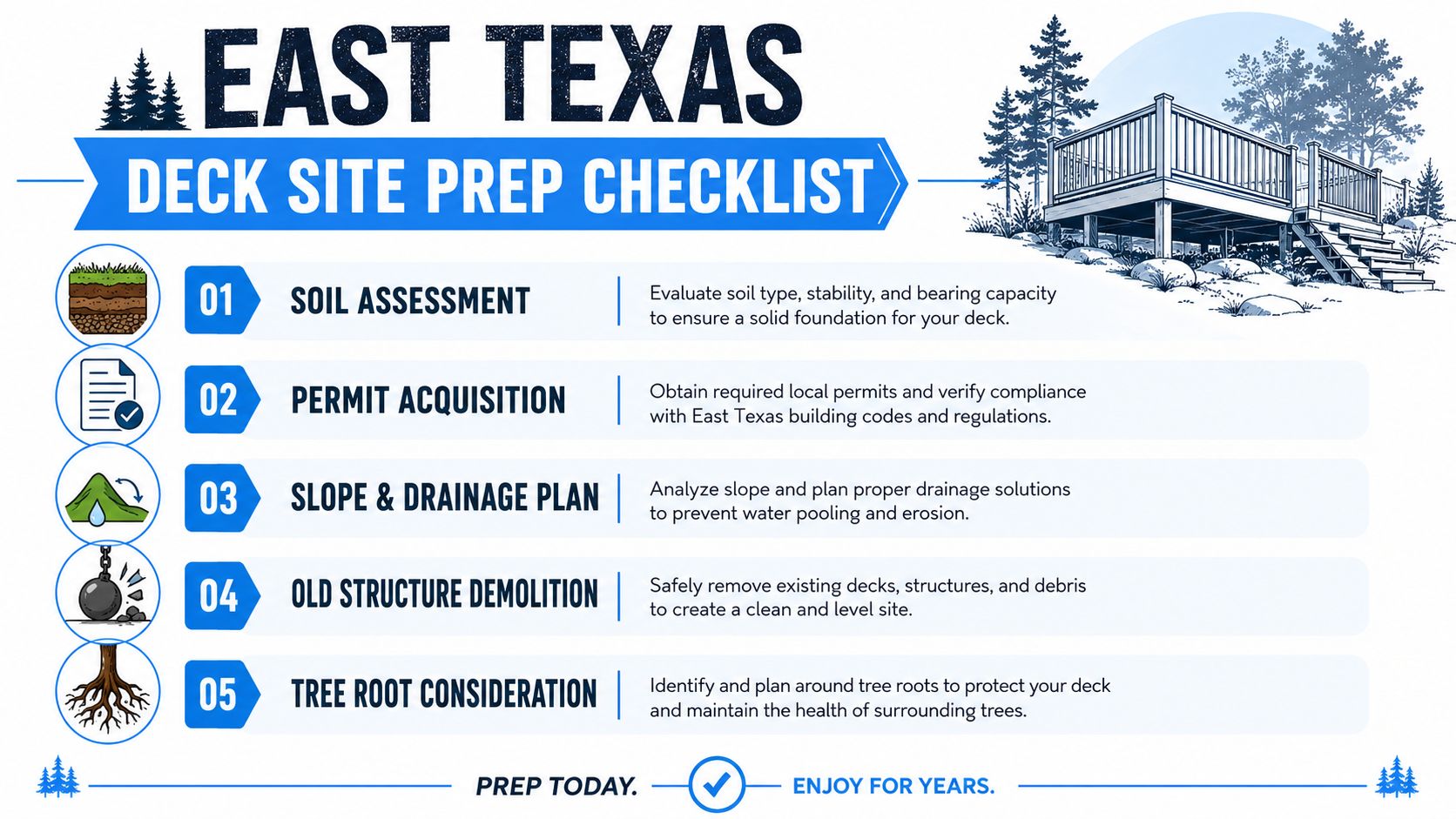
Clay soil, roots, slope, and access are where East Texas deck budgets get real. A clean online calculator can't tell you if the crew has to haul material through a tight side yard, cut around an oak root flare, or work on ground that sheds water toward the house. Those conditions add labor, and labor is a major part of the total.
The items that quietly add cost
Railings commonly add $30 to $120 per linear foot, stairs often run $75 to $200 per step, and permits can run $100 to $500, with many jurisdictions requiring permits for decks over 200 square feet or more than 30 inches above grade, according to Contractors Locator's deck cost calculator. Those line items can change a quote more than a homeowner expects, especially on a raised deck or a layout with multiple entries.
The soil matters just as much. Expansive clay can complicate footing work, and grading may be needed to keep water from pooling where the deck meets the house. If an old patio or existing structure has to come out first, demolition and disposal need their own line too.
A checklist that belongs in the estimate
- Soil Assessment: Check whether the yard needs deeper footing work or a different foundation approach.
- Permit Acquisition: Verify permit needs before pricing, especially for raised or attached decks.
- Slope and Drainage Plan: Make sure water moves away from the home, not into the new structure.
- Old Structure Demolition: Price removal separately so debris doesn't get buried in the total.
- Tree Root Consideration: Adjust footing placement when mature trees are close to the build area.
A written estimate should also tell you whether inspections are part of the schedule. If the contractor is vague about permit handling or foundation work, the final bill is likely to be vague too. For homeowners comparing options, the most useful question is simple, what changes if the yard is harder than it looks?
For a broader home exterior project that sits next to a deck build, see the planning approach used in home exterior remodeling services.
Sample Estimates for Common East Texas Decks
A small ground-level platform, a raised family deck, and a larger entertaining deck don't price the same way, even when the lumber yard is the same distance away. The footprint matters, but elevation, railing length, and stair count matter just as much. That's why two decks with similar square footage can land in very different final ranges.
A small 12×16 platform
A 12×16-foot deck is 192 square feet, which keeps it near the low end if it stays simple and ground-level. In pressure-treated wood, a basic build typically runs $2,900 to $4,800, while a composite version runs $4,800 to $8,600, according to the project benchmarks in the verified data. That kind of deck works well for a grill pad, a small sitting area, or a clean step-out from a back door.
The estimate stays tighter when stairs and railings are minimal. If the grade is forgiving and the access is good, the framing stays straightforward and the labor stays more predictable. That's the kind of job where a homeowner can keep scope under control without cutting corners.
A mid-size 16×20 raised deck
A 16×20-foot deck at 320 square feet is where line items start to matter more. The wood version can average $9,600 to $12,800, the composite version $12,800 to $22,400, and the premium package can reach $19,200 to $32,000. Add stairs, railings, and a permit, and the gap between the first guess and the final price gets easier to understand.
A larger entertaining deck
A 20×24-foot deck is 480 square feet, and once you add a partial cover, upgraded railing, and a raised layout, you're in a different class of project. For that kind of build, a realistic East Texas budget often lands between $18,000 and $30,000 depending on the material tier and the amount of site work required. Those numbers are why measuring the actual scope beats guessing from a photo.
For homeowners comparing outdoor spaces beyond decks, patios and fences planning often becomes part of the same budget conversation.
Financing, Payment Schedules, and Getting an Accurate Bid
Once the range makes sense, the next question is how to pay for the job without getting boxed into a bad deal. Most reputable contractors tie payment to milestones, not pressure. That usually means a deposit, then progress payments after framing, after the deck surface is in, and at final walkthrough.
Milestones matter more than promises
A payment schedule should track visible progress. If the contractor wants a large upfront payment without a clear material order or start date, that's a red flag. Written change orders matter too, because deck work can shift when hidden rot, bad footing conditions, or access issues show up after demolition starts.
A good bid answers two questions at once, what the deck costs and what would change that cost.
An on-site estimate is where the number usually gets honest. The crew can measure access, confirm elevation, see the existing structure, and decide whether the soil or layout will complicate the build. That's much more useful than a calculator built from square footage alone.
Use financing only after the scope is clear
If financing is part of the plan, wait until the scope is detailed and the bid is written. That way the loan or payment plan matches the project instead of a rough guess. For a larger remodel that may involve multiple exterior improvements, the same principle applies: get the scope fixed first, then talk about terms. A useful starting point for broader project planning is home additions and major remodels, because those budgets often overlap with deck decisions.
The smart sequence is simple, online research first, on-site estimate second, signed scope third. That order keeps the budget grounded in the actual yard instead of a generic price chart.
Smart Tips Before You Sign a Deck Contract
The cheapest square-foot quote is rarely the best value if it leaves out footing work, permit fees, or the railing system you want. A deck estimate should be easy to verify line by line, because that's how you avoid a pleasant-looking number that turns into a bigger final bill. The best bids read like a build plan, not a teaser.
What to check before you commit
- Compare written bids: Get at least three line-item estimates so you can see where each contractor put the money.
- Ask for similar local references: East Texas decks deal with the same soil, heat, and humidity you're dealing with.
- Verify licensing and insurance: If the paperwork isn't current, the savings aren't worth the risk.
- Confirm the exclusions: Landscaping restoration, electrical work, and hidden structural repair should be named clearly.
- Build in contingency: A 10% to 15% contingency helps cover surprises without blowing up the plan.
The other thing to watch is warranty language. If the contractor won't put workmanship terms in writing, that's a problem. You want to know who stands behind the build once the last inspection is done.
A solid deck building cost estimate should make the project easier to decide, not harder. When the line items are clear, you can choose between wood and composite, simple and raised, basic and upgraded, without guessing what's hiding in the fine print.
A CTA for Home Pro's Remodeling & Repairs. If you're planning a deck in Tyler or anywhere in East Texas, schedule a free on-site estimate so your budget is built from real measurements, real site conditions, and a written line-item scope you can compare.