
You're standing in your kitchen in the morning, coffee in hand, looking at oak doors that have gone orange with age. The finish is worn around the handles. One drawer front is chipped. But when you open a cabinet and press on the sides, the boxes still feel solid, and the layout works fine for how you cook.
That's the exact spot where most East Texas homeowners get stuck. A full tear-out feels like too much. A coat of paint feels like too little. And somewhere in between sits kitchen cabinets refacing, an option that's easy to misunderstand because the word sounds like painting when it isn't.
The decision doesn't start with door styles or colors. It starts with one question you can answer with a flashlight: are your cabinet boxes sound enough to carry a new finish for another decade or more? If they are, and your layout already works, refacing can give you a kitchen that looks new in days. If they aren't, covering them up just buys you a prettier problem. This guide walks you through that check, box by box, so you can walk into a contractor conversation with a verdict instead of a guess.
Table of Contents
- Refacing vs Replacement at a Glance
- What Cabinet Refacing Actually Covers
- Check Your Boxes and Choose the Path
- How Refacing Works, Step by Step
- Costs, Timelines and Material Life
- Confirm the Scope Before You Sign
Refacing vs Replacement at a Glance
Say your doors look tired but your boxes feel solid when you knock on them. You're not dreaming about moving the sink or adding an island. You just want the room to look current again. That's the kitchen refacing was built for, and the table below shows where the two paths split.
| Factor | Refacing | Full replacement |
|---|---|---|
| Cabinet boxes | Kept, only if sound | Removed and rebuilt |
| Doors and drawer fronts | Replaced | Replaced |
| Layout changes | Not possible | Possible |
| Structural damage | Cannot be repaired by refacing | Replaced |
| In-home timeline | Often 2 to 4 days for about 32 openings | Set by demolition, rough-in work and cabinet lead times |
| Disruption | Lower, mostly doors and surfaces | Higher, full demolition |
| Construction waste | Lower, boxes stay in place | Higher, boxes go to disposal |
| Cost direction | Lower than replacement | Higher than refacing |
Refacing keeps your cabinet boxes screwed to the wall and replaces everything you see: doors, drawer fronts, end panels and exposed surfaces. Replacement removes all of it, which is why it can also change the layout, fix storage that never worked, and rebuild a failing sink base. That freedom costs more time, because demolition, possible plumbing or electrical rough-in, and cabinet lead times all stack up before installation even starts.
The timeline gap matters for families who cook every night. A refacing crew working through roughly 32 cabinet and drawer openings can finish the in-home work in a few days, so your kitchen stays partly usable. If you want a fuller picture of the upside before you decide, this walkthrough of how cabinet refacing refreshes your kitchen lays out the practical benefits in plain terms.
The rule that decides it: refacing wins when the boxes are sound and the layout works. Replacement wins when either one fails.
What Cabinet Refacing Actually Covers
Think of refacing as a new outfit on a sound body. The body, your cabinet boxes and face frames, stays exactly where it is. What changes is everything that faces the room.

The Parts That Get Replaced or Covered
A typical reface covers the face frames with a bonded veneer or laminate skin, swaps in new doors and drawer fronts, adds matching end panels on exposed sides, and finishes with new hinges and hardware sized for the new doors. Because the skin is an engineered or veneered product bonded to the frame, the finish is a new material, not a coat of paint over your old one. That distinction explains why refacing grew as its own trade. A 2004 report in Professional Remodeler, summarized in a cabinet refacing cost history, noted that a complete new cabinet and door could cost a contractor about $200, while a replacement door ran roughly $35 to $100, which made covering sound boxes a different product from repainting them.
Here's a one-sentence definition you can repeat to any contractor: refacing replaces the doors, drawer fronts, end panels and exposed surfaces of cabinets whose boxes are sound, and keeps the existing layout.
What Refacing Leaves Alone
Your interior layout, storage geometry, carcass structure and sink-base construction don't change. That creates three clear limits worth naming before you fall in love with a door sample.
- Failing boxes: a new skin can't restore strength to swollen or delaminated panels, because the weak material is still carrying the load underneath.
- Poor layout: if you bump into the open dishwasher every night, refacing preserves that frustration under a nicer finish.
- Missing storage: refacing can't turn a door cabinet into deep drawers or add a pantry, because the openings stay the same size and shape.
Check Your Boxes and Choose the Path
Everything hinges on one question: will your boxes carry a new finish for another decade or more? Don't answer it from across the room. Grab a flashlight and a small level, empty the sink cabinet, and work through each box the way an installer would.

The Flashlight Checklist
- Swelling at box bottoms: run your hand along the lowest edges of base cabinets and feel for puffy, soft spots where mop water or leaks have soaked in.
- Delaminated particleboard: look for layers peeling apart or crumbling edges, especially where screws and hinges anchor.
- Sagging shelves and loose boxes: set the level across shelves, then push gently on each box to check for movement against the wall rail.
- The sink base: inspect this one hardest, because slow plumbing leaks and dishwasher drips cause most hidden damage. Look for dark staining, a musty smell and a floor panel that flexes under your palm.
- Drawer bottoms: pull a drawer out and press on its bottom panel. A panel that bows or crackles tells you the interior parts are aging out too.
- Pest damage: check rear corners and toe-kick areas for pinholes, frass or hollow-sounding wood when you tap it.
Why Moisture Decides More Than Appearance
Veneer and laminate only perform if they bond evenly to the frame. The U.S. Forest Service Wood Handbook reports that wood adhesives generally achieve optimum properties when wood moisture content is approximately 6% to 14%. In plain terms, your installer needs to confirm the substrates are clean, dry and sound before any skin goes on, because excess moisture weakens the bond, slows curing, and invites blistering and edge failure later. In East Texas, seasonal humidity plus the wet zone around sinks and dishwashers makes this check more important than it would be in a drier climate.
This is also where honest guidance matters more than a sales pitch. Guidance on sustainable kitchen cabinet design and when refacing is a poor fit makes the point that refacing suits sound carcasses with mostly cosmetic problems, while damaged or swollen boxes and broken layouts point to replacement. If you're still weighing a simpler paint job against all this, the Dublin kitchen cabinet painting advice from Aqua Painting is a useful reality check on what paint alone can and can't do. For lower-cost update ideas that fit around this decision, see our guide on how to update kitchen cabinets on a budget.
Watching a careful box inspection once will show you what your hands should be feeling for during your own check.
Your Box-by-Box Verdict
| Situation | Recommended path |
|---|---|
| Sound boxes, dated doors and drawer fronts | Refacing |
| Swollen or delaminated particleboard boxes | Replacement |
| Layout does not work for daily use | Replacement |
| Local sink-base leak with otherwise sound boxes | Repair the damaged section first, then decide |
| Sagging or loose boxes | Replacement |
| Plan to stay 10+ years on a limited budget with sound boxes | Refacing |
Covering damaged boxes doesn't save money. It schedules a second project a few years later, and paying for demolition twice erases whatever the reface saved you.
Ask for the result in writing, box by box, as a repair, reface or replace recommendation. That one document protects you more than any percentage-savings claim in a brochure.
How Refacing Works, Step by Step
Refacing looks simple from the doorway, but the order of operations is what separates a finish that lasts from one that lifts at the edges in year three. Here's the sequence a careful crew follows, and the slip to watch for at each stage.
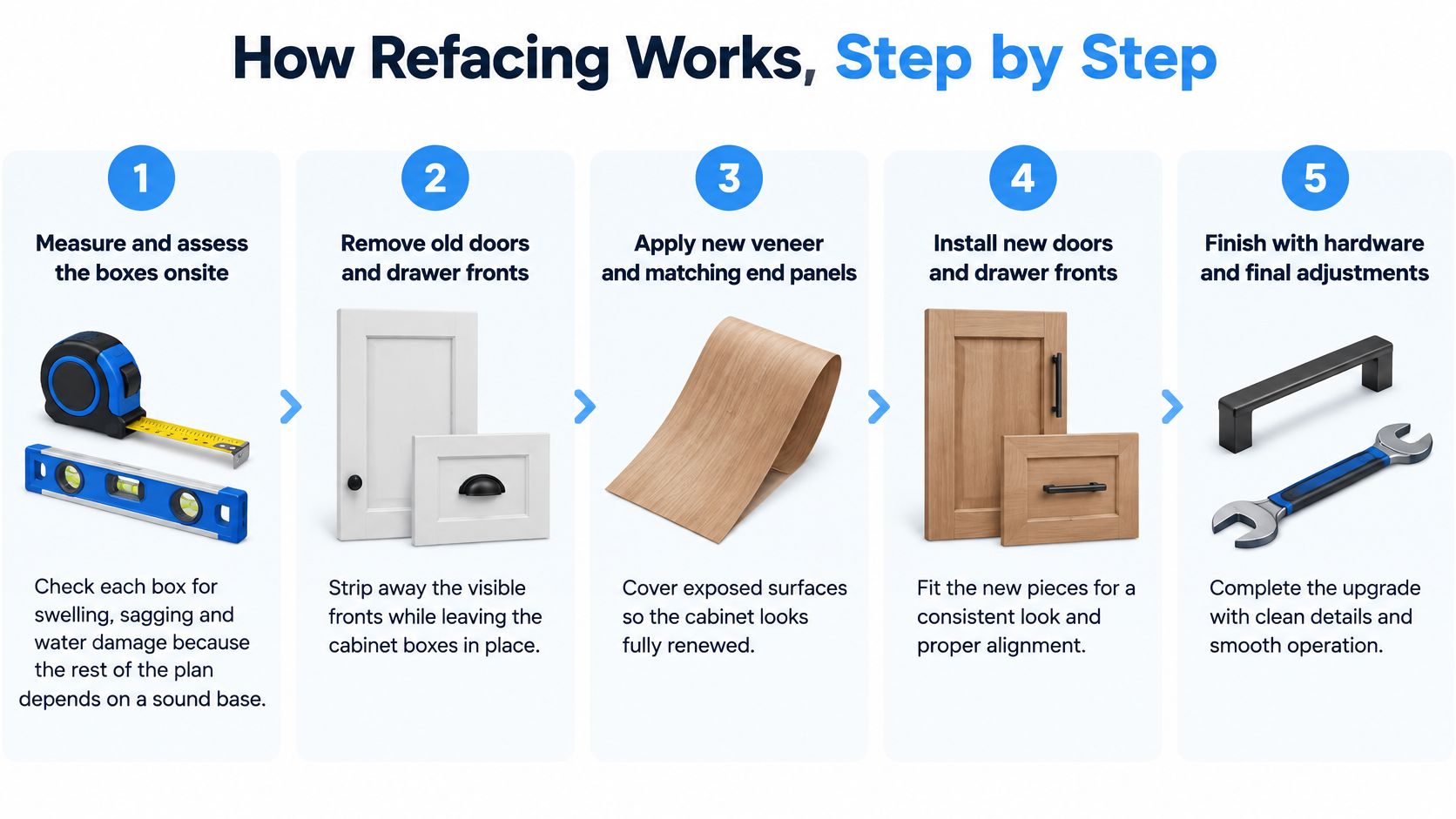
- Measure and assess onsite. The crew measures every opening and checks each box for swelling, sagging and water damage, because the whole plan depends on a sound base. The common slip is measuring from photos, which misses the one soft sink base that changes the scope.
- Choose style, material, color and hardware. You pick a door profile, veneer or laminate, finish and pulls from physical samples held against your counters and light. These choices set the production lead time, so changing your mind later restarts the clock.
- Order the custom pieces. Doors, drawer fronts and matching end panels are made to your measurements. This wait is usually the longest part of the project, and it's why signing day and install day are rarely in the same week.
- Strip and prep the frames. Old doors, drawers and hardware come off. The crew cleans, sands and repairs the face frames so the new skins bond to a sound, grease-free surface. Skipping this prep is the single most common cause of edge lift, because adhesive can't grip cooking residue.
- Apply veneer or laminate to frames and exposed sides. The new skin is bonded, trimmed flush and sealed at every exposed edge. Unsealed edges are where failure starts, since steam and splash water wick into the substrate at any open seam.
- Hang doors, fronts and hardware. New hinges go on, drawer fronts mount to your existing drawer boxes, and the crew confirms clearances around ovens and dishwashers so doors open fully without rubbing.
- Adjust, seal and walk through. Every door gets aligned, remaining edges get sealed, and you do a final walkthrough together. Rushing this step leaves uneven gaps that you'll notice every single day.
Your Walkthrough Checklist
Before you sign off, open and close everything yourself. Check that doors align with even gaps, drawers close evenly without dragging, every edge feels sealed with no rough or open seams, and appliance doors clear the new fronts. Run a fingertip along the bottom edge of upper cabinets near the stove and dishwasher, since those seams take the most steam. Anything that catches your nail now will catch moisture later, so point it out while the crew and their tools are still in the room.
Costs, Timelines and Material Life
Two kitchens with the same run of cabinetry can produce refacing quotes that sit far apart, and the gap usually confuses homeowners. The confusion clears up once you see how a quote is built. Refacing is priced like a made-to-measure order, not a flat package: the number of doors and drawer fronts, the material you choose, custom versus stock sizes, hardware, finishing labor, and any new end panels or appliance panels each add a line. A drawer-heavy kitchen costs more to reface than a door-heavy one of the same length, which surprises people who expect pricing by the foot alone.
Because every kitchen has a different count of those parts, no honest dollar figure applies across the board. What you can do is compare written local quotes built on the same list of components. Our kitchen remodeling cost guide shows how cabinet work fits into a full project budget, and if you're torn between surface work and starting over, this breakdown of refinishing versus replacing kitchen cabinets helps you weigh the smaller-scope option.
One more thing belongs in your head before any price does. Every number in this section assumes your boxes earned a pass on the condition check. A low refacing quote on a run with a soft floor or crumbling face frame buys a faster failure, not a cheaper kitchen, because new doors and veneer can't hold onto a box that's already moving.
| Material | Typical service life | Best use | Main weakness |
|---|---|---|---|
| Plastic laminate | 15 to 20 years under normal kitchen use | Busy kitchens, budget projects | Water and heat at seams |
| Wood veneer | 15 to 30 years when sealed and maintained | Natural wood look, premium finish | Water exposure without sealing |
| Thermofoil | Set by heat exposure and edge sealing, so get the warranty term in writing | Smooth modern doors | Heat near ovens and dishwashers can lift seams |
A cabinet update decision tool comparing refacing material service life puts properly installed plastic laminate at approximately 15 to 20 years and wood veneer at around 15 to 30 years when properly sealed and maintained. Read the conditions attached to those numbers, because they matter as much as the numbers themselves. Surfaces rarely wear out from ordinary use first. They fail where moisture gets into an edge, where oven or dishwasher heat works on a seam, or where an end panel was fitted loosely. Your specification should call for sealed exposed edges, correctly fitted end panels, heat clearances around appliances, and neutral-pH cleaners instead of abrasive products.
On timing, the onsite work takes days while custom door production sets the overall schedule, so the calendar depends more on the shop than on the crew in your kitchen. When you compare quotes, ask whether each one includes hardware, end panels, edge sealing, appliance clearances and cleanup. A low quote that leaves those out isn't a low price. It's an incomplete one.
Confirm the Scope Before You Sign
You've done the flashlight check and you have a sense of your verdict. The last step is turning that into a written scope before any money moves. These questions fit in a single email, and a good contractor will answer every one without flinching.
- Which boxes are being refaced, and which are being repaired or replaced?
- What is the substrate, MDF, plywood or particleboard?
- Which adhesive and coating are being used, and can you provide the product data sheets?
- Are the composite panels certified to the U.S. formaldehyde limits?
- How long should we ventilate the kitchen afterward, and when is it safe to store food in the cabinets?
- Does the quote include repair of any leaking or swollen sink base?
- What clearances are built in around the oven and dishwasher, and what warranty covers the finished work?
Why the Air Quality Questions Belong on That List
Keeping your old boxes cuts demolition waste, but refacing isn't automatically non-toxic. The project brings new composite panels, adhesives and finishes into your kitchen, and their emissions and cure times should be disclosed, not assumed. A TÜV SÜD technical update on formaldehyde emission measurement notes that U.S. composite-wood products are subject to EPA TSCA Title VI formaldehyde limits of 0.05 ppm for hardwood plywood, 0.09 ppm for particleboard and 0.13 ppm for thin MDF. It also notes the European Union REACH restriction limiting formaldehyde emissions from furniture and wood-based products to 0.062 mg/m³ starting August 6, 2026. You don't need to memorize those numbers. You need your contractor to confirm, in writing, that your panels meet the U.S. limits and to tell you how long to ventilate before food goes back in.
We specialize in custom cabinet installation and cabinet remodeling for kitchen and bathroom cabinets, and we offer free in-home consultations across East Texas. You can call 903-920-2969 or email homeprostyler@gmail.com to set one up, and our remodeling estimate checklist will help you compare what you receive. Ask for the written box-by-box repair, reface or replace recommendation first, and compare quotes only after that recommendation is in your hand.
If your flashlight check left you unsure whether your boxes pass, that's exactly what a free in-home consultation is for. We'll inspect each cabinet with you, give you the repair, reface or replace verdict in writing, and price only the path your kitchen can support. Start at Home Pro's Remodeling & Repairs or call 903-920-2969 to schedule your visit.