
You're standing beside the reception room, watching the caterer wait for a seating cue, the photographer check the light outside, and the DJ wonder whether the couple is ready for the entrance. Guests are still finding their tables, the bar line is growing, and a toast that was supposed to be brief has become a second program. In East Texas, where receptions may take place in a barn, a renovated home, or an outdoor living space, those small delays can affect dinner, dancing, photographs, and the venue's final departure time.
The best answer to how to plan a wedding reception timeline isn't a prettier list of events. It's an operating plan that tells every person when to move, who gives the cue, and what can be shortened if the evening runs late. A strong timeline protects the moments guests remember while giving vendors enough room to do their jobs well.
Table of Contents
- Why Your Reception Timeline Sets the Whole Evening
- Building Your Timeline From the End Time Backward
- Choosing the Right Reception Length for Your Guest List and Format
- Coordinating Vendors Catering and Bar Service Without Delays
- Hidden Timeline Killers and How to Build Smart Buffers
- Sample Timelines and Printable Templates for East Texas Venues
Why Your Reception Timeline Sets the Whole Evening
At one barn reception, guests arrived from the ceremony ready for drinks and conversation. The room, however, wasn't ready for them. Tables were still being adjusted, the band was completing its changeover, and family members were trying to locate the couple for photographs. The delay didn't come from one dramatic mistake. It came from several unassigned transitions.
By the time the grand entrance happened, guests were hungry and the bar had become crowded. Dinner service started late, speeches were pushed closer to the dancing, and the couple had to choose between sunset portraits and the dance floor. A written schedule would not have solved every problem, but a timeline with named responsibilities and breathing room would have prevented the chain reaction.
A reception usually depends on three forms of movement:
- Guest movement: People need clear cues to leave the ceremony, collect drinks, find seats, and gather for formal moments.
- Service movement: Caterers, bartenders, rental teams, and venue staff must work in a particular order.
- Emotional movement: The evening should build from welcome, to celebration, to relaxed dancing rather than interrupting the energy repeatedly.
A widely used reception baseline runs about four to five hours, with a cocktail period of roughly 45 to 60 minutes, dinner lasting about 60 to 90 minutes, speeches around 30 to 45 minutes, and open dancing taking roughly two to three hours. Those ranges are summarized in this wedding reception order-of-events guide, and they show why a reception timeline is an exercise in sequencing rather than merely filling a page.
Coordinator's rule: If a transition has no owner, it will probably take longer than expected.
East Texas venues add practical complications. A sunset photo request may compete with dinner service. A private home or barn may need a room reset while guests are enjoying cocktails. Outdoor kitchens and patios can create separation between the service team and the main room. A timeline that accounts for those conditions lets the couple enjoy a hosted evening instead of managing traffic from the sweetheart table.
Building Your Timeline From the End Time Backward
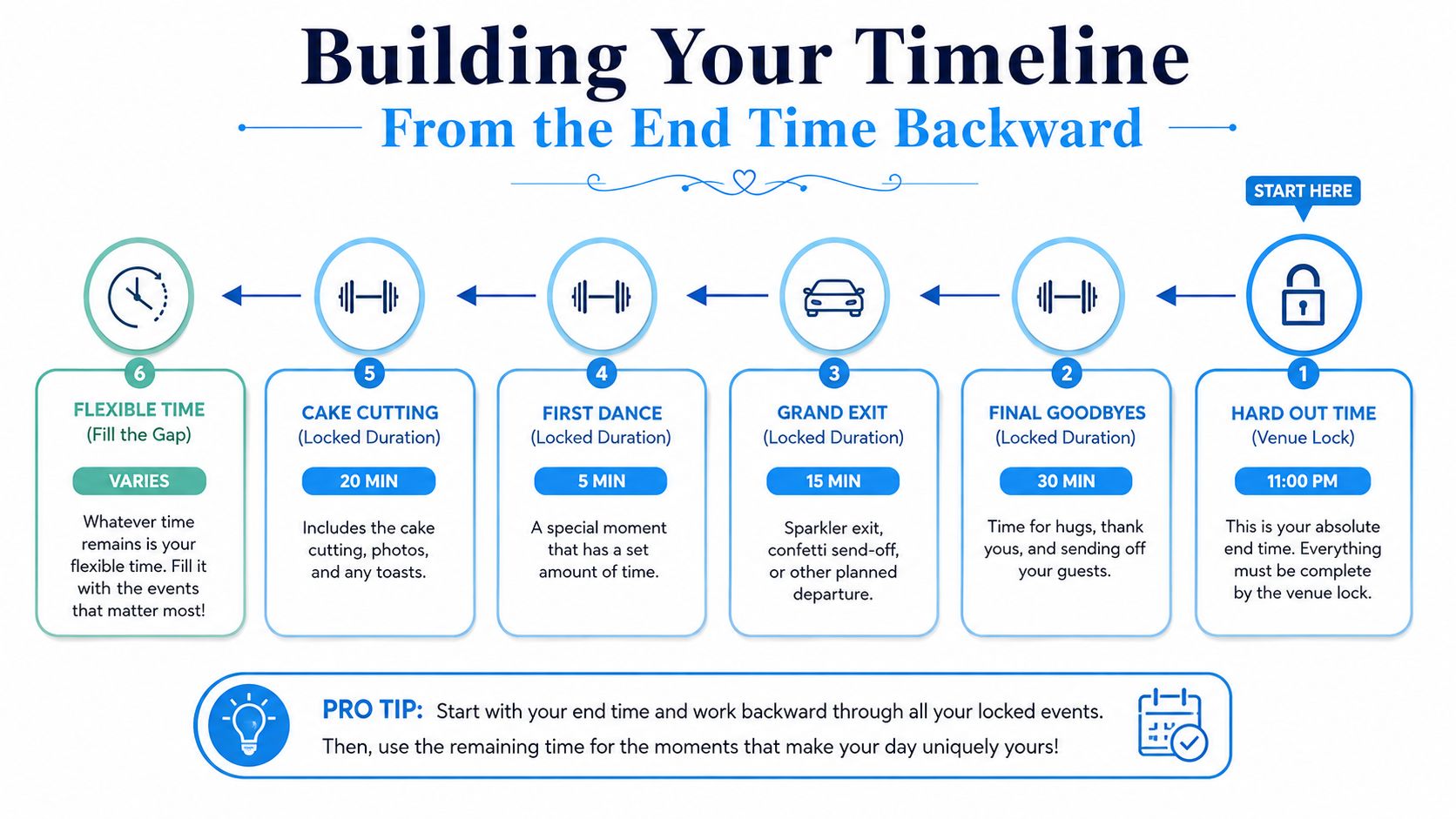
Start with the venue's hard out time, not with the ceremony entrance or the first dance. The hard out is the point when music must stop, guests must leave, and vendors need to begin load-out. Work backward from that fixed point so the final traditions don't get squeezed out.
Lock the fixed blocks first
A practical five-hour reception commonly includes about one hour for cocktails and four hours for dinner and dancing, according to The Knot's traditional wedding reception timeline. Use that as a planning benchmark, then replace each general block with the actual requirements of your venue and vendors.
Build the skeleton in this order:
- Write down the hard out time. Confirm when amplified music ends, when guests must depart, and whether cleanup or load-out is included in the contract.
- Place the final dance and send-off. These normally belong in the final 10 to 15 minutes of the reception, as noted in this reception timing guide. Working from that point protects the exit instead of treating it as an optional extra.
- Reserve the dancing block. Keep the floor open by about 90 minutes into the reception, a recommendation included in The Knot's planning template, so guests aren't waiting through a long sequence of formalities before they can participate.
- Place dinner and formalities. Dinner service, toasts, cake cutting, and dances should have clear positions rather than being stacked together. If guests need to sit twice in a short period, expect movement and conversation to slow the schedule.
- Add the grand entrance before dinner. Modern planning templates commonly place dinner within about 30 minutes of the announced entrance, as described in the historical and modern overview of wedding receptions. That keeps guests from sitting through an extended gap after the couple arrives.
- Fill flexible time last. Cocktail conversation, casual photographs, mingling, and open dancing can absorb small changes more easily than a plated meal or a scheduled send-off.
For a home reception or a property with several structures, account for guest movement the same way you'd account for a construction project's site access. The time required to move people, tables, equipment, or food between spaces belongs in the schedule. If you're planning a larger renovation or venue improvement, this guide to how long a home addition takes offers a useful reminder that fixed completion points must shape the work that comes before them.
The one-page skeleton should show the start and end of every major block, the person giving each cue, and the action that follows. The DJ, caterer, photographer, venue manager, and couple should be reading the same version.
This video offers another visual way to think about sequencing before you finalize the page:
Choosing the Right Reception Length for Your Guest List and Format
A four-to-five-hour seated dinner reception and a three-to-four-hour cocktail-style reception solve different problems. Neither format is automatically more elegant or more enjoyable. The right choice depends on how your guests gather, how food will be served, what the venue allows, and whether the couple values a full dance floor, a substantial meal, or a shorter social experience.
The classic seated dinner format
A seated dinner works well when guests expect a complete meal, the event includes several formal traditions, or the family group includes people who'll appreciate a more settled pace. The structure gives room for cocktails, an entrance, dinner, toasts, cake or dessert, dances, and open dancing. The trade-off is that every service transition takes time, and a long list of formalities can make the reception feel interrupted.
This format is often a better fit when:
- The meal is central: Plated or buffet service needs enough time for guests to eat without feeling rushed.
- The guest list is broad: Older relatives, children, and guests traveling from a distance may prefer seating and a defined meal.
- Traditions matter: Parent dances, cake cutting, cultural moments, and multiple toasts need deliberate placement.
- The contract supports it: The venue has enough time for setup, service, music, and cleanup.
The cocktail-style format
A three-to-four-hour cocktail reception can keep the evening focused on mingling, passed appetizers, lounge seating, and conversation. Our Vows' discussion of cocktail-style reception timelines describes the shorter format as a way to reduce guest fatigue and maintain energy. The format works best when the food is substantial, seating is intentional, and guests understand that the event won't follow a traditional dinner pattern.
It can be the stronger choice when:
- Mingling matters more than a formal meal: Guests can circulate instead of remaining at assigned tables.
- The couple wants fewer interruptions: A compact program leaves more room for conversation and dancing.
- The venue has a tight contract: A shorter event may fit better without forcing rushed setup or load-out.
- The guest profile suits it: A social crowd that's comfortable eating while standing or using lounge furniture will generally adapt more easily.
| Decision question | Seated dinner | Cocktail-style reception |
|---|---|---|
| Main guest experience | A paced meal with formal transitions | Continuous mingling and movement |
| Greatest strength | Accommodates a full traditional program | Keeps the event concise and energetic |
| Main risk | Service delays can reduce dance time | Guests may feel underfed or under-seated |
| Best planning focus | Meal timing and formalities | Food replenishment, seating, and flow |
Choose the format before choosing the songs or writing the toast order. A timeline can't fix a mismatch between the guest experience you want and the service model you've selected.
Coordinating Vendors Catering and Bar Service Without Delays
Vendors don't need more information. They need the right information at the right moment. The catering captain needs a fire time, the DJ needs a cue, the photographer needs access to key moments, and the venue team needs to know when a room can be reset.
Dinner should begin promptly after the entrance rather than leaving guests in their seats while the couple disappears for an unplanned photograph. The modern reception pattern commonly places dinner within about 30 minutes of the grand entrance, as described in this overview of wedding reception formats. If portraits are important, schedule them before guests are seated or give the photographer a defined window that doesn't compete with the first meal course.
Build one shared cue sheet
Give each vendor the same timeline, then mark the cues that affect their work:
- Catering: Identify when hot appetizers leave the kitchen, when the couple is seated, when buffet service opens, and when dessert is ready.
- Bar service: Confirm when the bar opens, who announces specialty drinks, and which person signals last call.
- DJ or band: List the exact order of the entrance, first dance, parent dances, cake cutting, open dancing, and final song.
- Photographer: Mark the entrance, toasts, dances, cake cutting, sunset portraits, and planned departure.
- Venue team: Note setup completion, guest seating, room flips, lighting changes, cleanup, and vendor load-out.
At an outdoor East Texas venue, the bar may sit near the patio while dinner service happens inside. The coordinator should give the DJ a seating cue only after the catering team confirms that guests can move without creating a line at the food station. At a barn venue with a flip, the photographer may use the transition for detail images while venue staff reset tables and the band completes its sound check.
Service principle: The person closest to the work should confirm readiness, while one coordinator gives the public cue.
A room flip deserves the same discipline you'd apply to a commercial build-out. Teams need a defined reset window, a place to stage equipment, and a single point of communication. Clear planning habits used in commercial renovation coordination translate well to receptions because both environments depend on sequencing, access, and handoffs.
Don't place speeches while servers are carrying plates through the room. For a plated meal, use a point when guests are settled and service traffic is quiet. For a buffet, keep announcements away from the first rush so guests can hear the speaker and move through the line without missing instructions.
Hidden Timeline Killers and How to Build Smart Buffers
Most sample timelines fail in the spaces between the named events. “Guests seated” may mean the coordinator opens the doors, or it may mean the final family member has found a missing place card. “Speeches” may mean two prepared toasts, or it may include an unplanned request from a relative. Those differences determine whether the schedule holds.
Find the unstable blocks
The widest timing ranges usually appear in the blocks couples treat as simple. Cocktail service may last 45 to 90 minutes, dinner about 60 to 90 minutes, speeches 30 to 45 minutes, and open dancing two to three hours, according to this detailed reception order guide. Build decisions around those ranges instead of copying a single sample schedule.
Common trouble spots include:
- Announcements: Guests may not hear the first call, especially across a lawn or between a barn and patio.
- Seating: Families stop to greet one another, elderly guests need assistance, and place cards create small bottlenecks.
- Toasts: A speaker may arrive late, lose notes, or add an unscheduled story.
- Photography: Family members wander away, sunset light changes, or a requested portrait list expands.
- Vendor arrival: A rental truck, florist, musician, or caterer may need more access time than expected.
- Room transitions: A ceremony site may need to become a dining space while guests are still nearby.
Protect the schedule without making guests feel rushed
Place 10 to 15 minutes of cushion around the transitions most likely to move, especially guest seating, a room flip, and the handoff from formalities to dancing. That cushion shouldn't appear as dead time on the guest-facing program. It belongs in the internal version used by the coordinator and vendors.
Decide in advance what gets compressed. A coordinator can shorten an extended cocktail period, combine dessert and cake announcements, reduce the number of formal dances, or move a planned portrait session to a quieter point during dancing. Don't cut the final dance or send-off first. Those moments belong near the end and are difficult to recreate once guests begin leaving.
Keep toasts assigned and timed during planning. If the reception includes more speakers than the schedule comfortably supports, ask whether every person needs a microphone moment or whether several people can contribute to one coordinated toast.
A quality-control mindset helps here. The same habit of checking work at defined stages appears in a structured quality assurance process. Before the reception, verify the cue sheet. During the event, confirm readiness. After each major block, check the next transition rather than assuming the schedule is still intact.
Sample Timelines and Printable Templates for East Texas Venues
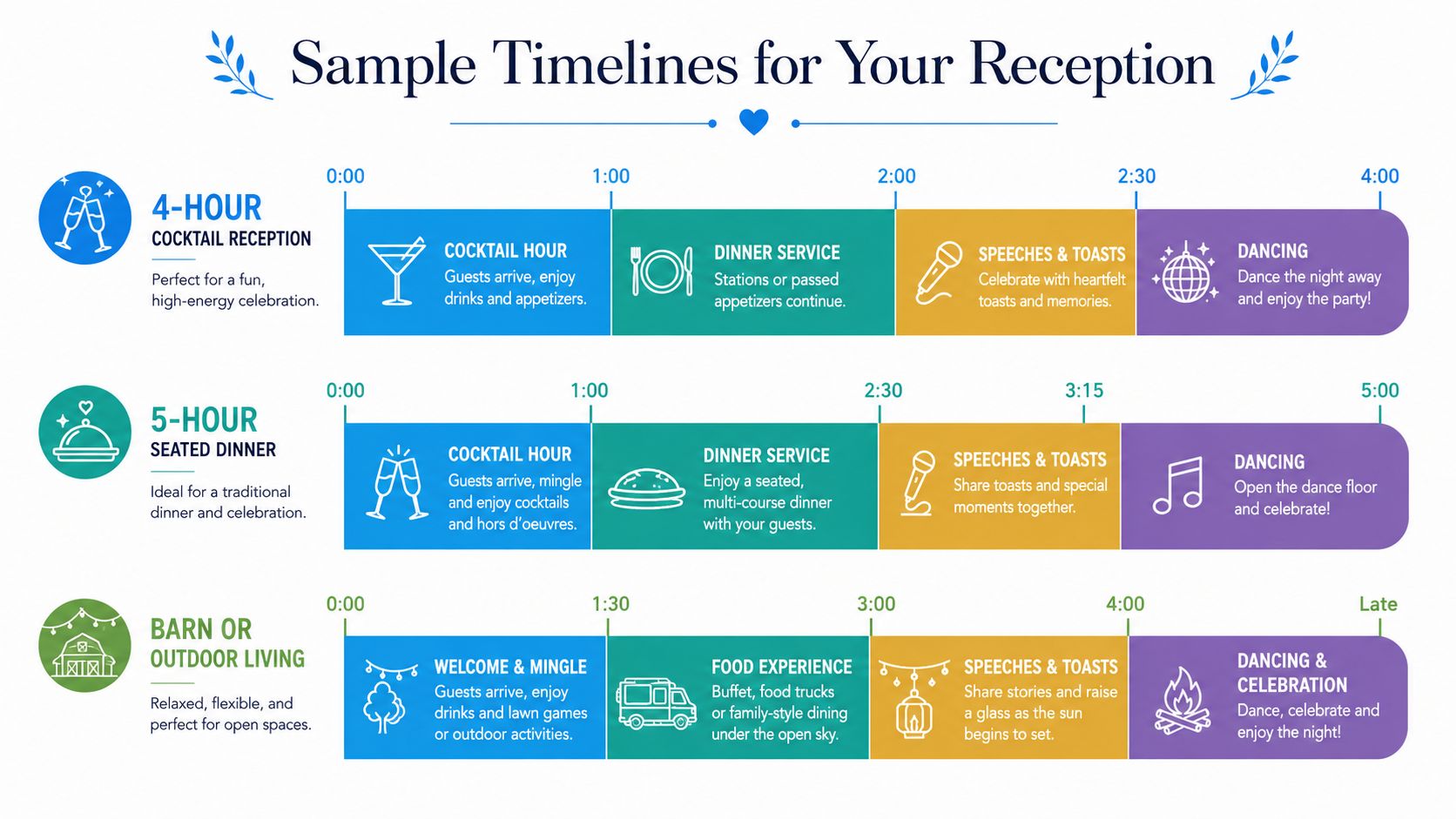
A sample timeline should be a starting structure, not a promise that every reception will run identically. The times below use the established reception patterns, then add practical cues for a seated event, a cocktail format, and a venue that needs a flip.
Four-hour cocktail reception
Use this for a social event with substantial appetizers, lounge seating, and limited formalities.
- 5:00 pm: Guest arrival, bar opens, passed food begins.
- 5:45 pm: Coordinator announces seating or gathers guests for the entrance.
- 6:00 pm: Grand entrance, welcome, and first dance.
- 6:15 pm: Couple mingles while food continues; photographer captures guest interaction.
- 6:45 pm: Short toast sequence.
- 7:00 pm: Dessert or cake moment, followed by open dancing.
- 8:30 pm: Last dance preparation and final call for photographs.
- 8:45 pm: Last dance and send-off in the final 10 to 15 minutes, consistent with this reception order guidance.
Five-hour seated dinner
This format gives the meal and formal program more room while preserving a substantial dance block.
- 5:00 pm: Cocktail hour and guest arrival.
- 6:00 pm: Seating announcement and grand entrance.
- 6:15 pm: Welcome and first dance.
- 6:30 pm: Dinner service begins.
- 7:30 pm: Toasts, with service traffic paused.
- 8:00 pm: Cake cutting, dessert, or parent dances.
- 8:30 pm: Open dancing.
- 9:45 pm: Final dance and send-off preparation.
- 10:00 pm: Last dance, send-off, and vendor transition.
Barn or outdoor living space with a flip
The flip must be treated as its own operation, not as an invisible gap.
- 4:30 pm: Ceremony ends; guests move to cocktails and lawn seating.
- 4:45 pm: Venue team resets ceremony space for dinner while the bar and photographer work in separate areas.
- 5:45 pm: Coordinator confirms tables, place settings, lighting, and sound.
- 6:00 pm: Guests are seated and the couple enters.
- 6:15 pm: Dinner begins.
- 7:15 pm: Toasts and formal dances.
- 8:00 pm: Open dancing, with an optional outdoor portrait cue.
- 9:45 pm: Final transition announcement.
- 10:00 pm: Last dance and send-off.
Print one internal page for the coordinator, DJ, caterer, photographer, and venue manager. Include the hard out time, vendor arrival and load-out details, every public announcement, the person responsible for each cue, and the backup plan for weather or a delayed room flip. Keep the guest-facing program simpler. Guests need to know what's happening, while vendors need to know what happens next.
Before finalizing, verify the venue contract, confirm who can authorize a schedule change, review the toast order, and decide which flexible block absorbs an overrun. A reception feels relaxed when the team has already made those decisions before the first guest arrives.
If you're planning an East Texas home, barn, patio, or outdoor living space for your celebration, Home Pro's Remodeling & Repairs can help create the practical spaces that support a smoother event, including additions, patios, decks, outdoor kitchens, barns, and related improvements. Visit Home Pro's Remodeling & Repairs to discuss your project, request an onsite estimate, and plan the space around how you want guests to gather.