
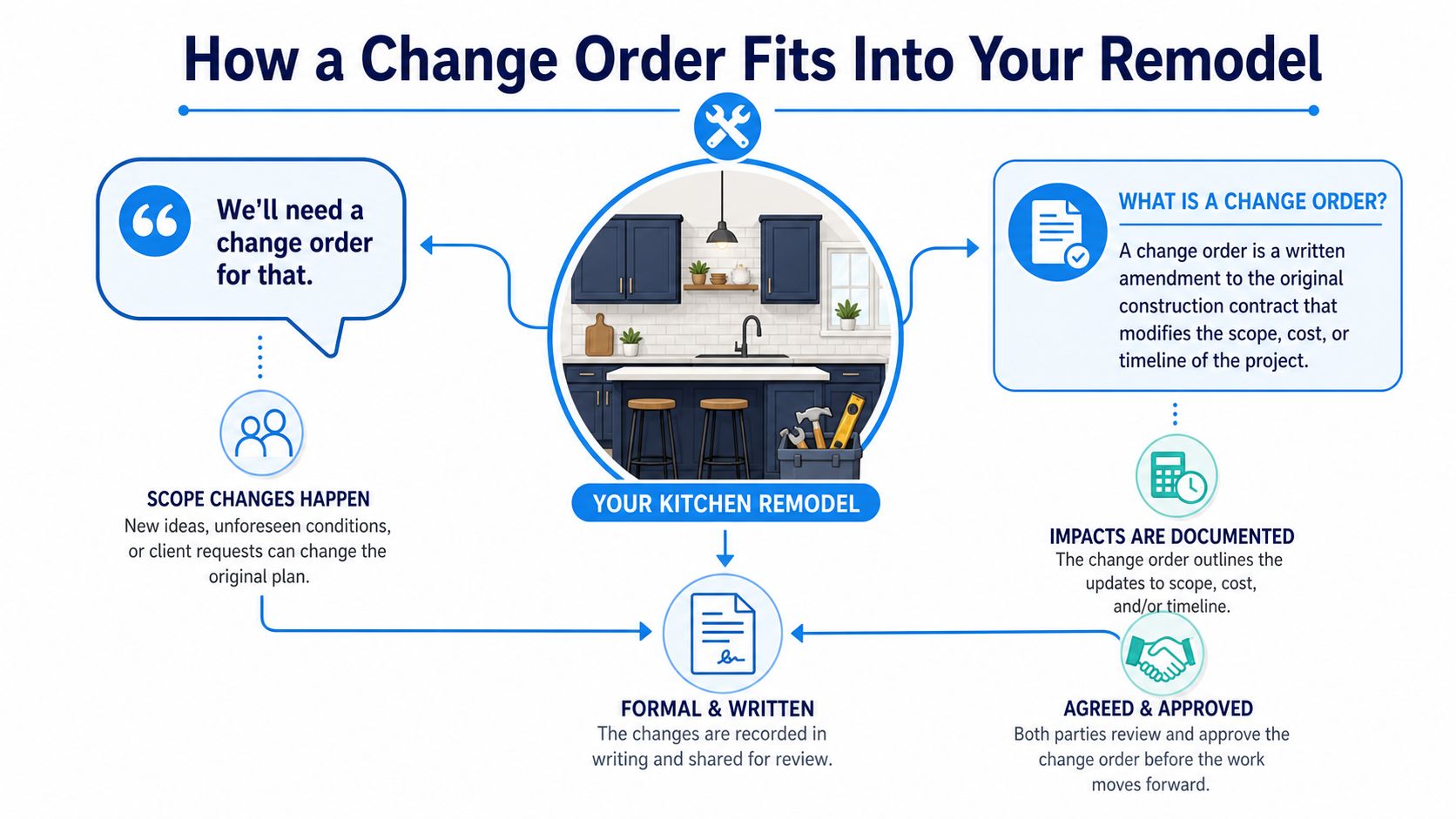
A change order in construction is a written amendment to the original contract that changes the scope, cost, or schedule after work has started. It's a normal part of remodeling, but it becomes a financial exposure point when you approve extra work casually or without signed paperwork.
You're standing in the middle of a kitchen remodel when your contractor opens a wall and finds wiring nobody could see during the estimate. Or perhaps you've changed your mind about the island, selected a different tile, or asked for an extra outlet after the crew has already begun. Then you hear the sentence that makes most homeowners uneasy: “We'll need a change order for that.”
That sentence doesn't automatically mean something has gone wrong. It means the work no longer matches the agreement you signed. The change order records what's different, what it costs, and whether the completion date moves. Once you understand those three pieces, you can handle the conversation calmly and protect your budget.
Table of Contents
- How a Change Order Fits Into Your Remodel
- Why Change Orders Happen More Often Than People Expect
- A Real Remodel Example From Surprise to Signed Paperwork
- What a Properly Drafted Change Order Must Include
- How Change Orders Are Priced and Why They Cost More
- How a Single Change Order Can Shift Your Whole Schedule
- Best Practices Homeowners Can Use on Every Project
- The Short Version of What a Change Order Really Means
How a Change Order Fits Into Your Remodel
Your original remodeling contract is the project's baseline. It usually ties together the drawings, specifications, allowances, selected materials, contract price, and planned timeline. If the crew builds exactly what those documents describe, the contractor works within the original agreement.
A change order is the formal written amendment used when that baseline changes after the contract has been executed. Under AIA contract practices, the document identifies the revised work and the adjustment to the contract sum or contract time, making it an auditable record of who approved what and when. The AIA explanation of construction change orders describes this process in the context of managing scope, price, and schedule changes.
The three items you need to see
Every change order should answer three homeowner questions:
- Scope: What work is being added, removed, substituted, or revised?
- Cost: How will the contract price change, including credits for deleted work?
- Schedule: Will the completion date or an interim milestone move?
If the contractor says, “We can add that,” ask, “Will you put the scope, price, and schedule impact in a written change order before the work begins?” A clear statement of work template can also help you understand how detailed project descriptions should be.
A change order is routine, but routine doesn't mean harmless. Historical research on public infrastructure projects found change orders associated with a 23.75% increase in project costs, while another study cited in that paper reported mean overruns of 12.6% of original contract value, with 48% attributed to change orders and 52% to rework in the cited research paper. Those figures come from broader project research, not a promise about your kitchen, but they show why casual approvals deserve attention.
For a practical guide to limiting uncontrolled additions before construction, review this resource on scope creep prevention.
Why Change Orders Happen More Often Than People Expect
You can approve a carefully detailed remodel and still encounter a change order. Plans describe the intended result, but your house contains existing walls, floors, wiring, pipes, and framing that may not match the drawings. Product availability can change, measurements can prove imperfect, and your preferences may become clearer once the room starts taking shape.
AIA Contract Documents reported that the average number of change orders rose from 1.7 on the smallest projects to 11.18 on the largest projects in its research note. The broader lesson for a homeowner is simple: treat a change as a normal possibility to manage, not as an automatic sign that the contractor made a mistake.
The usual triggers
| Trigger | How often it appears | Typical cost impact |
|---|---|---|
| Homeowner design change | Common once selections and spaces become tangible | Added labor, materials, disposal, and possible schedule disruption |
| Hidden condition | Appears when walls, floors, ceilings, or cabinets are opened | Removal, repair, redesign, inspection, and replacement work |
| Code or inspection requirement | Depends on what the work reveals and what the authority requires | Corrective work, permit coordination, and possible delay |
| Material availability or substitution | Can arise when specified products aren't available or suitable | Price difference, revised installation, and procurement time |
| Drawing or field conflict | Emerges when plans don't align with existing conditions | Clarification, rework, trade coordination, and lost productivity |
Your choices are usually the easiest changes to spot. You might select a larger window, move a wall, upgrade a faucet, or replace cabinet hardware after seeing the room in person. The preference may be reasonable, but it can still require new materials, revised installation steps, disposal, or removal of work already planned. Before approving it, ask what changes in the scope, price, and completion date.
A hidden condition follows a different path. A contractor cannot price concealed wiring, deteriorated framing, or an inaccessible pipe precisely when nobody can see it during estimating. Opening the wall turns an assumption into a known condition, which may require repair, redesign, inspection, or replacement. A drawing conflict can create similar work if the plan does not fit the existing structure.
Code and inspection requirements can also create changes. Work exposed during demolition may require corrective work or permit coordination, even if neither party expected that task in the original scope. Material substitutions bring another decision: confirm whether the replacement changes the price, appearance, installation method, or delivery timing.
Use these triggers as a pre-demolition checklist. Ask which conditions remain uncertain, which selections are still open, and how the contract handles substitutions. A contingency gives you room to respond without treating every discovery as a crisis. Discuss the appropriate amount with your contractor and financial adviser rather than relying on a universal formula.
A Real Remodel Example From Surprise to Signed Paperwork
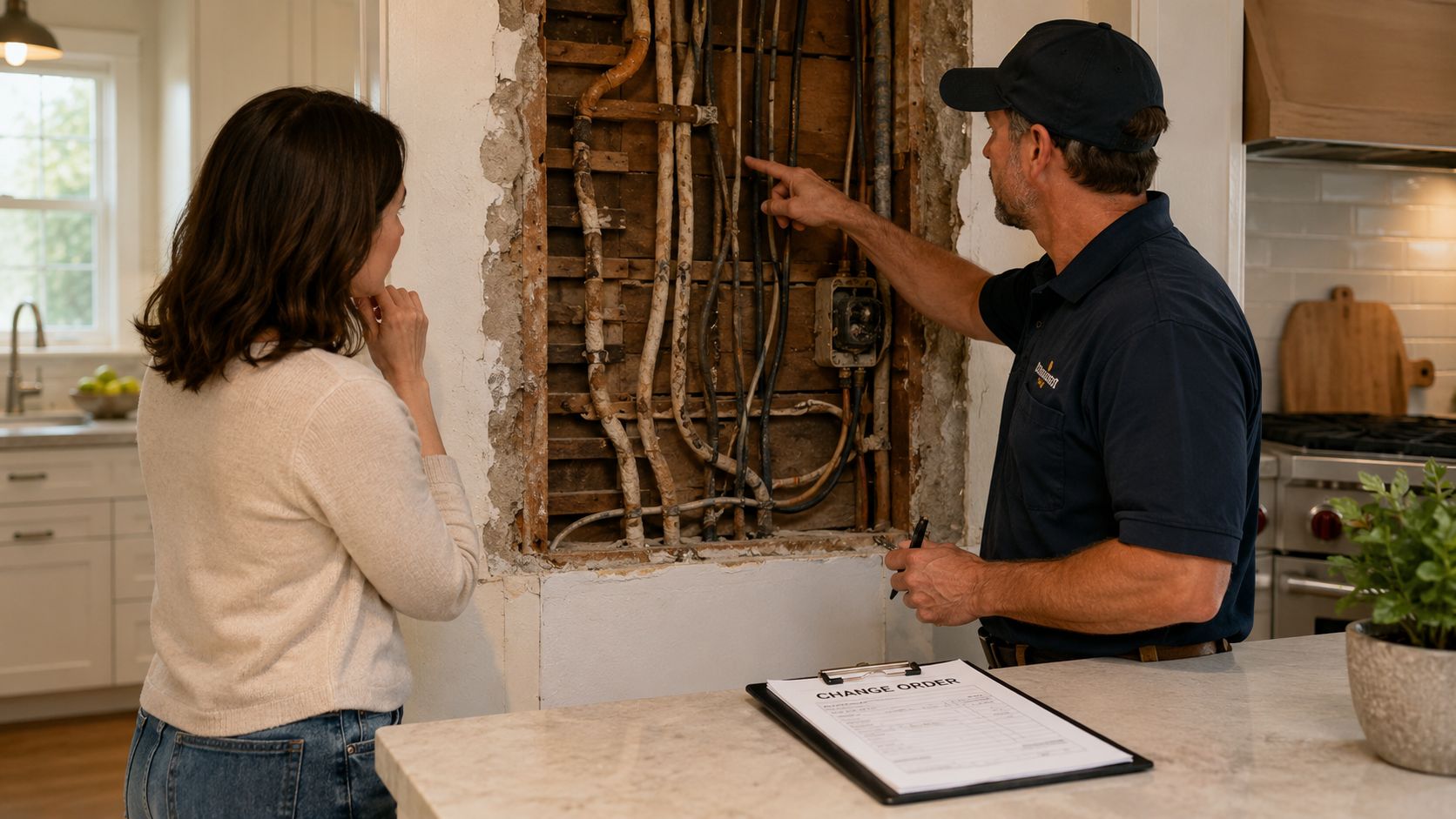
A kitchen remodel in an older house can change direction in a single afternoon. The contract covers cabinet removal, new cabinets, updated lighting, drywall repair, and finish work. During demolition, the carpenter opens a plaster wall and finds cloth-covered wiring running into an earlier addition.
The contractor pauses the affected work, photographs the finding, and explains the concern. As the homeowner, ask:
- What exactly was found?
- Why does it affect the contracted work?
- Is an electrician or inspector needed?
- Can the remaining work continue safely while it is evaluated?
These questions keep a surprising discovery from becoming a rushed approval. You are trying to understand what changed, what choice you have, and what the choice will cost.
The contractor compares the finding with the original scope. If the existing wiring was excluded, the electrician may describe work such as removing the exposed wiring, installing compliant wiring, connecting the affected circuit to the panel, and coordinating any required inspection. That description belongs in a written change-order request, rather than in a hallway conversation or an informal instruction to the crew.
Follow the paper trail
The proposed change order should give you enough information to make a decision: photographs, the electrician's scope or quote, the added price, and any schedule adjustment. Check that it identifies the project, date, parties, and affected work before you sign.
Practical rule: A surprise should become a written description before it becomes a crew assignment.
Discuss the available choices with the contractor. The electrician might isolate one circuit, or a larger rewiring scope might offer the safer solution. Compare the effect on safety, cost, and timing, then make sure the selected option is written into the amendment. The required parties should sign before revised work begins, unless an immediate safety issue calls for emergency action under the contract and applicable rules.
This video provides another visual explanation of the homeowner and contractor conversation around a change order:
The process can be summarized as follows: the issue is identified, the options are explained, and your chosen scope, price, and schedule are recorded and approved. That paper trail gives you control over the decision instead of leaving the remodel to proceed on an assumption.
What a Properly Drafted Change Order Must Include
A good change order lets a person who wasn't at the job site understand the decision later. If the description only says “extra electrical,” it leaves too much room for disagreement. A stronger description identifies the location, quantity, method, related patching, and what the contractor will leave complete.
Use these fields as your review checklist
- Project identification: Confirm the homeowner's name, property address, original contract date, and project reference.
- Change number and date: Make sure the amendment can be tracked alongside prior changes.
- Initiating party: Note whether the homeowner requested the revision, the contractor identified a field condition, or a design professional issued direction.
- Detailed work description: State what's added, removed, or substituted. “Add two recessed lights in the kitchen, reroute the circuit to the panel, and patch drywall” is much safer than “extra electrical.”
- Cost adjustment: Look for labor, materials, equipment, subcontractor pricing, overhead, profit, credits, and the resulting contract adjustment.
- Schedule impact: State whether the work changes a milestone or final completion date.
- Approvals: Include dated signatures from the required parties before changed work begins.
The cost section should show whether the amendment increases or decreases the contract value. A deleted cabinet run, for example, should produce a credit if the original agreement included it. The schedule section deserves equal attention. Even if the added work costs little, waiting for a specialty product or inspection can affect several trades.
Attach supporting material when it helps explain the decision. A marked-up plan, cabinet elevation, photograph, product sheet, or subcontractor proposal can prevent a short sentence from carrying too much meaning. The AIA A201 general conditions overview offers useful context for understanding how general conditions address changes and project administration.

Watch for incomplete paperwork
Be cautious if the form has no date, no reference to the original contract, no schedule statement, or no signature line for you and the contractor. A lump sum with no scope can be just as troublesome as a detailed scope with no price breakdown.
The document should also make clear whether it settles the entire known impact of the change or only authorizes investigation. If the contractor needs to open more of the wall before pricing the full repair, ask for a written authorization that states the limited purpose and the method used to price the next stage.
How Change Orders Are Priced and Why They Cost More
Post-contract work often costs more per unit than work included in the original bid because the crew is entering an established sequence instead of following a clean production plan. The labor rate may not change, but productivity can. A carpenter may need to leave a nearly complete task, protect finished surfaces, return after another trade, and remobilize with different tools.
Materials can create another difference. A small quantity may require a special order, rush delivery, or a separate trip. A subcontractor may also charge for work performed out of sequence because the revised task interrupts the crew's planned workload. Contractors commonly add overhead and profit to change work. Published construction guidance commonly cites markups around 10% to 15%, and some sources cite 15% to 25%, depending on the project and pricing context as discussed in this change-order pricing guidance.
The pricing method matters
A unit-price contract can be relatively straightforward. If the agreed unit price covers one outlet, one square foot of tile, or one linear foot of trim, the contractor applies that rate to the changed quantity, then adds any documented items outside the unit.
A cost-plus arrangement starts with actual allowable costs and applies the agreed fee or markup. A lump-sum remodel usually requires a more complete proposal because the contractor must estimate labor, materials, coordination, disposal, protection, and schedule effects together.
| Cost component | Original bid rate | Change-order rate | Why it costs more |
|---|---|---|---|
| Labor | Planned within the crew's normal sequence | Recalculated for interruption or return visits | The crew may lose productivity or remobilize |
| Materials | Purchased with the broader project order | Ordered separately or substituted | Small quantities and urgent delivery can add cost |
| Subcontractor work | Coordinated into the baseline schedule | Fitted around existing commitments | Out-of-sequence work can require a premium |
| Overhead and profit | Included in the original contract pricing | Applied under the contract's change rules | The contractor still manages, supervises, and guarantees the added work |
Consider a rough plumbing correction originally estimated at $500. If the contractor adds a 10% markup, that produces $550 before any separate remobilization cost. If the crew must return for $300 in documented remobilization, the revised total becomes $850. This is an illustration of pricing mechanics, not a universal market quote, and the actual contract terms control.
The approval path
The clean workflow has several handoffs:
- The need is identified. You request a layout change, or the crew documents a concealed condition.
- The original scope is checked. The contractor determines whether the issue is already included.
- The impact is priced. Labor, materials, subcontractor quotes, markup, credits, and schedule effects are assembled.
- The proposal is submitted. You receive a written change order rather than an informal total.
- Questions are resolved. You can request backup, compare alternatives, or ask for value-engineering options.
- The amendment is signed. The approved price and schedule become part of the contract record.
Residential turnaround depends on the complexity of the work and the availability of quotes. A small selection change may be priced quickly, while a concealed structural or electrical issue may require site review, design input, and permit coordination.
Before you approve: Ask whether the price is fixed, estimated, or time and materials, and ask what happens if concealed conditions continue after work begins.
Don't assume silence means consent. An email saying “go ahead” may not satisfy the contract's approval requirements, and a text message may omit the schedule or final price. Keep the discussion moving, but insist that the final authorization appears on the change-order document.
How a Single Change Order Can Shift Your Whole Schedule
Schedule problems rarely come from the added task alone. They come from where that task sits in the sequence.
Suppose an electrician discovers that a kitchen circuit needs to be rerouted before the walls can close. The electrical revision may require additional rough-in work and another inspection. Drywall can't proceed until that checkpoint is complete, and the tile setter may not be able to start until the drywall and waterproofing work are finished.
Follow the dependencies
Remodeling trades operate in a linked chain:
- Framing establishes the openings and backing.
- Plumbing and electrical install systems before walls close.
- Inspections may need to occur before concealment.
- Drywall and tile depend on approved rough work and suitable surfaces.
- Finish carpentry depends on completed walls, floors, and installed fixtures.
If one trade misses its slot, the next crew may already be committed elsewhere. The contractor then has to rebook people, protect partially finished areas, and revise the production schedule. A short field delay can become a much longer calendar problem when the next available trade date is not immediate.
Ask your contractor three schedule questions whenever a change appears: Which activity is affected? Which trade is locked in next? What completion date is now realistic? A signed amendment gives both parties a clear basis for documenting a time adjustment. For larger additions and more involved projects, homeowners can also use this guide to understand how long a home addition takes.
The schedule impact belongs on the same document as the price. A revised completion date, added working days, or affected milestone gives you something concrete to evaluate. It also prevents the common frustration of paying for an approved change while assuming the original finish date still applies.
Why a phone call isn't enough
A homeowner may say, “Go ahead and move the outlet,” during a walkthrough. The contractor may understand the request differently, the electrician may install a different configuration, and the invoice may later include related patching that nobody discussed.
That ambiguity can become a payment dispute. In more serious situations, undocumented work can complicate a lien claim, warranty discussion, insurance documentation, or permit record. The exact consequence depends on the contract, local law, and facts, so legal advice may be appropriate when a dispute has already developed.
A signed change order protects both sides. It tells the homeowner what will be paid and tells the contractor what work was authorized.
The homeowner's exposure is clear: paying for work that wasn't defined or receiving a result that differs from the request. The contractor's exposure is just as real: performing extra labor without proof that the owner approved the price. Updated documents may also matter when lien waivers, insurance riders, or permit-related records need to match the actual scope.
Use the signed amendment as project risk insurance, not administrative clutter. It protects the relationship by replacing memory with a shared record, protects the budget by identifying the financial adjustment, and protects the home by documenting what was changed.
Best Practices Homeowners Can Use on Every Project
Good change-order management starts before demolition. Ask the contractor to explain the approval process in the base contract, including who can authorize work, how pricing is calculated, and how schedule adjustments are recorded. Agree on markup treatment early, so you aren't learning the pricing rules during a stressful discovery.
Before work starts
- Define the baseline: Review drawings, specifications, allowances, finishes, exclusions, and the planned completion date.
- Discuss contingency: Set aside a project reserve with your household budget adviser. The right amount depends on the property, design certainty, and concealed-condition risk.
- Clarify authority: Decide whether only the homeowner can approve changes or whether another representative has written authority.
- Record selections: Keep product names, model numbers, colors, quantities, and approved alternates with the contract.
- Ask about permits: If you're changing a kitchen layout or building systems, review this guide on whether a kitchen remodel needs a permit.
When a surprise appears
Pause the affected work when it's safe to do so. Ask for photographs, a plain-language explanation, the options available, and the consequences of doing nothing. Request itemized pricing rather than accepting a vague lump sum, and ask the contractor to state the schedule effect on the same change-order form.
Don't let urgency erase review time. If an immediate safety issue requires action, ask the contractor to document the emergency work, the reason it couldn't wait, and how the remaining scope will be priced.
After approval
Create a dedicated digital and paper folder. Save the signed amendment, attachments, revised drawings, product information, invoices, and related emails. Track the cumulative contract value and compare it with your available reserve after every approval.
Keep one running log: Date, change description, approved amount, schedule effect, signature status, and payment status.
Request an updated schedule when an amendment affects sequencing. Watch for pressure to approve verbally, unclear descriptions, missing credits, stacked markups, or a contractor who won't identify the approval authority. When sharing project documents through online services, review the provider's terms and privacy policy before uploading personal or property information.
Disciplined records give you an advantage without creating hostility. You can ask precise questions, make timely decisions, and preserve a working relationship built on the same written facts.
The Short Version of What a Change Order Really Means
A change order in construction is a written amendment to the original contract. It changes the work, the price, the schedule, or some combination of those items after the project agreement is in place.
For a homeowner, the practical test is simple. If the request changes what the crew is building, ask for the change in writing. If it changes what you'll pay, ask for an itemized price and any credit. If it changes when the project will finish, ask for the revised date or milestone. Then sign the amendment before the new work begins, unless the contract and circumstances require a documented emergency response.
Change orders aren't proof that your contractor failed. Remodels involve design decisions, concealed conditions, material substitutions, code coordination, and field discoveries. The risk appears when someone treats a verbal approval, quick text, or vague allowance as a substitute for a signed contract amendment.
Keep every approved change order with the original contract and current plans. When the project reaches the punch list, that file shows what you agreed to, what you paid for, and how the scope changed.
If you're planning a remodel in Tyler or across East Texas, Home Pro's Remodeling & Repairs offers design-build remodeling, additions, kitchens, bathrooms, roofing, and exterior improvements with on-site consultations and structured project communication. Visit the team to discuss your scope, target budget, and a clear process for handling changes before construction begins.